
Federal Realty’s Infill Retail Strategy: Portfolio Expansion, Macroeconomic Pressures, and the Stakes of Consistent Dividend Growth
Federal Realty Investment Trust continues to grow its retail property portfolio through acquisitions and redevelopment, even as inflation and interest rates pressure costs and tenant rent collections. The company’s long record of dividend growth and portfolio optimization highlights its commitment to shareholder returns, but future performance will hinge on maintaining occupancy, integrating new assets, and navigating evolving retail and capital market dynamics.
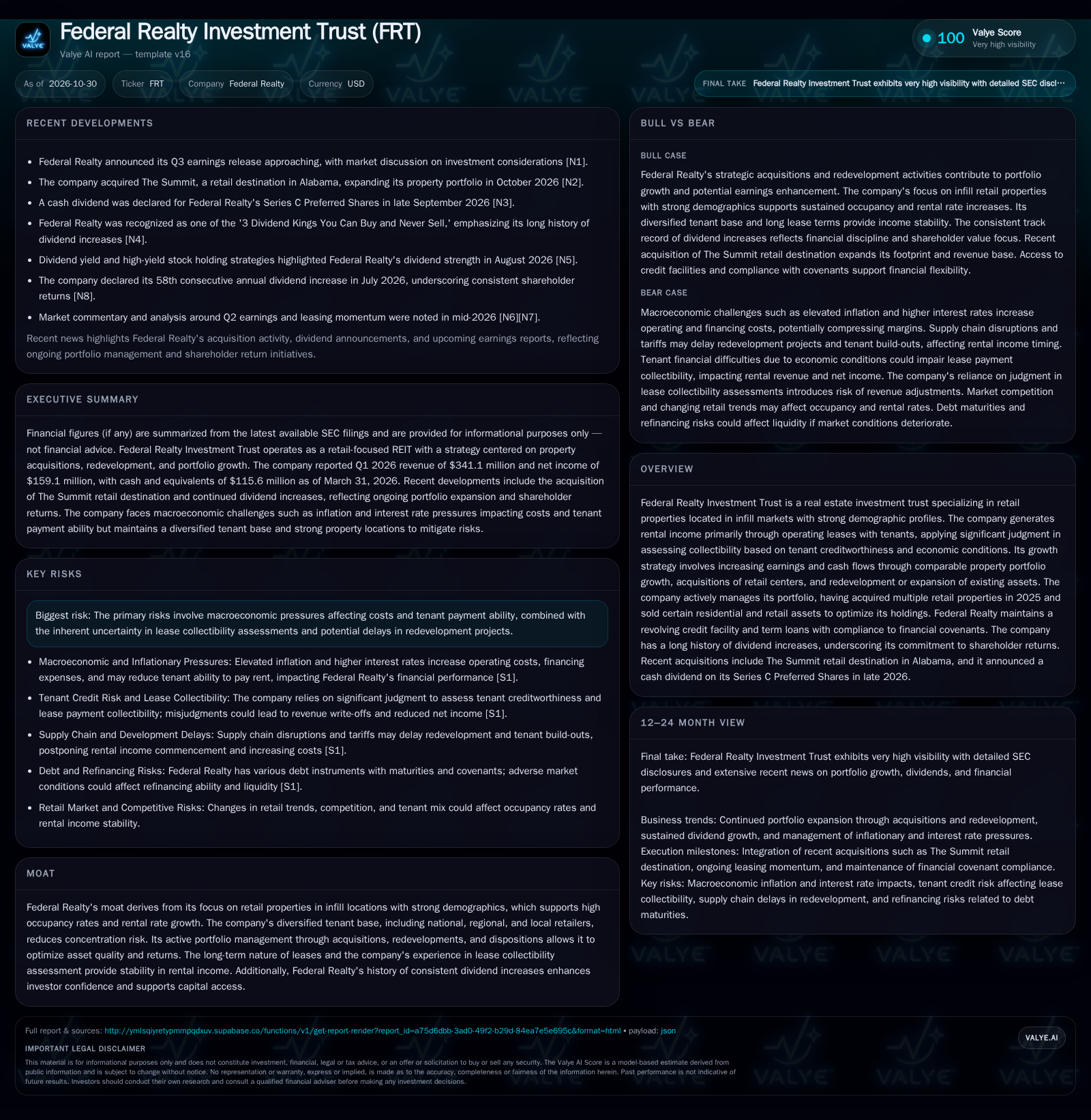
The cited source reports dividend-related activity; that disclosure alone does not establish dividend-policy continuity, management confidence, or a material constraint on capital flexibility. The company reported $341.1 million in revenue and $159.1 million in net income for Q1 2026, while facing inflationary and interest rate headwinds that could affect tenant payment ability and redevelopment costs. The trust’s infill location focus, diversified tenant base, and active portfolio management underpin its strategy, but future success depends on maintaining high occupancy, integrating acquisitions, and managing debt maturities in a challenging macroeconomic environment. [S1] [S2] [N2] [N8]
Federal Realty Investment Trust is doubling down on its strategy of owning and redeveloping retail properties in densely populated, high-income markets. Recent acquisitions, including The Summit in Alabama, and a 58-year streak of annual dividend increases, underscore management’s focus on both growth and shareholder returns. Yet, the company faces persistent macro headwinds—rising costs, tenant credit risks, and potential refinancing challenges—that could test its ability to sustain earnings momentum and capital deployment. The interplay between portfolio expansion, disciplined asset management, and the realities of today’s capital markets will shape Federal Realty’s trajectory over the next several years.
Recent Acquisitions, Dividend Milestones, and the Macroeconomic Backdrop
Federal Realty’s recent acquisition of The Summit, a major retail destination in Alabama, marks a continued push into high-quality, infill markets with strong demographics. This follows a series of retail property purchases in 2025, each ranging from roughly $123 million to $289 million, and selective asset sales that generated significant gains. The company reported $341.1 million in revenue and $159.1 million in net income for Q1 2026, with $115.6 million in cash and equivalents as of March 31, 2026. Additionally, Federal Realty declared its 58th consecutive annual dividend increase in July 2026, reinforcing its reputation for steady shareholder returns. However, these moves play out against a backdrop of persistent inflation and rising interest rates, which are pressuring both operating costs and tenant payment capacity. [S1] [S2] [N2] [N8]
How Federal Realty’s Portfolio Generates Value—and Where Economics Could Shift
Federal Realty’s core business model centers on owning, managing, and redeveloping retail properties that generate rental income through operating leases. These leases typically provide predictable cash flows, with rental rates often linked to market conditions and tenant creditworthiness. The company’s focus on infill locations with strong demographics can support higher occupancy rates and rental premiums, while long-term leases offer a degree of revenue stability.
Operating leverage is a key dynamic: as fixed property costs are spread over a growing rental base (through acquisitions, redevelopment, or rent escalations), incremental revenue can disproportionately benefit earnings and funds from operations. Conversely, inflation and interest rate increases put upward pressure on operating expenses and financing costs, potentially squeezing margins if rental growth lags cost escalation.
The cited source reports dividend-related activity; that disclosure alone does not establish dividend-policy continuity, management confidence, or a material constraint on capital flexibility. The company reported cash and liquidity metrics for the period; these figures do not by themselves establish operating runway, investment capacity, financial flexibility, or financing capacity. Asset sales have been used to recycle capital and optimize the portfolio, but this approach depends on favorable market conditions and buyer demand.
Infill Retail Advantage: Differentiation and the Challenge from Evolving Retail Formats
Federal Realty’s competitive position is anchored in its concentration on retail properties in infill locations with affluent demographics, often in established urban or first-ring suburban markets. These locations tend to enjoy high barriers to entry, limited land availability, and consistent consumer demand, which can support occupancy and pricing power relative to less strategically situated peers.
However, the retail landscape is undergoing structural shifts, with e-commerce, omnichannel retailing, and changing consumer preferences pressuring some traditional retail formats. Competing REITs, private investors, and institutional owners vie for high-quality retail assets, driving up acquisition costs and compressing yields. The ability to attract and retain a diverse tenant mix—including experiential, service-oriented, and necessity-based retailers—may help mitigate risks of obsolescence and vacancy.
Potential substitutes include mixed-use developments and alternative property types (such as logistics, multifamily, or office), especially as land use priorities shift in urban markets. Federal Realty’s active portfolio management and redevelopment track record are strengths, but continued differentiation will depend on adapting to evolving tenant needs and retail trends.
Redevelopment Payoff and Successful Integration Drive Accelerated Earnings Growth
The most favorable scenario for Federal Realty involves successful integration of recent acquisitions like The Summit, efficient execution of redevelopment projects, and sustained demand for infill retail space. If the company is able to maintain or increase occupancy rates, achieve rent escalations above inflation, and recycle capital from selective asset sales into higher-yielding properties, earnings and funds from operations could outpace expectations.
A confirming sign would be continued gains in comparable-property net operating income, strong leasing momentum with creditworthy tenants, and above-average rent growth relative to peers. Further, if redevelopment projects are delivered on budget and on schedule—despite supply chain and permitting challenges—this would validate the company’s ability to create value beyond acquisition-driven expansion.
This scenario could be further strengthened if interest rates stabilize or decline, lowering financing costs and supporting higher asset values.
Balancing Portfolio Growth with Macroeconomic Headwinds
The most plausible trajectory for Federal Realty is one of steady, but pressured, growth. The company continues to expand its portfolio through selective acquisitions and redevelopment, while actively managing tenant mix and occupancy in response to shifting retail trends. Inflation and higher interest rates persist, elevating operating and financing costs and requiring careful rent negotiations and tenant credit monitoring.
Federal Realty’s established presence in prime infill markets and diversified tenant base provide resilience, but rental growth may only modestly outpace expense inflation. Asset recycling supports incremental portfolio improvement, though gains from sales may moderate if buyer demand weakens.
Evidence supporting this scenario would include stable or slightly rising occupancy rates, modest growth in funds from operations per share, and continued compliance with debt covenants, even as cost pressures persist.
Tenant Credit Stress and Capital Market Tightening Erode Earnings Momentum
A more adverse scenario could emerge if inflation and interest rates remain elevated or worsen, straining tenant finances and increasing the risk of lease defaults or rent concessions. Retail bankruptcies or tenant downsizing, especially among discretionary or weaker credit tenants, could drive higher vacancies and require costly re-tenanting or redevelopment.
If Federal Realty faces delays or cost overruns on redevelopment projects—potentially due to supply chain disruptions or regulatory hurdles—anticipated returns could be diluted, and cash flows may fall short of expectations. At the same time, tighter credit markets or a shift in investor risk appetite could complicate refinancing or force asset sales at unfavorable prices.
Confirmation of this scenario would be a decline in occupancy rates, rising lease write-offs, negative trends in same-property net operating income, and pressure on dividend coverage. Breaching debt covenants or having to curtail acquisitions and redevelopment would further signal downside risk.
Testing Federal Realty’s Thesis: Operational, Financial, and Market Milestones to Track
Sustained occupancy rates and trends in leasing spreads, especially for recently acquired properties and redeveloped assets, would provide early signals of demand resilience or weakness.
Comparable-property net operating income growth, if disclosed, would help assess the company’s ability to outpace expense inflation and deliver on value creation targets.
The pace and cost discipline of redevelopment and expansion projects, including integration milestones for The Summit and other recent acquisitions, should be closely monitored.
Trends in tenant rent collections, credit losses, and lease modifications—particularly among discretionary retail categories—would indicate tenant health and revenue stability.
Compliance with debt covenants and the ability to refinance or extend existing credit facilities on favorable terms, as reported, are critical for ongoing potential financial flexibility.
Asset recycling activity—including sales proceeds, timing, and redeployment of capital—would reveal management’s ability to optimize the portfolio in changing market conditions.
External factors such as interest rate trends, inflation expectations, and broader retail market health will shape both property values and tenant risk profiles.
Disclaimer: This is research-only, informational analysis and not investment advice. It may include AI-generated interpretation and general industry context. Always verify important details using primary sources.

Comments