
Rocket Companies in 2026: Platform Expansion, AI Leverage, and the Stakes of Mortgage Market Integration
Rocket Companies has consolidated its position as the leading U.S. mortgage originator and servicer through the integration of Redfin and Mr. Cooper, expanding into a comprehensive homeownership platform. The company’s scale, AI-driven technology, and high client retention offer competitive advantages, but ongoing challenges in housing market cyclicality, regulatory complexity, and acquisition integration remain central to the investment case.
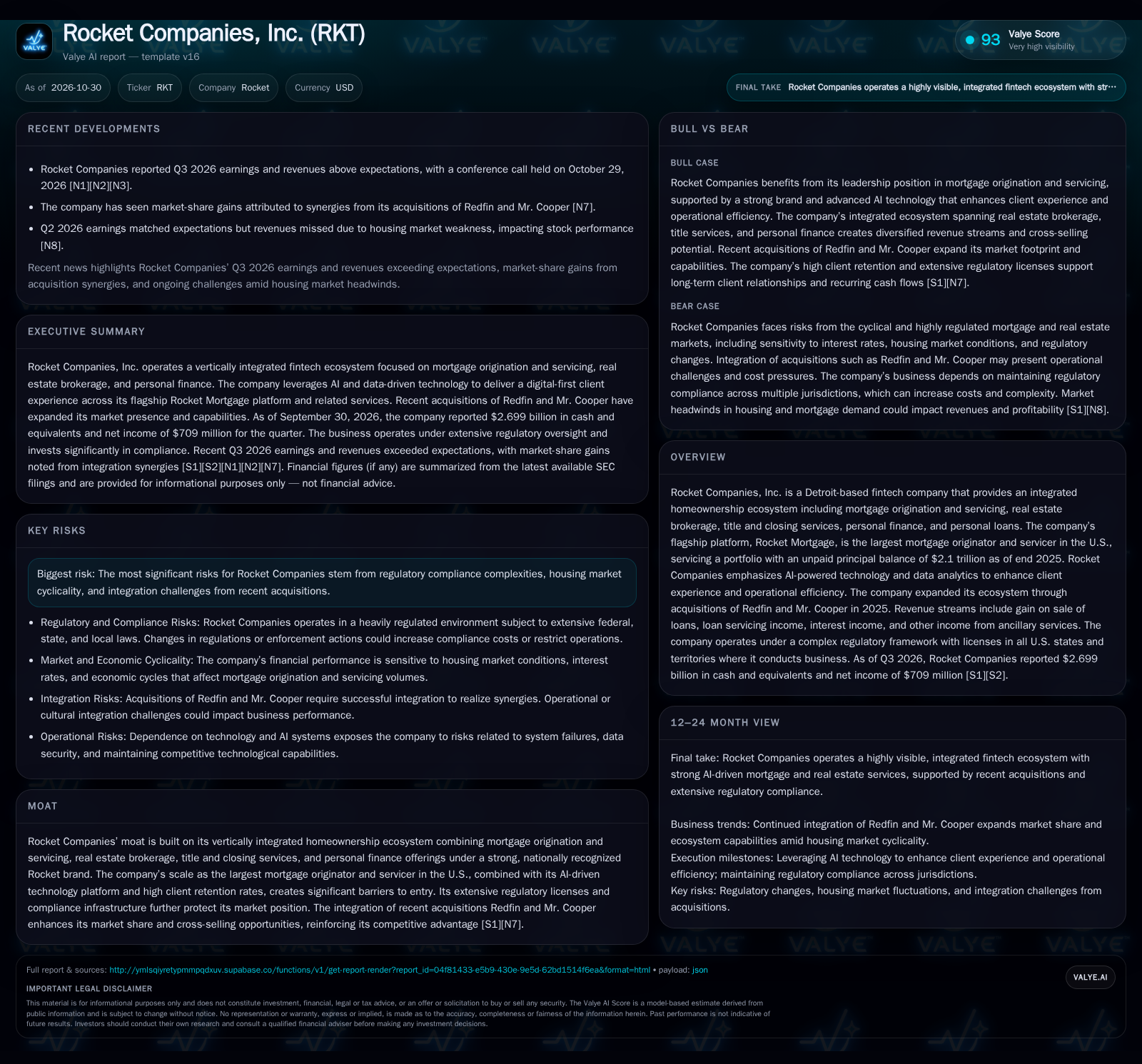
Rocket Companies, now the largest mortgage originator and servicer in the U.S., is leveraging acquisitions (Redfin and Mr. Cooper) to create a vertically integrated, AI-enhanced homeownership ecosystem. Recent earnings exceeded expectations and market-share gains are attributed to acquisition synergies, but the company remains exposed to housing market cycles, regulatory scrutiny, and the risks of integrating major platforms. Successful cross-selling, operational efficiencies, and regulatory navigation will determine the durability of Rocket’s moat and earnings power in coming years. [S1] [S2] [N1] [N2] [N7]
Rocket Companies stands at a strategic crossroads in late 2026, having transformed from a digital mortgage originator into a multifaceted fintech platform spanning real estate, mortgage servicing, and personal finance. The acquisitions of Redfin and Mr. Cooper have broadened Rocket’s addressable market, enabling deeper integration across the homeownership journey. Recent financial results and market-share gains suggest early success in leveraging these assets, yet the company’s fortunes remain tightly bound to the cyclicality of the U.S. housing market, the challenge of integrating large acquisitions, and the ongoing demands of regulatory compliance. The next phase will test whether Rocket can convert scale and technology into durable, higher-margin growth—or whether structural headwinds constrain its ambitions.
Acquisition Integration and Market-Share Gains Define Rocket’s 2026 Landscape
As of September 30, 2026, Rocket Companies reported $2.699 billion in cash and equivalents alongside $709 million in net income for the quarter, reflecting robust profitability. The company’s mortgage servicing portfolio reached $2.1 trillion in unpaid principal balance at the end of 2025, maintaining its position as the nation’s largest mortgage originator and servicer. Two pivotal acquisitions—Redfin (digital real estate brokerage) and Mr. Cooper (mortgage servicing and origination)—were completed in 2025, creating a broader, vertically integrated ecosystem. Recent Q3 2026 earnings and revenues exceeded expectations, and market-share gains have been attributed to synergies from these integrations. However, Q2 2026 performance showed sensitivity to housing market weakness, highlighting the company’s exposure to macroeconomic cycles. [S1] [S2] [N1] [N2] [N7] [N8]
How Rocket Monetizes the Homeownership Lifecycle
Rocket Companies generates revenue primarily through mortgage origination (gain on sale of loans), interest income while holding loans for sale, and ongoing loan servicing income. The addition of Redfin brings real estate transaction revenue, while Mr. Cooper enhances servicing scale and origination throughput. Ancillary revenue streams include deposit income, title and closing services (Rocket Close), personal finance (Rocket Money), and personal loans (Rocket Loans).
The company’s vertically integrated model aims to increase lifetime value per client through cross-selling across mortgage, brokerage, and personal finance. AI and data-driven technology promise operational efficiencies—such as improved underwriting, customer targeting, and loan servicing—potentially lowering acquisition costs and driving better margins if scale is leveraged effectively. However, revenue is highly sensitive to origination volumes, which depend on interest rates and housing activity, while servicing income offers somewhat more stability but is still exposed to prepayment and credit risks. The economics of integration depend on realizing cost synergies and increasing the attachment rate of ancillary services per client.
Fixed costs—particularly technology investment, compliance, and marketing—are significant, but the company’s scale creates operating leverage potential if volumes recover or cross-selling deepens. Capital needs revolve around funding loan origination pipelines, compliance reserves, and ongoing technology investments. While reported cash is strong, the platform’s economics hinge on maintaining high client retention, cross-selling effectiveness, and cost discipline.
Rocket’s Moat: Scale, Data, and Brand Versus Disruption and Traditional Rivals
Rocket’s competitive edge is rooted in its scale as the largest U.S. mortgage originator and servicer, its nationally recognized Rocket brand, and its AI-powered, vertically integrated platform. These attributes create meaningful barriers to entry: extensive regulatory licensing, significant technology investment, and a high client retention rate (97% annually as of 2025) make it difficult for smaller or less sophisticated competitors to replicate the model quickly. The integration of Redfin and Mr. Cooper expands product breadth and data depth, enhancing the potential for personalized marketing and cross-sell.
However, Rocket faces formidable counterforces. Traditional banks, credit unions, and digital-first fintechs all compete for mortgage origination and servicing share. Tech-enabled brokerage models and alternative real estate platforms threaten to erode margins if consumers become less loyal to integrated ecosystems. Regulatory scrutiny remains ever-present, and housing market cycles can quickly shift the competitive landscape. Technology substitution risk is real: if a new entrant delivers a meaningfully superior digital experience or cost structure, Rocket’s advantage could narrow, particularly if switching costs for consumers prove low.
If Integration Synergies and AI Drive Cross-Sell, Rocket Could Unlock Durable Margin Expansion
The most bullish outcome for Rocket Companies is that the integration of Redfin and Mr. Cooper rapidly increases client attachment rates across its product suite, with AI-driven personalization and operational efficiencies lowering cost-to-acquire and cost-to-serve. If the company successfully leverages its unified data platform to identify homebuyers early, capture them through the brokerage channel, and seamlessly transition them to Rocket Mortgage and other services, lifetime client value could rise sharply.
Evidence confirming this would include sustained market-share gains, rising per-client revenue, and improved operating margins—even amid moderate housing activity. Disclosure of cross-sell rates, cost synergies realized, and higher client retention or engagement post-acquisition would further validate the scenario. Falsification would occur if integration costs remain high, client churn increases, or if the company fails to expand wallet share among newly acquired Redfin or Mr. Cooper clients.
Integrated Scale Supports Resilience, But Housing Cyclicality and Compliance Limit Upside
The most plausible outcome is that Rocket Companies leverages its expanded ecosystem to protect—and gradually grow—market share, but revenue and margin growth remain closely tied to the broader housing cycle. The company’s scale, brand, and technology offer some insulation from competitive pressure and enable incremental cross-sell, yet integration synergies materialize more slowly than hoped, and regulatory and compliance costs remain elevated.
Supporting evidence would include stable or modestly rising servicing portfolio balances, flat-to-improving net client retention, and steady if unspectacular revenue per client. If disclosed, incremental cost savings or gradual improvement in ancillary service attachment rates would support this thesis. Evidence against it would be persistent margin pressure, operational dis-synergies, or a failure to gain share in a recovering origination market.
Integration Stumbles and Market Weakness Expose Rocket’s Sensitivity to Cycles
The bear case centers on the possibility that integration of Redfin and Mr. Cooper proves more challenging than anticipated, with higher-than-expected costs, platform incompatibilities, or cultural clashes undermining operational efficiency. If housing market weakness persists or worsens, origination volumes could fall, eroding gain-on-sale revenue and increasing the fixed-cost burden. Regulatory scrutiny or compliance missteps could add to pressure.
Downside confirmation would come from declining market share, rising integration costs, deteriorating client retention, or a spike in legal/compliance expenses. Evidence of poor cross-sell performance, negative synergies, or customer confusion across the ecosystem would further support the negative scenario. On the other hand, stabilization of origination and servicing margins, or successful resolution of integration hurdles, would limit the downside.
What Will Determine Whether Rocket’s Platform Integration Delivers Sustainable Value?
Actual cross-sell rates and revenue per client across the integrated Rocket/Redfin/Mr. Cooper ecosystem—if disclosed—would provide direct evidence of synergy realization.
Progress on integration cost savings and operational synergies, including any quantification of realized efficiencies, would help test the thesis.
Market-share trends in mortgage origination and servicing volumes, particularly relative to peers, will indicate competitive traction.
Client retention and engagement metrics, both legacy and for newly acquired platforms, would show whether integration is improving or eroding loyalty.
Disclosure of ancillary service attachment rates (title, insurance, personal finance) will illuminate success in deepening wallet share.
Updates on regulatory or legal expenses and outcomes will clarify the impact of compliance risks on profitability.
Operating margin trends, especially as housing volumes fluctuate, will reveal the degree of operating leverage and cost control.
Any commentary or data on AI-driven improvements to underwriting, customer acquisition, or servicing efficiency would help validate the technology narrative.
Disclaimer: This is research-only, informational analysis and not investment advice. It may include AI-generated interpretation and general industry context. Always verify important details using primary sources.

Comments