
Wisconsin Electric Power: Regulatory Anchoring, Inflation Pressures, and the Stakes of Midwest Utility Resilience
Wisconsin Electric Power’s regulated utility model provides stable revenue through authorized rates and cost-recovery mechanisms, but inflation, supply chain disruptions, and weather volatility pose material risks to margins and infrastructure planning. The company’s current financials reflect a tightly reported liquidity position and continued exposure to regional economic and policy shifts.
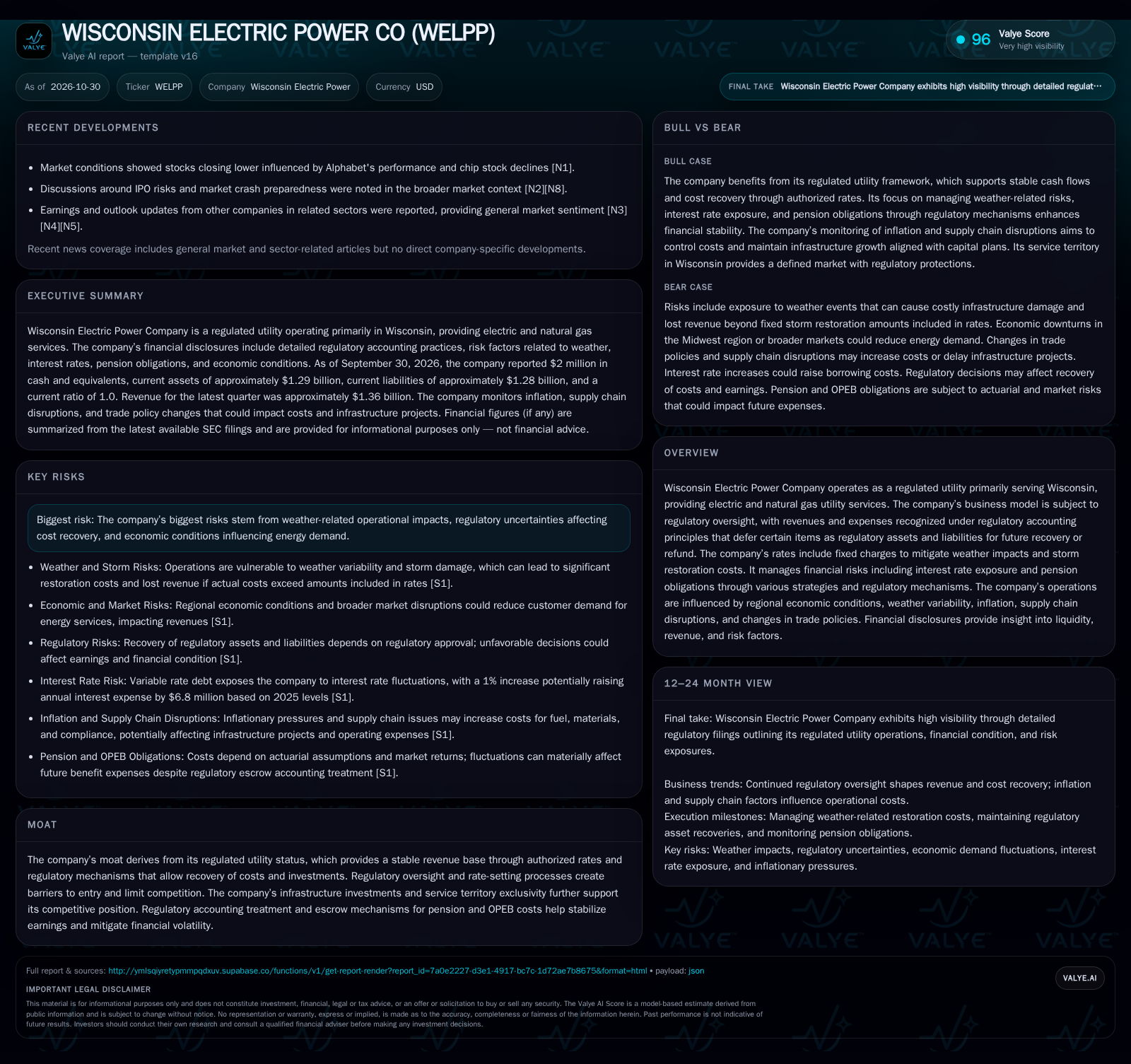
Wisconsin Electric Power operates under a regulated utility framework in Wisconsin, with current quarterly revenue of $1.36 billion and a current ratio of 1.0 as of September 2026. While regulatory accounting and fixed charges in rates help stabilize earnings and offset weather unpredictability, exposure to inflation, supply chain disruptions, and interest rate risk could impact cost structures and future returns. The company’s ability to recover costs via regulatory mechanisms and manage pension and OPEB obligations will be central to sustaining its financial resilience in a shifting economic environment. [S1] [S2]
Wisconsin Electric Power Company stands as a prototypical regulated utility, anchoring its business on stable, state-approved rates and a defined service territory within Wisconsin. The company’s most recent filings reveal a large-scale operation with $1.36 billion in quarterly revenue and a current ratio of 1.0, but also underscore a delicate balance between regulatory cost recovery and exposure to external shocks. Inflation, tightening supply chains, and unpredictable weather events continue to test the limits of regulatory protections, forcing ongoing operational and financial adaptation to sustain resilience and capital investment.
Recent Financials and Operational Position: Tight Liquidity and Revenue Stability
As of September 30, 2026, Wisconsin Electric Power reported $1.36 billion in quarterly revenue and reported liquidity-ratio trends of 1.0, with $2 million in cash and equivalents and both current assets and liabilities at approximately $1.29 billion. The company reported cash and liquidity metrics for the period; these figures do not by themselves establish operating runway, investment capacity, financial flexibility, or financing capacity. The company’s reliance on regulatory accounting and rate structures that include fixed charges and storm restoration cost recovery stabilizes revenue, but also makes ongoing regulatory engagement and economic context critical to future performance. [S2]
The absence of changes to insider trading plans in the latest quarter signals no major governance or ownership shifts, and the company continues to operate under a framework of regulatory accounting, deferring certain revenues and expenses as regulatory assets and liabilities, subject to eventual approval for recovery or refund. [S1] [S2]
How the Regulated Utility Model Shapes Revenue, Cost Structure, and Capital Allocation
Wisconsin Electric Power derives its revenue almost entirely from regulated electric and natural gas utility services. Rate cases, approved by state regulators, set the allowable revenue, incorporating estimated normal weather, projected demand, and anticipated operating and capital costs. Fixed charges in rates help mitigate margin volatility from weather variability, and regulatory mechanisms allow for the deferral and recovery of certain extraordinary costs, such as storm restoration or pension obligations. [S1]
The business model is capital-intensive, requiring significant ongoing investment in infrastructure, grid maintenance, and compliance. These investments are typically funded by a mix of retained earnings and long-term debt, with the cost of capital embedded in the rate base. Operating leverage is present but partially constrained by regulatory lag—cost increases can only be passed through following rate case approval, creating a potential mismatch in periods of rapid inflation or supply chain shocks. Pension and OPEB costs are managed through escrow arrangements, but remain sensitive to actuarial assumptions and market returns. [S1]
Interest rate exposure is managed by limiting variable rate debt and opportunistically locking in long-term fixed rates; a 1% increase in rates would increase annual interest expense by $6.8 million on 2025 variable rate debt levels, underscoring the sensitivity of funding costs to macroeconomic shifts. [S1]
Regulatory Barriers and Service Territory: Defining the Utility’s Defensibility
Wisconsin Electric Power operates with an effective local monopoly within its regulated service territory—competition is restricted by regulatory exclusivity and high barriers to entry tied to infrastructure scale and permitting. The company’s primary competitors are not direct market entrants, but rather substitute technologies (distributed generation, energy efficiency, and, at the margin, alternative fuels) and the risk of regulatory or policy shifts that could erode allowed returns or introduce new forms of competition.
The regulated model provides stability: rates are set to recover prudent costs and a reasonable return on invested capital, and regulatory accounting allows for smoothing of extraordinary events. However, the company’s competitive resilience is increasingly tested by external factors—federal/state energy policy changes, customer adoption of distributed energy resources, and pressure from inflation and supply chain disruptions that could compress margins or delay infrastructure deployment.
Peer utilities in the Midwest face similar dynamics; differentiation occurs in regulatory relationships, cost management, investment discipline, and the ability to navigate evolving grid demands. The company’s moat is strongest in its rate base and regulatory relationships, but is not immune to broader energy transition and economic risks.
When Regulatory Recovery and Infrastructure Execution Outpace Headwinds
A favorable scenario for Wisconsin Electric Power would see continued regulatory support for rate base growth, with timely approval of cost recovery for capital projects, storm restoration, and inflation-driven expenses. If inflation moderates or the company effectively passes through higher costs via new rate cases, margins could be preserved or expanded. Successful management of pension and OPEB obligations—either through favorable market returns or regulatory escrow mechanisms—would further stabilize earnings.
Upside could be confirmed by evidence such as: above-expected authorized returns in future rate cases, regulatory approval for accelerated recovery of deferred costs, a visible decline in unbilled revenues volatility, and sustained or improved operating margins despite macroeconomic pressures. If the company demonstrates the ability to complete infrastructure projects on schedule and within budget, even amid supply chain disruptions, it would signal operational resilience and underpin long-term growth in the rate base.
Stable Returns Amid Regulatory Lag and Persistent Cost Pressures
The most plausible trajectory is one where Wisconsin Electric Power continues to deliver stable, if unspectacular, returns due to its regulated status. Revenue and margins remain largely protected by the ability to recover prudent costs through the rate base, but with a lag—meaning periods of elevated inflation or supply chain disruption may compress margins until the next successful rate case. Weather variability and storm events create episodic earnings volatility, partially mitigated by fixed rate charges, but not eliminated.
Base case confirmation would come from steady quarterly revenue growth in line with historical trends, a current ratio that remains close to 1.0 without material draws on liquidity, and regulatory filings that show continued approval for cost recovery and rate adjustments. Falsification would include regulatory pushback on rate increases, significant project delays due to supply chain issues, or sharp increases in unbilled revenue volatility driven by abnormal weather or demand shocks.
Cost Overruns, Regulatory Headwinds, and Economic Weakness Erode Returns
Adverse outcomes could materialize if the company faces major storm events or infrastructure failures with costs exceeding amounts recoverable through rates, forcing absorption of losses or deferred recovery. Persistent inflation and supply chain constraints could drive up costs faster than rate cases can adjust, squeezing margins and potentially requiring higher debt issuance at rising interest rates. If Midwest economic conditions deteriorate, energy demand could fall, further pressuring revenue.
Pension or OPEB actuarial losses not recoverable under regulatory mechanisms could also weigh on earnings.
Tracking the Resilience and Earnings Quality of Wisconsin Electric Power
Quarterly and annual trends in authorized rate base growth and allowed returns, as disclosed in regulatory filings, will clarify the company’s ability to expand and earn on capital investments.
The pace, size, and regulatory approval outcome of new rate cases—especially those citing inflation, storm restoration, or supply chain disruptions—would help test whether cost recovery is keeping up with external pressures.
Changes in unbilled revenue estimates, if disclosed, may indicate shifts in customer demand, weather-driven volatility, or operational forecasting accuracy.
Reported pension and OPEB expenses, actuarial assumptions, and regulatory treatment (escrow recoveries or deferrals) will affect forward-looking earnings stability.
Interest expense trends and the proportion of variable versus fixed-rate debt, if updated, would signal exposure to further rate hikes and their impact on funding costs.
Project execution metrics—such as infrastructure completion timelines, capital expenditure overruns, and regulatory approval delays—would help assess operational discipline and risk.
Disclaimer: This is research-only, informational analysis and not investment advice. It may include AI-generated interpretation and general industry context. Always verify important details using primary sources.

Comments