
Vor Biopharma: Clinical Progress, Liquidity Strength, and the Stakes of Autoimmune Commercialization
Vor Biopharma’s lead candidate, telitacicept, has achieved its first regulatory approval in China for Sjögren’s disease, offering a tangible validation milestone for the pipeline. The company’s substantial liquid assets support continued clinical expansion, but the absence of current product revenue, ongoing net losses, and the challenge of replicating approval beyond China define the risk-reward equation. Near-term value hinges on clinical data, regulatory outcomes, and the path to commercialization in autoimmune indications.
Vor Biopharma stands out among clinical-stage biotechs for its recent regulatory win in China and a reported liquidity position, with over $480 million in liquid assets versus minimal near-term liabilities. The company’s future, however, is tied to the broader success of telitacicept in late-stage trials and the ability to secure approvals and commercial adoption outside China. Investors face the classic biopharma tradeoff: high potential upside if pivotal data and regulatory progress align, but ongoing net losses and development risks remain.
Vor Biopharma’s recent regulatory achievement in China for its lead candidate, telitacicept, marks a rare moment of validation for a clinical-stage biotech, especially in the fiercely competitive autoimmune and hematologic disease space. Yet, the underlying business model remains unproven: net losses persist, and future value creation depends on successful clinical readouts, further regulatory wins, and eventual commercial uptake, especially outside China. The coming quarters will test whether Vor’s scientific and financial assets can be translated into a repeatable, durable business.
Recent Approval and Financial Position Define Near-Term Landscape
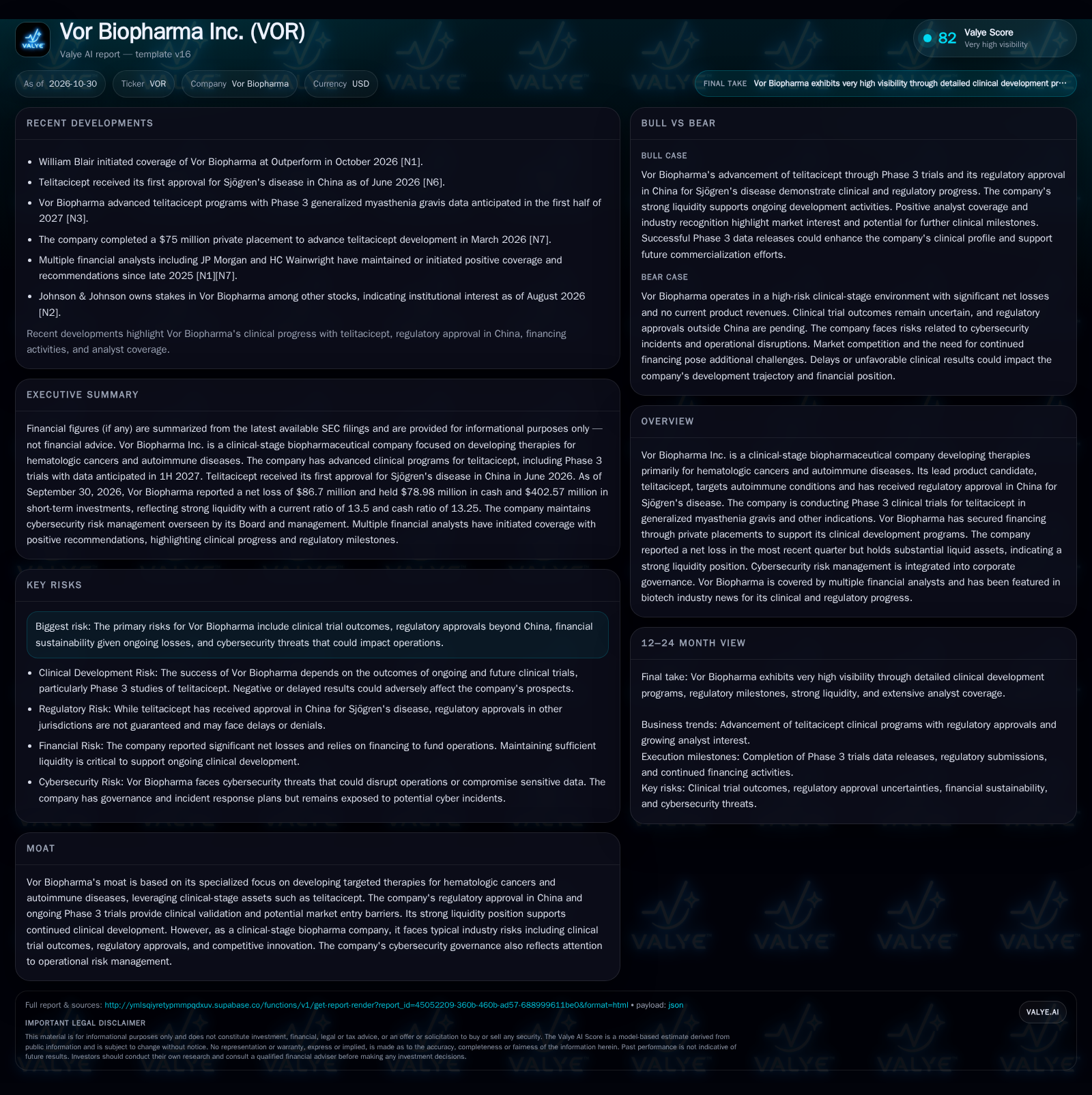
Vor Biopharma’s most material recent development is the first regulatory approval of telitacicept for Sjögren’s disease in China as of June 2026—a critical inflection point that provides external validation of the company’s pipeline [S2]. This milestone could serve as a springboard for further development in other autoimmune indications and geographies, but it is not yet accompanied by product revenue.
Financially, Vor reported a net loss of $86.7 million for Q3 2026, underscoring the capital-intensive nature of late-stage biotech development [S2]. However, with $78.98 million in cash and $402.57 million in short-term investments, the company’s $481.55 million in liquid assets dwarfs its current liabilities of $36.34 million, reflected in a current ratio of 13.5. The company reported cash and liquidity metrics for the period; these figures do not by themselves establish operating runway, investment capacity, financial flexibility, or financing capacity.
The company is also drawing analyst attention, with multiple positive recommendations and recent coverage initiated at Outperform, suggesting heightened market interest as pivotal data and further regulatory milestones approach [N1] [N7] [N8].
Pipeline Economics: Capital Intensity, Delayed Revenue, and the Leverage of Success
Vor Biopharma’s business model is typical of clinical-stage biotech: heavy up-front investment in research and development with no current product revenue, and value realization contingent on successful pipeline progression and eventual commercialization. The economics hinge on a binary outcome—either telitacicept (and future assets) reach approval and generate sales, or continued net losses necessitate additional financing or strategic alternatives.
Pricing and volume dynamics for autoimmune therapies can be attractive if clinical differentiation is established: drugs that address high-unmet-need populations, especially in chronic conditions like Sjögren’s disease, often command premium pricing and face less immediate generic risk. However, initial approval in China does not guarantee pricing power or broad reimbursement in other markets, and commercial terms or royalty structures tied to partnerships (if any) are not disclosed.
Fixed costs are dominated by R&D, clinical trial execution, and regulatory activities. Operating leverage could emerge if a product is commercialized, as incremental sales typically carry high margins once manufacturing and distribution are scaled. Until then, Vor’s capital needs will be dictated by the pace and breadth of its clinical programs, and the timing of potential regulatory inflection points.
Navigating a Crowded Landscape: Clinical Advantage or Commodity Risk?
Vor Biopharma operates in intensely competitive fields—autoimmune disease and hematologic cancer—populated by established pharmaceutical companies, emerging biotechs, and a flow of new entrants. The company’s competitive position depends on several factors: the clinical efficacy and safety profile of telitacicept versus existing standards of care, the breadth of indications pursued, and the ability to differentiate mechanistically or commercially.
First approval in China offers validation but does not guarantee global leadership; regulatory, payer, and adoption hurdles differ substantially across regions. Larger rivals may have advantages in commercial infrastructure, established relationships with providers and payers, and experience navigating complex reimbursement environments. At the same time, Vor’s specialized focus and early clinical wins provide a potential edge if further pivotal data are positive.
Substitutes include both existing biologics and emerging modalities (e.g., cell therapies, novel biologics) targeting similar pathways. Switching costs for prescribers can be significant if a new therapy demonstrates superior outcomes, but market inertia and entrenched competitors represent persistent headwinds.
A Flywheel of Clinical Success and Geographic Expansion
The bullish scenario for Vor Biopharma is built on a virtuous cycle: telitacicept’s positive clinical data in additional autoimmune indications (such as generalized myasthenia gravis, with Phase 3 data expected in 1H27 [N3]) lead to further regulatory approvals outside China. Each new approval unlocks additional market opportunity, increases revenue visibility, and enhances the company’s negotiating leverage for partnerships or commercialization.
Confirmation of this scenario would require: (1) successful pivotal trial results in major indications, (2) timely regulatory submissions and approvals in the U.S., EU, and other key markets, (3) evidence of commercial uptake and pricing power in early launch geographies, and (4) sustained analyst and investor interest, as reflected in upward estimate revisions or additional coverage.
This pathway could also open up opportunities for business development—out-licensing, partnerships, or even acquisition interest from larger pharma—if Vor’s assets demonstrate clear differentiation and commercial potential.
Execution Risk and the Realities of Global Biotech Commercialization
The most plausible medium-term trajectory for Vor Biopharma is a mix of incremental clinical progress and persistent execution challenges. Telitacicept’s China approval provides a platform but does not guarantee rapid or broad-based global adoption. The path to U.S. and EU approvals is fraught with regulatory uncertainty, and outcomes from ongoing Phase 3 trials remain binary risk events.
In this scenario, Vor continues to invest in its pipeline, reporting additional clinical and regulatory milestones, but faces a lengthy pre-commercial phase marked by ongoing net losses. Revenue generation may be limited to milestone or royalty streams from regional partnerships (if any are struck), with full-scale commercialization delayed until further approvals are secured.
Analyst coverage and investor sentiment likely track closely to clinical data flow and regulatory news.
Pivotal Data Disappoint or Regulatory Delays Derail Momentum
The primary risk for Vor Biopharma is negative or inconclusive results from ongoing late-stage trials, particularly in indications outside China. If pivotal data for telitacicept fail to demonstrate material efficacy or raise safety concerns, the company’s lead asset could stall, eroding both market credibility and partnership potential.
Regulatory setbacks—such as delays, additional data requests, or outright denials in major markets—would further extend the time to revenue and could force management to seek additional financing or pursue strategic alternatives under less favorable terms.
Confirmation of this downside would be visible in halted trials, missed milestones, analyst downgrades, and a deteriorating cash position.
Tracking Vor Biopharma’s Progress: Clinical, Regulatory, and Commercial Milestones to Test the Investment Thesis
Progress and outcomes from ongoing Phase 3 trials for telitacicept in indications beyond Sjögren’s disease, especially generalized myasthenia gravis [N3].
Regulatory submission and approval timelines for telitacicept in the U.S., EU, and other key markets—any updates or delays would materially impact the outlook.
Evidence of commercial uptake, pricing, and reimbursement for telitacicept in China, and, if disclosed, early revenue figures or launch commentary.
Updates on additional pipeline assets and whether Vor can leverage its development platform into new clinical programs or partnerships.
Changes in cash burn rate and liquidity position, especially if clinical timelines slip or additional trials are initiated.
Any announced business development activity, such as licensing deals, partnerships, or acquisition interest.
Analyst estimate revisions, new coverage initiations, or rating changes in response to company developments.
Disclaimer: This is research-only, informational analysis and not investment advice. It may include AI-generated interpretation and general industry context. Always verify important details using primary sources.

Comments