
Ryan Specialty Holdings: Scale, Specialization, and the Stakes of E&S Market Leadership
Ryan Specialty Holdings’ position as a leading specialty insurance intermediary is underpinned by its scale in the E&S market, focus on talent and technology, and exposure to consolidation-driven tailwinds.
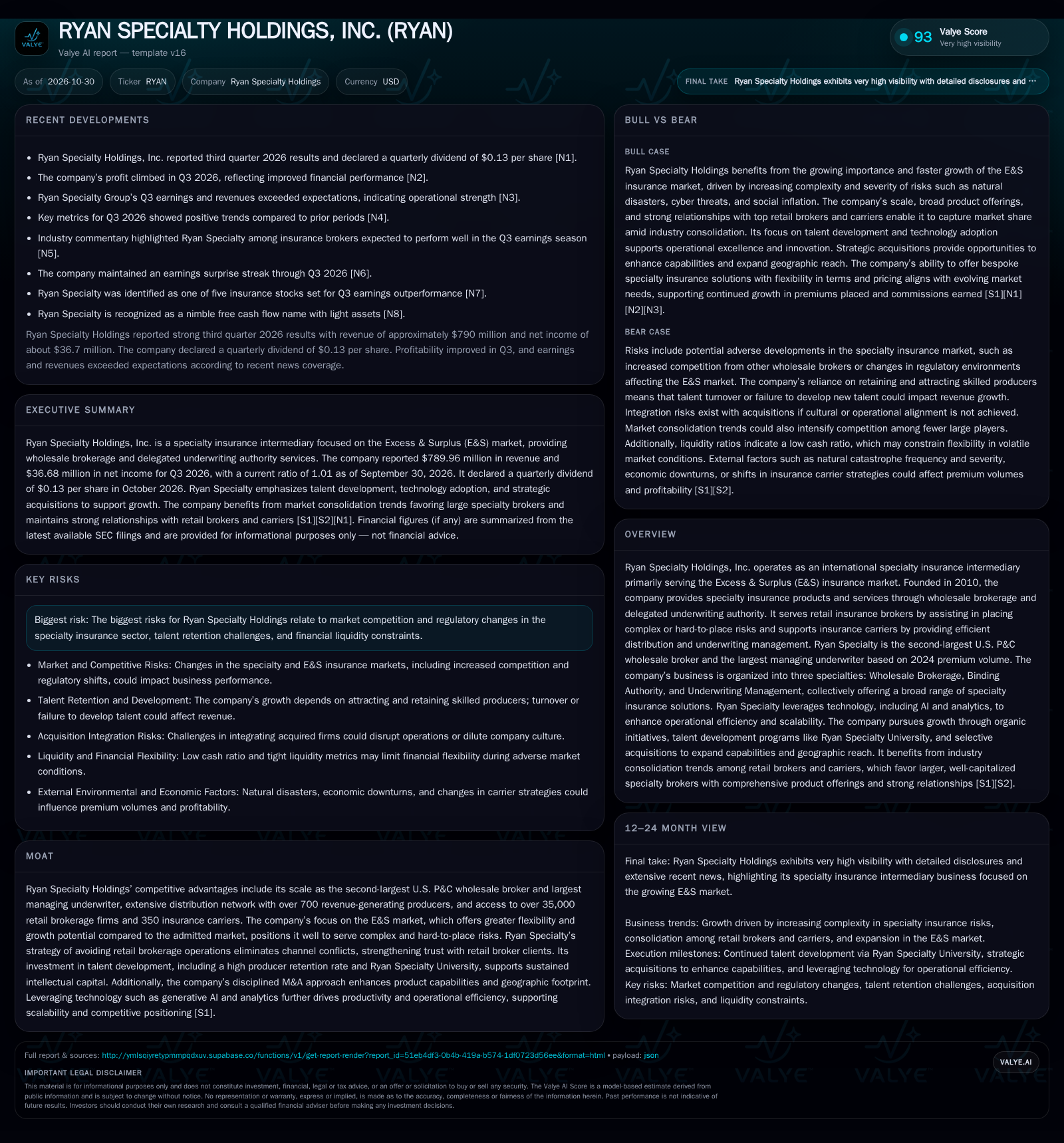
Continued execution on talent, technology, and selective acquisitions will be critical for maintaining its edge as the E&S market evolves. [S1] [S2] [N1] [N2] [N3] [N4]
Ryan Specialty Holdings stands out as a scale-driven specialist in the U.S. Excess & Surplus (E&S) insurance market, a segment that thrives on complexity and customization. The company’s Q3 2026 results, with both revenue and net income surpassing expectations, reinforce its operational momentum and the strength of its business model amid ongoing industry consolidation. However, its reported cash ratio and tight liquidity metrics highlight a potential vulnerability if the insurance cycle turns or acquisition integration proves difficult. The coming quarters will test whether Ryan Specialty can continue to outpace the market by deepening its specialty focus, sustaining high talent retention, and leveraging technology—without overextending its risk profile or balance sheet.
Q3 2026 Outperformance and Liquidity Constraints Shape the Near-Term Narrative
Ryan Specialty reported approximately $790 million in revenue and $36.7 million in net income for Q3 2026, exceeding consensus estimates and extending its streak of positive earnings surprises. This operational momentum comes as the company continues to benefit from both organic growth and industry consolidation trends that favor large, specialized intermediaries. [S2] [N2] [N3] [N4]
As of September 30, 2026, Ryan Specialty’s balance sheet showed $168.8 million in cash and equivalents, a current ratio of 1.01, and a notably reported cash ratio of 0.03. [S2]
The cited source reports dividend-related activity; that disclosure alone does not establish dividend-policy continuity, management confidence, or a material constraint on capital flexibility. [N1] [S1]
How Ryan Specialty Converts E&S Complexity into Profitable Growth
Ryan Specialty’s economics are rooted in its role as an intermediary—facilitating the placement of complex, hard-to-place risks via the E&S market on behalf of retail brokers and insurance carriers. Revenue comes primarily from commissions and fees for brokering and underwriting services, rather than from taking direct underwriting risk. This model ties top-line performance to premium volume, product mix, and the company’s ability to command higher fees for specialty expertise.
The E&S segment typically allows for more flexible pricing and terms, enabling the company to capture higher margins than standard admitted markets. The variable cost structure is driven heavily by producer compensation, but scale and technology adoption (including generative AI and analytics) have the potential to deliver operating leverage, especially as the company integrates acquisitions and automates routine processes. [S1]
The high current liabilities reflect the pass-through nature of insurance premiums, but also highlight the importance of disciplined working capital management.
The intermediary business model inherently depends on maintaining strong relationships with both retail brokers and carriers, which can be influenced by market cycles and regulatory changes. For instance, shifts in underwriting guidelines or risk appetite among carriers could impact the types of risks Ryan Specialty can place, thereby affecting commission volumes and fee structures. Furthermore, the company's ability to innovate in product offerings and customize solutions is critical in differentiating itself from competitors and justifying premium pricing. This customization often requires deep underwriting expertise and agile operational processes, which can be enhanced through targeted technology investments and continuous talent development.
Scale, Specialization, and the Evolving Landscape of Specialty Intermediation
Ryan Specialty’s position as the second-largest U.S. P&C wholesale broker and the largest managing underwriter by 2024 premium volume provides substantial bargaining power and market access. Its distribution network—over 700 revenue-generating producers, access to 35,000+ retail brokerage firms, and 350+ carrier relationships—creates a flywheel effect: scale attracts more complex risks, which in turn reinforces scale. [S1]
A distinctive element is the company’s exclusive focus on specialty and E&S lines, avoiding direct competition with retail brokers and minimizing channel conflict. This strategic clarity shores up trust within its distribution ecosystem. However, the same consolidation trends that benefit Ryan Specialty also create larger, better-capitalized rivals in wholesale and specialty broking, intensifying competition for talent, clients, and carrier relationships.
Technology-driven entrants and large retail brokers expanding into specialty lines represent credible substitutes. The longevity of Ryan Specialty’s advantage will depend on its ability to maintain product breadth, talent quality, and technology-enabled efficiency as barriers to entry rise.
The competitive dynamics in the E&S space are also shaped by regulatory environments that vary by state, influencing the complexity and cost of compliance for intermediaries. Ryan Specialty’s scale can provide advantages in managing these regulatory burdens through centralized compliance functions and technology-enabled monitoring. However, as regulatory scrutiny intensifies, the company must balance growth ambitions with the need for robust risk controls and transparent reporting. Additionally, the evolving preferences of retail brokers and insureds—such as demand for digital interfaces and faster turnaround times—may pressure traditional intermediaries to accelerate digital transformation or risk losing market share to more technologically adept entrants.
If E&S Demand Accelerates and Ryan Specialty Deepens Its Moat
In a favorable scenario, continued growth in E&S premiums—driven by increased risk complexity (cyber, climate, social inflation) and further consolidation among retail brokers—could allow Ryan Specialty to capture outsized share and expand margins. The company’s investment in talent development (e.g., Ryan Specialty University) and operational technology could yield further productivity gains, reinforcing cost advantages and retention.
Successful integration of selective acquisitions would expand specialty capabilities and geographic reach, supporting both cross-sell and premium volume growth. If the company demonstrates sustained producer retention above 95%, accelerating fee income, and improving operating margin, it would validate this scenario.
Confirmation would come from above-peer premium growth rates in E&S, declining expense ratios, and evidence of technology-driven efficiency gains. Falsification would include a drop in producer retention, margin compression, or loss of premium growth momentum relative to the specialty market.
In an environment where E&S demand accelerates, Ryan Specialty’s ability to leverage data analytics and AI could enable more precise risk selection and pricing, further enhancing margins. By integrating predictive analytics into underwriting workflows, the company can identify emerging risk trends earlier and tailor products accordingly, increasing client stickiness. Moreover, if the company successfully cultivates a culture of continuous learning and innovation through its talent programs, it can sustain high producer engagement and attract top industry professionals, reinforcing its competitive moat. Such capabilities would also facilitate cross-selling opportunities across specialty lines, deepening client relationships and diversifying revenue streams.
Stable Growth with Margin Discipline Amid Managed Competition
The most plausible medium-term scenario is one of continued, but moderate, growth in E&S market share, with Ryan Specialty leveraging its scale, talent, and technology to maintain mid-single-digit revenue increases. Margin expansion would be incremental, as operating leverage from technology adoption is balanced by competitive pressures and ongoing investment in talent and compliance.
The company is likely to continue its strategy of selective acquisitions, but integration costs and the need to preserve cultural cohesion could temper near-term synergies. Dividend payments may continue at current levels, with capital allocation decisions balancing shareholder returns and reinvestment needs.
This scenario would be confirmed by ongoing high producer retention, steady premium growth in line with E&S market trends, and stable or slightly improving operating margins. Signs of strain—such as rising expense ratios, integration setbacks, or liquidity stress—would point to downside risk.
Margin Compression and Liquidity Stress in a Volatile Risk Landscape
In an adverse scenario, increased competition from both established and digital-first intermediaries could erode commission rates and fee income, particularly if retail brokers or carriers seek to internalize more specialty capabilities. Talent attrition or inability to develop new producers could lead to weakened client relationships and slower growth.
If integration of acquisitions falters, operational disruptions or cultural misalignment could exacerbate margin pressure.
Downside confirmation would include declining producer retention (below 90%), negative operating leverage (rising expense ratios), missed earnings, or the need to raise external capital to maintain operations or fund investments. Early warnings would come from deteriorating current or cash ratios, failed acquisition integrations, or loss of key carrier/broker relationships.
Testing the Resilience of Ryan Specialty’s Specialty-Focused Growth Model
Quarterly and annual premium volume growth in the E&S segment relative to industry benchmarks—outperformance would support the scale thesis.
Producer retention rate—if disclosed, sustained levels above 95% would indicate ongoing talent and relationship strength.
Operating margin trends—improvement would suggest successful technology leverage and integration; margin compression could signal competitive or integration headwinds.
Expense ratio movement—declining ratios would confirm operating leverage; rising ratios may indicate cost pressures or integration challenges.
Acquisition pace and integration outcomes—a useful metric would be realized revenue/cost synergies and retention of acquired producers post-integration.
Technology adoption milestones—evidence of AI and analytics translating into measurable productivity or margin improvements would validate part of the operational efficiency thesis.
Disclaimer: This is research-only, informational analysis and not investment advice. It may include AI-generated interpretation and general industry context. Always verify important details using primary sources.

Comments