
Naploy Corp.: Early-Stage Health App Ambitions Meet Execution and Monetization Hurdles
Naploy Corp.
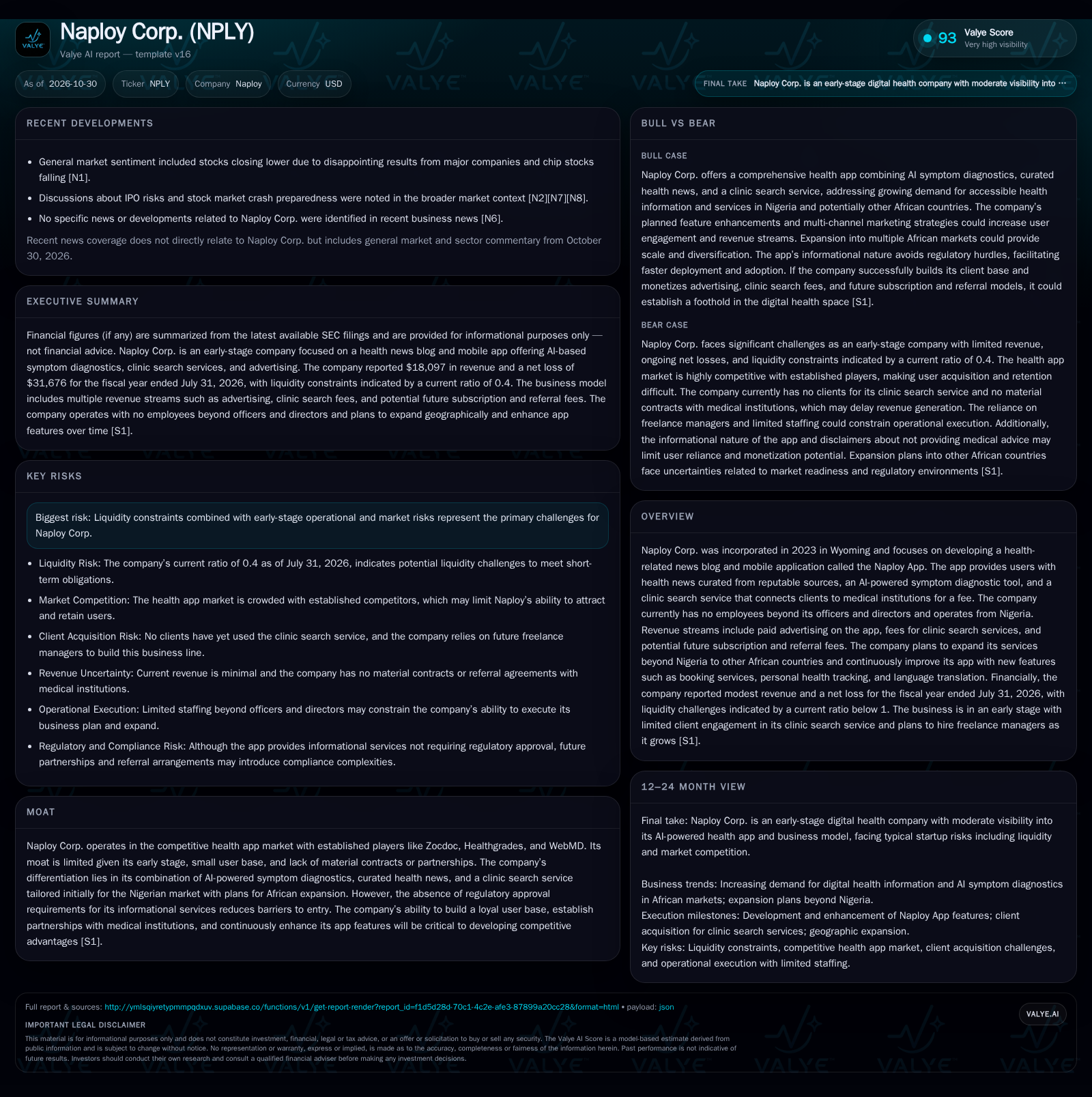
Naploy Corp. operates a health-focused app with AI-powered symptom diagnostics, curated news, and a clinic search service targeting Nigeria and planned African expansion. The thesis hinges on whether Naploy can convert product features and expansion plans into user traction, institutional partnerships, and diversified recurring revenue before cash limitations force retrenchment or dilution. [S1]
Naploy Corp. aims to carve out a niche in the competitive digital health space by offering an app that integrates AI-powered symptom checking, curated health news, and a clinic search service for users in Nigeria and, eventually, across Africa. However, the company remains in its formative stages: as of July 2026, it has yet to serve a single clinic search client, holds no institutional referral contracts, and operates with only its officers and directors as staff. [S1]
Where Naploy Stands: Revenue, Liquidity, and Client Engagement Snapshot
As of July 31, 2026, Naploy Corp. reported $18,097 in revenue and a net loss of $31,676, with a current asset base of $40,228 against current liabilities of $100,657, yielding a current ratio of 0.4 [S1]. The company reported cash and liquidity metrics for the period; these figures do not by themselves establish operating runway, investment capacity, financial flexibility, or financing capacity. The company’s only revenue to date comes from app-based advertising. Critically, Naploy has not yet served any clients through its clinic search service, and it holds no material contracts or referral agreements with medical institutions [S1]. With no employees beyond its officers and directors, operational capacity is minimal. These facts set a context of ambitious product and geographic expansion plans but with acute execution risks and funding limitations.
Underlying Economics: Multi-Stream Ambitions, Fixed Cost Lightness, and Monetization Challenges
Naploy’s business model aspires to blend advertising, paid search services, and future subscriptions or referral fees into a diversified revenue mix. Currently, advertising—likely contextual banners and pop-ups targeting medical institutions—forms the sole income stream. This model typically relies on scaling user engagement and traffic to command meaningful ad pricing, but the company’s nascent user base and lack of clinic search clients suggest low current monetization per user.
The clinic search service, which would connect users to medical providers for a fee, has not yet generated revenue or built institutional relationships. If realized, such a service could offer higher-margin, transactional revenue, but it depends on both user trust (to submit requests) and institutional buy-in (to pay referral or lead-generation fees).
A subscription layer—if launched—could provide recurring revenue but may face resistance given the abundance of free health information online and the app’s current focus on information rather than direct care or regulated medical advice. Data analytics services, another future ambition, would require significant scale and compliance safeguards.
Naploy’s fixed cost base is currently low, with no staff beyond management and reliance on freelance managers planned for scaling. This limits burn but also constrains execution, especially in user support, sales, and institutional onboarding. The company’s $45,000 investment in app and web assets is a sunk cost, but ongoing development and feature enhancement will require capital or cash flow. Overall, the business model is asset-light but highly dependent on user growth, engagement, and the eventual conversion of institutional relationships into monetizable contracts.
Navigating a Crowded Health App Market: Differentiation and Barriers to Entry
Naploy enters a highly competitive digital health landscape, facing both global incumbents—such as Zocdoc, Healthgrades, and WebMD—and regionally focused platforms. Its differentiation is rooted in combining AI-powered symptom diagnostics, curated news, and a fee-based clinic search tailored for African markets. The informational nature of its offering avoids direct regulatory hurdles, but this also means lower switching costs for users and minimal built-in defensibility.
Established platforms typically benefit from network effects, high brand trust, and deep institutional partnerships, all of which Naploy currently lacks. The absence of material contracts with medical providers removes a potential barrier to entry that could otherwise protect margins or user stickiness. Further, the company’s zero-client status in its clinic search business and lack of recurring revenue indicate a nascent moat at best.
Potential advantages could come from localizing content, supporting regional languages, and tailoring features (e.g., booking, health tracking) to African healthcare realities. However, these advantages are only realized if Naploy can rapidly build both a user base and institutional relationships—difficult tasks given resource constraints and entrenched competition.
If Product Enhancements and Regional Expansion Drive Adoption
The bull case depends on Naploy successfully leveraging its AI-powered diagnostics, localized news, and expanding feature set (e.g., booking, health tracking, language support) to attract a sizable user base in Nigeria and subsequently in other African countries. If the company can establish traction with consumers, especially for the clinic search service, it could then approach medical institutions for referral arrangements or paid partnerships.
Meaningful user engagement and early institutional adoption would enable Naploy to build diversified revenue streams—ads, search fees, subscriptions, and possibly data analytics. The informational positioning allows for rapid iteration and deployment, potentially outpacing more regulated competitors in certain African markets.
Evidence confirming this scenario would include: a rapid increase in active users; first clinic search clients served; signed contracts or referral agreements with medical institutions; and visible growth in non-advertising revenue streams. Falsification would be continued stagnation in user growth, absence of institutional partnerships, or an inability to monetize beyond ads.
Gradual Traction with Persistent Funding and Monetization Headwinds
The most plausible scenario is gradual progress: Naploy may achieve modest user growth as it incrementally improves app features and expands marketing efforts, leading to limited but growing advertising and possibly the first clinic search transactions. However, lacking significant institutional buy-in and facing slow adoption of fee-based services, revenue growth may lag operating needs.
The company may need to seek additional funding—potentially through equity dilution or convertible debt—to bridge the gap to sustainable cash flow.
Evidence supporting this pathway would include: small but rising user and engagement metrics; initial (but not scaled) clinic search requests; pilot agreements with a few medical institutions; and periodic capital raises. Falsification would be a failure to grow the user base, continued zero client engagement, or inability to secure even bridge financing.
Liquidity Constraints and Execution Gaps Force Retrenchment
The absence of material contracts or clinic search clients by late 2026 increases the risk that the business model remains unproven.
If the company cannot secure additional funding or demonstrate rapid progress in user and institutional engagement, it may face insolvency, require asset sales, or be forced into a strategic pivot away from its core ambitions. The informational focus, while avoiding regulatory burdens, could also limit perceived value and user trust—especially if competing apps deepen their medical integration or local partnerships.
Downside evidence would be continued losses with stagnant or declining revenue, further depletion of current assets, lack of new funding, and no progress in institutional contracting or fee-based transactions.
Milestones That Will Determine Whether Naploy’s Expansion Thesis Holds
Monthly and quarterly growth in active app users and engagement metrics; a useful metric would be daily active users (DAU) and user retention rates, if disclosed.
Number and value of clinic search requests processed and successfully matched to institutions; first client served would be a key inflection point.
Signed contracts or referral agreements with medical institutions, and the structure (fee-based, recurring, or transactional) of such arrangements.
Breakdown of revenue by source: advertising versus clinic search fees, subscriptions, or other services; diversification would support the thesis.
User feedback and ratings, especially regarding the accuracy and perceived utility of the AI symptom checker and clinic search features.
Development and rollout of new features (e.g., booking services, health tracking, language support) and their adoption rates.
Geographic expansion milestones: user acquisition and institutional partnerships in new target countries (e.g., Benin, Kenya, Ethiopia), if disclosed.
Disclaimer: This is research-only, informational analysis and not investment advice. It may include AI-generated interpretation and general industry context. Always verify important details using primary sources.

Comments