
OmniAb’s Discovery Platform: Partner Growth, Revenue Fluctuations, and Technological Edge
OmniAb’s multi-species transgenic animal and AI-powered antibody discovery platform has built a broad partner base and pipeline, but the company’s economics hinge on the unpredictable success and reporting of external biopharma partners.
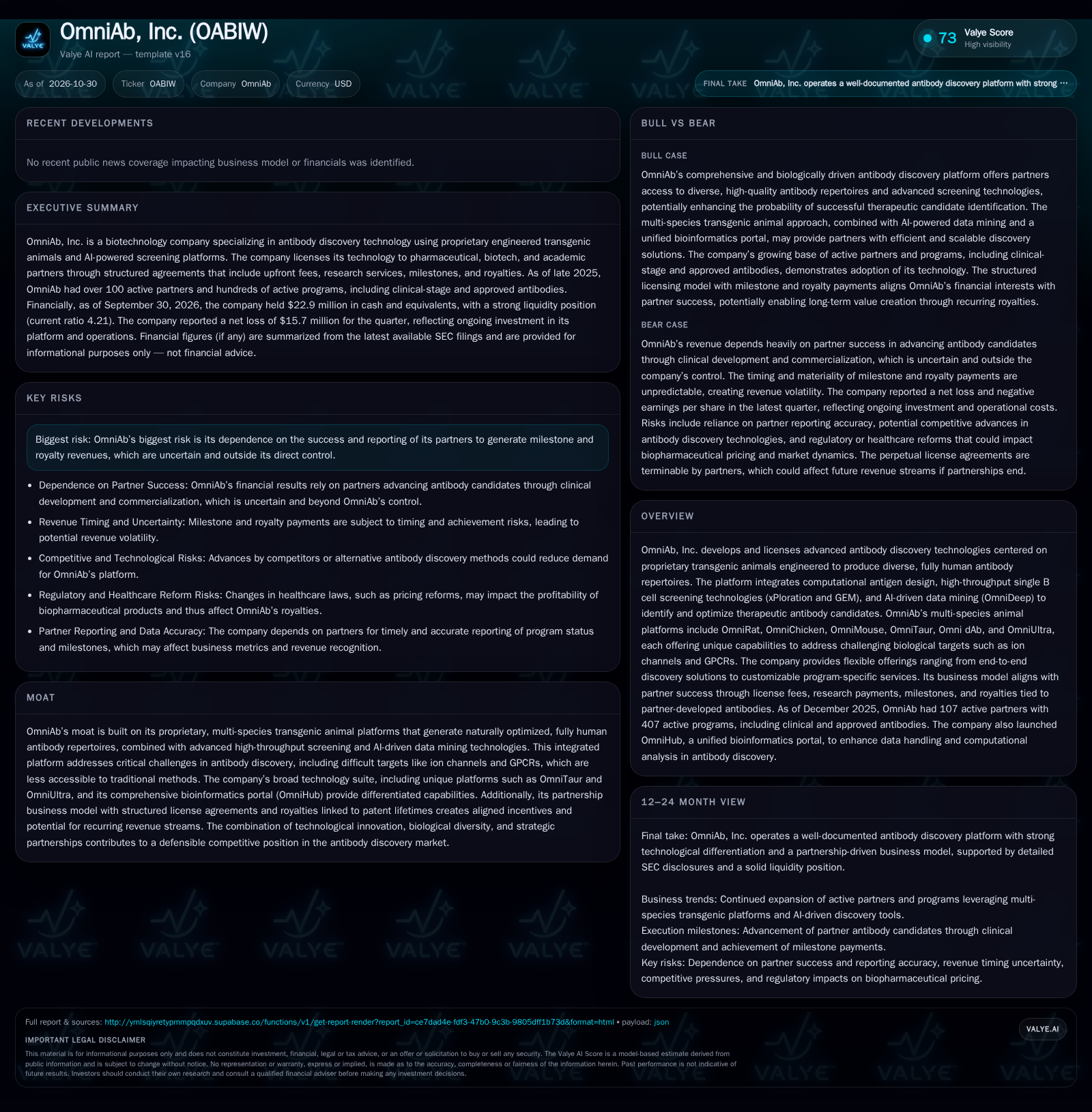
OmniAb licenses a differentiated antibody discovery platform to over 100 biopharma partners, integrating proprietary transgenic animals, high-throughput B cell screening, and AI analytics. The model ties long-term revenue to partners’ clinical and commercial success, with royalties and milestones as key drivers.
OmniAb, Inc. stands at the intersection of advanced biotechnology and platform economics, offering a comprehensive antibody discovery suite built on engineered transgenic animals and AI-driven analytics. The company’s fortune is closely intertwined with its partners—biopharma and biotech firms that license OmniAb’s technology to accelerate their drug pipelines. With over 100 partners and hundreds of active programs, OmniAb’s platform is widely adopted, but the timing and magnitude of the company’s revenue are dictated by unpredictable external R&D and regulatory outcomes. This creates a business model with substantial long-term optionality but short-term revenue volatility, especially as the company continues to invest heavily in R&D and platform expansion.
Recent Developments: Expanding Partner Pipeline Amid Ongoing Platform Investments
As of December 31, 2025, OmniAb had 107 active partners and 407 active antibody discovery programs, with 27 antibodies in clinical development, two under regulatory review, and three already approved and commercialized by partners [S1]. This signals broad adoption of OmniAb’s discovery engine across the pharmaceutical and biotech landscape. [S2] [S2] The company’s revenue remains largely milestone- and service-driven, with royalties expected to become more meaningful only as more partnered products reach commercialization [S1]. The materiality and timing of these royalties remain uncertain and are highly dependent on the clinical and commercial outcomes achieved by partners.
OmniAb’s Revenue Model: Drivers of Growth and Variability
OmniAb’s economics are structurally tied to the success of its partners. The company earns revenue from upfront or annual license fees, research service payments, milestone payments at various R&D and regulatory inflection points, and royalties on commercial sales of antibodies developed using its platform [S1]. Royalty payments are typically in the low- to mid-single digits and extend for the longer of 10 years from first commercial sale or patent expiration [S1].
In the near term, the business is heavily weighted to one-time or episodic milestone payments and service revenues, which are lumpy and unpredictable. Milestone achievement depends on external clinical progress and regulatory outcomes, neither of which OmniAb controls. Royalties, which could drive high-margin, recurring revenue over the long run, are only realized if and when partners’ drugs are commercialized—an event with long lead times and high attrition risk.
The platform’s fixed-cost base is driven by ongoing R&D, maintenance and expansion of proprietary animal colonies, and continued investment in computational and AI tools. If a material number of partnered drugs reach commercial scale, operating leverage could be significant: incremental royalty revenue carries low direct cost, boosting margins. However, if partnered programs stall or fail, the company’s cost structure could become burdensome relative to revenue, prolonging losses.
Evaluating OmniAb’s Competitive Advantage and Platform Defensibility
OmniAb’s competitive position is anchored in its proprietary transgenic animal platforms (OmniRat, OmniChicken, OmniMouse, OmniTaur, Omni dAb, OmniUltra), which generate fully human antibody repertoires optimized by natural immune evolution [S1]. This biological approach offers potential advantages over in vitro methods or synthetic libraries, particularly for challenging targets such as ion channels and GPCRs that are not easily addressed by traditional discovery technologies [S1].
The integration of high-throughput B cell screening (xPloration, GEM) and AI-powered data mining (OmniDeep), as well as the launch of the OmniHub bioinformatics portal, deepens the technology stack and may improve partner workflow and discovery efficiency [S1]. However, the market for antibody discovery platforms is highly competitive, with alternative technologies (e.g., phage display, yeast display, machine learning-driven design, other transgenic animal platforms) and new entrants aiming to disrupt the space.
Switching frictions are moderate: while partners may invest significantly in platform integration, OmniAb’s license agreements are perpetual but terminable without penalty, limiting contractual lock-in [S1]. The company’s broad species coverage and technical flexibility may create some stickiness, but rapid advances in competing discovery modalities or partner consolidation could erode share. Ultimately, the durability of OmniAb’s moat will be tested by the pace of partner innovation, regulatory changes, and the emergence of alternative discovery platforms.
Royalty Income Potential from Successful Partner Programs
The most favorable outcome for OmniAb is a scenario in which a growing number of partner programs advance successfully through clinical trials, regulatory approval, and commercial launch. In this pathway, milestone payments would accelerate, and—critically—royalty streams from multiple commercial products would begin to scale. Because royalties are high-margin and often extend for years under patent protection, even modest success rates across OmniAb’s large partner/program base could yield a step-change in revenue and profitability.
Confirming evidence would include a visible increase in the number of partnered antibodies reaching late-stage clinical trials or regulatory approval, followed by announcements of commercial launches and reported royalty revenue growth. Additional positive signals would be new deals with large partners, expansion of existing partner programs, or public disclosures of material milestone or royalty payments. Conversely, if the number of clinical or commercial-stage programs stagnates or declines, or if reported royalty revenue remains immaterial, this upside scenario would be falsified.
Program Growth Trends, Milestone Timing, and Investment Continuity
The most plausible medium-term scenario is that OmniAb continues to expand its partner and program base, with a gradual increase in the number of clinical-stage and regulatory-stage antibodies, but the majority of revenue remains milestone- and service-driven. Ongoing R&D investment, expansion of platform capabilities, and the need to maintain technological differentiation keep costs elevated, resulting in continued operating losses until a critical mass of royalties is achieved.
Confirmation would come from sequential growth in the number of active programs, periodic milestone payments, and the addition of new partners, but without a material inflection in royalty revenue. The base case would be challenged if there is an unexpected acceleration in late-stage program advancement (supporting the upside) or if partner attrition, competitive losses, or regulatory headwinds reduce the active program count or slow new deal flow (supporting the downside).
Risks from Partner Loss and Market Competition Impacting Profitability
A negative scenario for OmniAb would unfold if partners terminate agreements, partnered programs fail to progress, or competitors introduce superior or lower-cost antibody discovery platforms. Because partners can terminate licenses without penalty and milestone/royalty payments depend entirely on external R&D and commercial success, OmniAb could see declining active program counts, fewer milestones, and minimal royalty revenue. This would force the company to either cut costs, seek external financing, or risk further dilution for shareholders if losses persist.
Downside confirmation would include a shrinking number of active partners or programs, publicized partner terminations, non-renewal of major agreements, or disclosures of significant competitive wins by alternative platforms. A prolonged period of net losses without evidence of royalty revenue scaling, or the need for dilutive capital raises, would further validate this scenario.
Criteria for Assessing OmniAb’s Platform Strength and Royalty Generation
Sequential growth (or contraction) in the number of active partners and programs reported each quarter would help test the platform’s adoption and stickiness [S1].
The count of OmniAb-derived antibodies in late-stage clinical trials, regulatory review, and commercial launch is a direct indicator of future milestone and royalty potential [S1].
Reported milestone and royalty revenues (if disclosed) versus prior periods would clarify the pace at which episodic and recurring revenues are scaling.
Material new partner announcements, especially with large-cap pharma or biotech firms, would signal continued platform relevance and commercial appeal.
Disclosures of partner terminations, program discontinuations, or competitive wins by alternative discovery platforms would be early warning signs for downside risk.
Trends in R&D and operating expense levels relative to revenue growth would inform the sustainability of investment and operating leverage.
Any changes in license contract structure—such as moves toward more binding or longer-term agreements—would affect revenue visibility and partner incentives.
Disclaimer: This is research-only, informational analysis and not investment advice. It may include AI-generated interpretation and general industry context. Always verify important details using primary sources.

Comments