
Colgate-Palmolive in 2026: Global Scale, Margin Discipline, and Consumer Dynamics
Colgate-Palmolive’s 2026 results highlight the tension between its entrenched global brands and evolving market pressures.
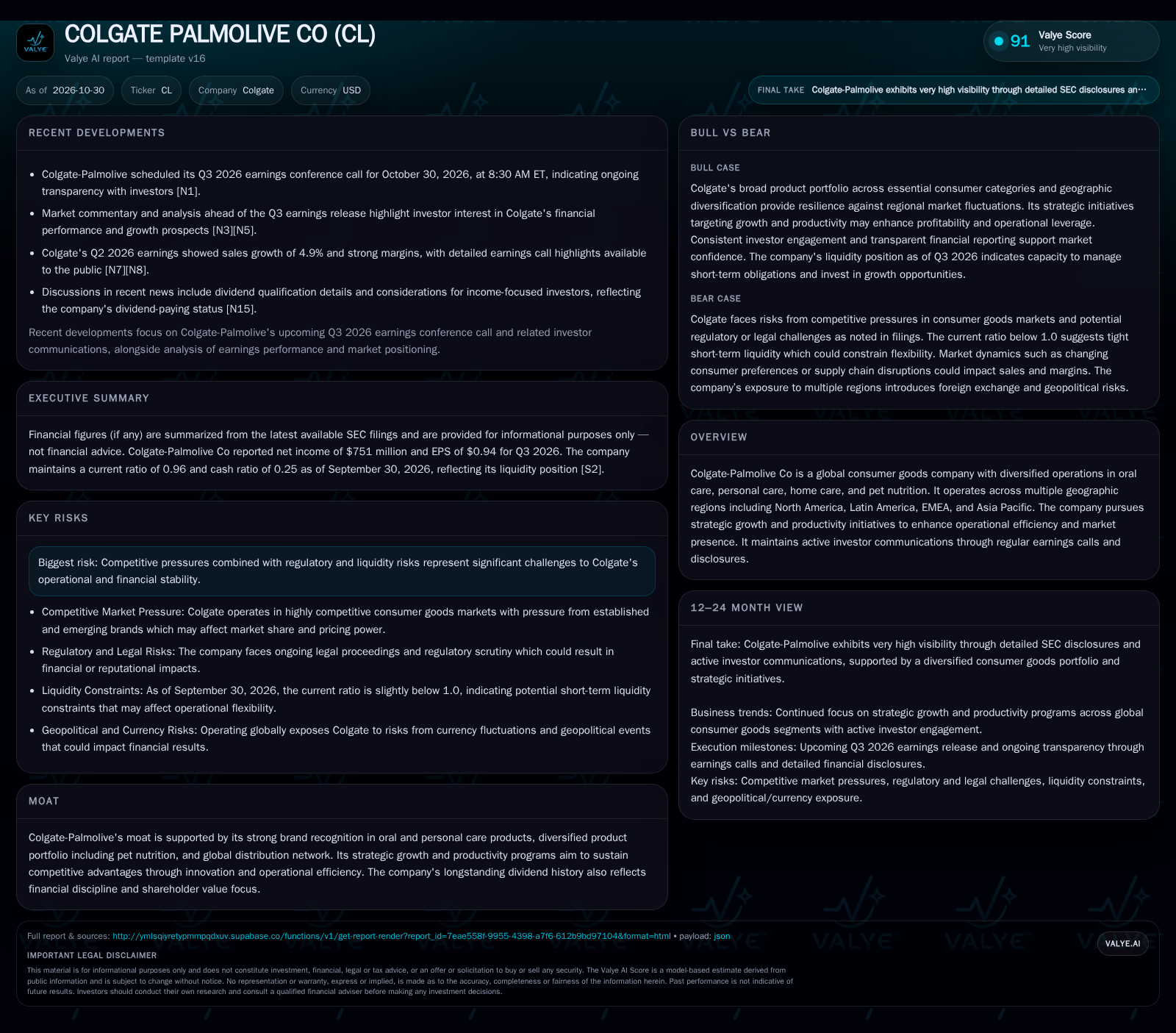
Colgate-Palmolive reported Q3 2026 net income of $751 million and EPS of $0.94, with a current ratio of 0.96 and cash ratio of 0.25. The core question is whether Colgate can sustain operational leverage and pricing power in an environment of shifting consumer preferences and margin pressure.
Colgate-Palmolive’s 2026 performance underscores both the strengths and vulnerabilities of global consumer goods giants. With entrenched brands across oral care, personal care, home care, and pet nutrition, Colgate continues to deliver steady profit growth and communicate actively with investors. The company’s ability to translate brand equity and global scale into sustainable margin expansion will be tested as competitive, regulatory, and consumer dynamics evolve.
Recent Financial Results and What They Reveal About Colgate’s Position
Colgate-Palmolive reported net income of $751 million for Q3 2026, translating to basic and diluted EPS of $0.94 [S2]. This result builds on Q2’s 4.9% sales growth and strong margin performance, underscoring the company’s ability to deliver earnings growth in a mature, slow-growth sector [N7] [N8]. The company reported cash and liquidity metrics for the period; these figures do not by themselves establish operating runway, investment capacity, financial flexibility, or financing capacity. [S2] The company continues to emphasize strategic growth and productivity initiatives, but must do so while managing competitive, regulatory, and liquidity risks.
How Colgate Generates Profits: Portfolio Breadth, Pricing, and Margin Leverage
Colgate-Palmolive’s business model is anchored in global scale, recurring demand for essential consumer goods, and a diversified product portfolio spanning oral care, personal care, home care, and pet nutrition [S2]. Historically, oral care—especially toothpaste—delivers the highest margins due to brand power and relatively low price sensitivity. The company’s ability to command shelf space and premium positioning in both developed and emerging markets supports stable pricing, though increasing private label and digital-native competitors threaten this dynamic.
Colgate’s reported sales growth and margin strength in 2026 suggest continued success in passing through price increases or optimizing product mix [N7] [N8]. However, the report does not specify whether growth is driven by price, volume, or mix—leaving open the question of underlying elasticity and future sustainability. Fixed costs in manufacturing, distribution, and marketing create scope for operating leverage, but also amplify downside risk if volumes falter. Strategic growth and productivity initiatives may target cost efficiencies, supply chain optimization, and digital transformation, but require capital and management focus.
A deeper understanding of Colgate’s profit generation also hinges on the interplay between pricing power and consumer price elasticity across different markets. In mature economies, where consumer spending is relatively stable but growth is slow, the ability to implement price increases without significant volume loss is critical to margin expansion. Conversely, in emerging markets, volume growth tends to be more sensitive to price changes due to lower disposable incomes and higher price competition. Therefore, Colgate’s margin leverage depends on its capacity to tailor pricing strategies regionally and to innovate products that justify premium pricing, balancing affordability with perceived value. This nuanced pricing approach is essential to sustaining profitability amid diverse consumer behaviors and competitive landscapes.
Brand Moat and the Evolving Consumer Landscape: Defending Share in a Crowded Field
Colgate’s primary competitive advantage lies in its global brand equity, particularly in oral and personal care, and its extensive distribution reach. These factors create barriers to entry, but category incumbents face relentless pressure from both multinational peers and agile local challengers. In oral care, premiumization and innovation (e.g., whitening, sensitivity, natural ingredients) allow for price segmentation, but also invite fast-follower competition and erode loyalty if consumer trends shift.
Pet nutrition (Hill’s) provides diversification and exposure to a premium, faster-growing segment, but also faces competition from both legacy pet food giants and specialty/natural upstarts. Home and personal care offerings compete in lower-margin, commoditized categories where cost and shelf presence are paramount. Regulatory and legal risks—cited in Colgate’s filings—can disrupt operations or reputations, especially as consumer product safety and environmental scrutiny intensify [S1] [S2]. The company’s ability to defend share and margins will depend on sustained innovation, marketing investment, and agility in responding to shifting consumer preferences and retail channels.
The evolving consumer landscape also introduces complexity in channel dynamics that affect Colgate’s competitive position. The rise of e-commerce and direct-to-consumer platforms shifts the traditional retail power balance, potentially reducing the influence of established shelf presence. This transition requires Colgate to invest in digital marketing, data analytics, and supply chain agility to maintain brand visibility and consumer engagement online. Additionally, the proliferation of niche and natural brands appeals to increasingly health- and environmentally-conscious consumers, challenging Colgate to innovate not only in product formulation but also in transparent sourcing and sustainability practices. The company’s ability to integrate these dimensions into its brand narrative and operational model will influence its resilience against both global and local competitors.
Margin Expansion and Emerging Market Growth Could Outpace Expectations
If Colgate successfully executes on its strategic growth and productivity programs, it could achieve outsized operating leverage and margin expansion. This scenario would require a combination of effective price increases, premium product innovation, and supply chain efficiencies, particularly in emerging markets where volume growth is more robust. Stronger-than-expected demand in pet nutrition or successful entry into new adjacencies (such as digital health or eco-friendly products) could further accelerate top-line and margin growth.
Evidence that would confirm this scenario includes sustained mid-single-digit or higher sales growth with rising operating margins, positive volume growth in core categories, and disclosure of successful cost-reduction initiatives. Additional signals could include increased market share in emerging markets and new product launches gaining traction. Conversely, if reported growth proves to be predominantly price-driven with volume stagnation or if productivity gains fail to materialize, this scenario would be less credible.
Operational efficiencies underpinning margin expansion could be amplified through advanced supply chain digitization and automation. By leveraging data-driven forecasting and inventory management, Colgate can reduce waste, optimize logistics, and respond swiftly to market fluctuations, thereby lowering fixed and variable costs. In emerging markets, scalable manufacturing and localized sourcing may further enhance cost competitiveness while supporting faster product iteration aligned with local preferences. Moreover, strategic partnerships or collaborations in innovation ecosystems could accelerate product development cycles, enabling Colgate to capture premium segments more effectively. These operational enhancements, combined with successful premiumization and market penetration, create a reinforcing cycle that could drive sustainable margin growth beyond traditional levers.
Resilient Earnings but Margin Pressures Persist in a Mature Consumer Goods Landscape
The most plausible trajectory is for Colgate to maintain modest revenue growth and defend margins through incremental price/mix optimization, ongoing cost management, and selective innovation. The company’s entrenched brands and broad reach should provide some insulation from volume declines even as competition intensifies and consumer preferences shift.
Confirmation of this scenario would come from continued earnings stability, steady (but not accelerating) top-line growth, and margin profiles consistent with historical norms. Early warning signs would include a sustained deterioration in volumes, margin compression from promotional pressure, or rising SG&A and legal costs that offset productivity gains.
Margin Compression and Liquidity Strain: Risks of Competitive and Regulatory Shocks
Colgate’s primary vulnerabilities lie in its sub-1.0 current ratio and exposure to adverse competitive or regulatory events. In a downside scenario, aggressive discounting by competitors, acceleration of private label share, or a failure to respond to changing consumer tastes could erode both volume and pricing power.
This scenario would be confirmed by declining sales volumes, margin contraction despite price increases, or disclosures of significant legal/regulatory charges.
What Will Determine Colgate’s Trajectory in 2027 and Beyond?
The breakdown of sales growth by price, volume, and mix—if disclosed—would clarify whether margin expansion is sustainable or masking volume declines.
Trends in operating margin and SG&A as a percentage of revenue would help test the effectiveness of ongoing productivity programs.
Market share movement in oral care and pet nutrition across key regions would reveal Colgate’s ability to defend core franchises.
Evidence of successful premium product launches or new category entries would support the company’s innovation thesis.
Legal and regulatory disclosures, including the magnitude and frequency of new proceedings or settlements, would inform risk assessment.
Updates on cost inflation, supply chain resilience, or raw material sourcing would help gauge the impact of external shocks.
If disclosed, digital and direct-to-consumer channel growth rates would show Colgate’s adaptation to changing retail landscapes.
Disclaimer: This is research-only, informational analysis and not investment advice. It may include AI-generated interpretation and general industry context. Always verify important details using primary sources.

Comments