
ARB IOT Group: Leadership Transition, AI Data Center Bets, and the Economics of Scaling Technology Solutions
ARB IOT Group’s push into AI-driven data center solutions and IoT technologies is matched by ambitious contract wins and a deep leadership bench, but persistent net losses and currency risk complicate the path to sustainable profitability. The real test is whether new management can convert technical capabilities and liquidity into defensible margins and operational leverage.
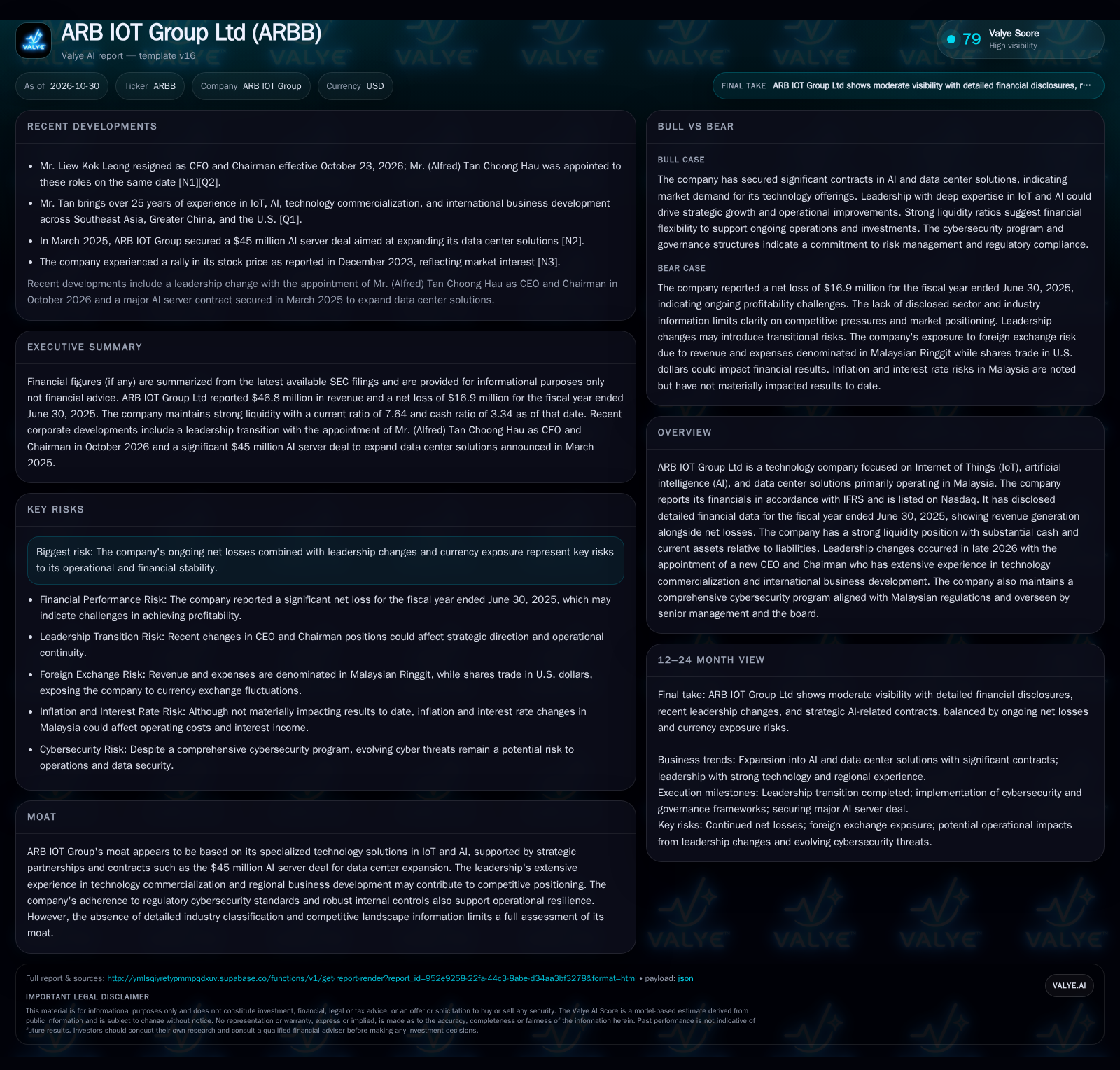
ARB IOT Group Ltd has reported substantial revenue growth, a major AI server contract, and a recent CEO transition, but remains unprofitable as of June 2025. The next phase depends on execution under experienced new leadership and the ability to translate technology investments into recurring, higher-margin business.
ARB IOT Group Ltd stands at a strategic crossroads, combining a recent leadership overhaul with significant contract wins in AI and data center solutions. Despite generating nearly $47 million in revenue for the year ended June 2025, the company remains in the red, posting a net loss of $16.9 million. The appointment of a seasoned CEO with deep regional and technical experience may be pivotal as ARB IOT Group seeks to transform its business model from project-driven revenues to a more sustainable, margin-rich foundation.
Recent Financials, Contract Wins, and Leadership Change Reshape the Company’s Outlook
As of June 30, 2025, ARB IOT Group reported revenue of approximately $46.8 million USD and a net loss of $16.9 million USD, underscoring the tension between top-line growth and persistent operating losses [S1]. The company reported cash and liquidity metrics for the period; these figures do not by themselves establish operating runway, investment capacity, financial flexibility, or financing capacity. [S1] In March 2025, ARB IOT Group announced a $45 million AI server agreement to expand its data center offerings, suggesting momentum in high-value contracts within the AI and IoT service domains. Leadership transitioned in October 2026, with Mr. (Alfred) Tan Choong Hau, a veteran in IoT and technology commercialization, taking the helm as CEO and Chairman. These developments collectively set the stage for a phase of strategic recalibration and operational execution.
How ARB IOT Group’s Technology Solutions Could (and Might Not) Generate Profitable Scale
ARB IOT Group’s core offerings—IoT systems, AI-driven solutions, and data center expansion—point to a business model that blends hardware integration, software enablement, and managed services. The large AI server contract implies a project-based revenue structure, which can generate lumpy but substantial top-line contributions, especially in the build-out phase. However, the company’s ongoing net losses suggest that either gross margins are thin, operating expenses are high relative to revenue, or both. If the company is primarily implementing bespoke solutions or acting as a systems integrator, margins may be pressured by high customization and labor costs.
For ARB IOT Group to achieve sustainable profitability, it will likely need to shift toward recurring revenue streams—such as managed services, software subscriptions, or ongoing data center operations contracts—that offer higher margins and better visibility. Operating leverage may materialize if the company can standardize its solutions and expand its customer base without proportional increases in operating costs. Conversely, persistent reliance on large, one-off contracts could leave cash flows volatile and margins structurally constrained.
Navigating Regional and Sectoral Competition in IoT and AI Integration
ARB IOT Group operates within a highly competitive landscape, where global and regional players vie for share in IoT, AI, and data center solutions. The company’s specialization in regulated Malaysian markets may provide some insulation against international competitors, but the lack of disclosed sector specifics obscures the depth of its differentiation. Its moat appears to rest on technical expertise, strategic contracts, and compliance with local cybersecurity regulations, which may deter less established entrants.
However, larger technology integrators, regional telcos, and specialized cloud/data center providers represent credible substitutes—often with greater scale, more standardized offerings, and deeper customer relationships. If ARB IOT Group can leverage its leadership’s regional networks and move up the value chain toward proprietary platforms or managed services, it could carve out a defensible niche. Otherwise, the risk remains that commoditization and price competition will erode margins, especially as AI and IoT integration becomes more standardized.
What Success Looks Like: Recurring Revenue, Margin Expansion, and Regional Scale
The most favorable scenario for ARB IOT Group is one in which the $45 million AI server deal acts as a springboard for further data center and AI-driven managed services contracts—moving the business from episodic project revenues to a base of recurring, higher-margin income. Under the new CEO, the company could leverage its technical and regional expertise to standardize its offerings, build out a suite of managed IoT/AI services, and deepen relationships with enterprise and government clients.
Confirmation of this scenario would include a visible ramp in recurring revenue as a share of total sales, improving gross and operating margins, and evidence of contract renewals or multi-year service agreements. Additional large-scale wins in data center operations or cross-border expansion would further validate the thesis. Falsification would occur if the company remains dependent on lumpy one-off deals, fails to control costs, or is unable to grow its managed-services footprint.
Likely Trajectory: Gradual Improvement, Cost Discipline, and Operational Execution under New Leadership
The most plausible medium-term outcome is that ARB IOT Group continues to secure project-based contracts in AI and IoT, with incremental improvements in operational efficiency but no immediate breakthrough to profitability. The new CEO’s background in technology commercialization may bring sharper focus to cost management and business development, but the transition period could be marked by execution risks and the need to rebuild momentum.
Key confirming evidence would include a reduction in net losses relative to revenue growth, stable or improving liquidity despite ongoing investments, and early signs of repeat business or pilot managed services. Falsification would be seen if losses widen, liquidity erodes, or leadership turnover disrupts customer relationships or operational continuity.
Persistent Losses, Margin Compression, and Execution Risk in a Competitive Market
In the adverse scenario, ARB IOT Group’s project-based revenue model remains dominant, but margin pressures intensify as larger competitors enter or expand in the Malaysian and regional AI/IoT space. If the company cannot transition to more standardized, recurring services, operating losses could persist or worsen, depleting liquidity and undermining investment capacity. Currency volatility, inflation, or interest-rate shocks in Malaysia could further erode reported results for U.S.-dollar investors.
This downside would be confirmed by continued or accelerating net losses, declining cash balances, and the absence of new multi-year or recurring contracts. Additional risks include failed project delivery, regulatory challenges, or customer attrition during the leadership transition.
Milestones and Metrics That Will Reveal If ARB IOT Group’s Strategy Is Working
Progression in the mix of recurring revenue versus project-based revenue—if disclosed—would clarify whether ARB IOT Group is moving toward a more sustainable business model.
Gross and operating margin trends, especially following the AI server contract, would help test whether scale and product mix are improving profitability.
The pace and quality of contract wins, including size, duration, and customer type (e.g., enterprise, government), would indicate market traction and sales execution.
Cash flow from operations, as distinct from headline liquidity, would test whether the business is generating or consuming cash on a sustainable basis.
Impact of currency fluctuations on reported results, particularly given the RM/USD exposure, should be monitored for volatility or translation effects.
Leadership stability and strategic clarity under the new CEO, as reflected in organizational updates or public communications, would help assess execution risk.
Any disclosure of customer renewal rates, churn, or satisfaction scores would offer insight into ARB IOT Group’s ability to retain and expand its client base.
Changes in regulatory or cybersecurity standards in Malaysia, and the company’s response, could affect operational continuity and compliance costs.
Disclaimer: This is research-only, informational analysis and not investment advice. It may include AI-generated interpretation and general industry context. Always verify important details using primary sources.

Comments