
Arbor Realty Trust: Structured Finance Scale, Agency Platform, and the Stakes of Credit Quality in a Volatile Market
With a $12.1B structured loan book and a $36.2B servicing portfolio, Arbor Realty Trust’s dual-segment model provides diversified income but faces mounting pressure from negative earnings, interest rate volatility, and credit risk. The company’s ability to recycle bridge loans into agency executions and manage geographic and asset concentration will be pivotal for future performance.
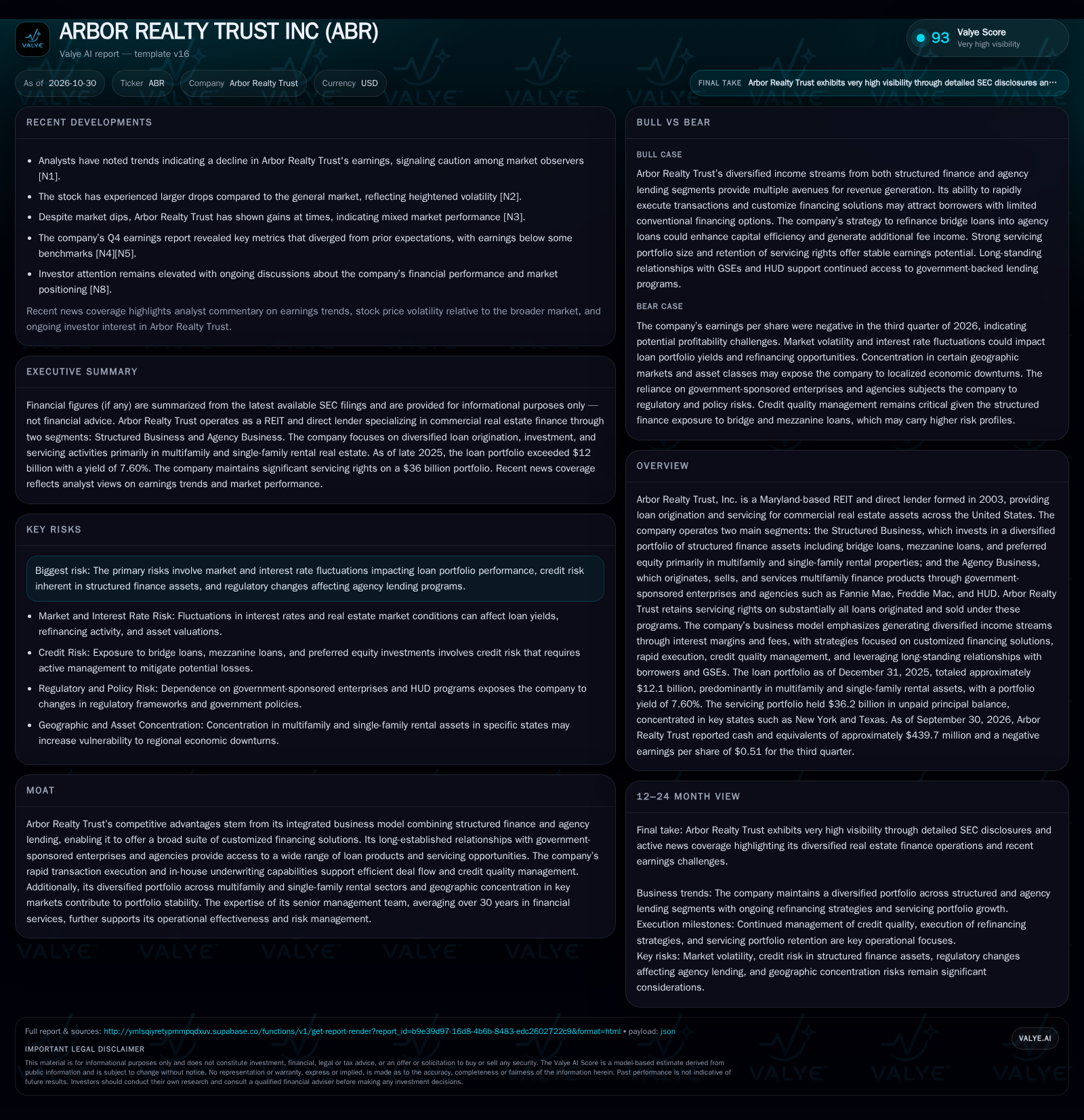
Arbor Realty Trust operates as a nationwide REIT and direct lender focused on multifamily and single-family rental real estate. Its dual-segment model—combining structured finance with agency lending and servicing—yields diversified income streams, but recent negative earnings and heightened market volatility raise questions about sustainability. The core thesis hinges on capitalizing on refinancing flows and maintaining credit quality amid interest rate headwinds and regional risk exposures. Watch for shifts in loan performance, servicing retention, and the balance between structured and agency executions to test the durability of Arbor’s earnings power. [S1] [S2] [N1] [N2]
Arbor Realty Trust stands at a crossroad: its $12.1 billion structured finance portfolio and $36.2 billion agency servicing platform together create a business model that is both diversified and exposed to the cycles and shocks of U.S. commercial real estate. While the company’s ability to originate, recycle, and service multifamily and single-family rental loans at scale is a structural strength, recent negative earnings and margin compression signal intensifying headwinds. The next phase for Arbor will hinge on its ability to manage credit risk, preserve servicing economics, and adapt to shifting interest rate and real estate market dynamics.
Recent Financials Highlight Margin Pressure and Profitability Concerns
As of December 31, 2025, Arbor Realty Trust reported a $12.1 billion structured loan and investment portfolio, with 73% exposure to multifamily and 26% to single-family rental assets, primarily in Texas, Florida, and Arizona. The company’s agency business originated $5.07 billion in loans during 2025 and retained servicing rights on a $36.2 billion unpaid principal balance. Overall portfolio yield was 7.60% versus a 6.94% cost of funds, leaving a relatively thin net interest margin. Most notably, Arbor reported a negative earnings per share of -$0.51 for Q3 2026 and held $439.7 million in cash and equivalents as of September 30, 2026. Analyst commentary and news coverage underscore earnings declines and heightened stock volatility compared to the broader market, raising questions about the sustainability of Arbor’s business model under current conditions. [S1] [S2] [N1] [N2] [N4] [N5]
How Arbor’s Dual-Segment Model Drives—and Constrains—Earnings
Arbor Realty Trust’s economics are built on two pillars: the Structured Business, which generates interest income from bridge, mezzanine, and preferred equity loans, and the Agency Business, which produces origination and servicing fees from GSE and HUD-backed lending. The structured portfolio’s relatively high yield (7.60% in 2025) reflects the risk premium from non-permanent and transitional loans, but this benefit is partially offset by a rising cost of funds (6.94%), compressing net interest margins. The agency segment’s economics hinge on origination volume, sales margins (138 basis points in 2025), and the annuity-like revenue from servicing rights on loans that are off Arbor’s balance sheet.
The company’s strategy of refinancing balance sheet bridge loans into agency executions is intended to recycle capital, reduce risk-weighted assets, and generate incremental fee income. This model, if executed well, can create operating leverage, as servicing portfolio growth and recurring fee streams scale without proportional increases in fixed costs. However, negative EPS in Q3 2026 highlights the risk that credit losses, lower origination volumes, or margin compression can quickly erode profitability. The capital intensity of structured lending, coupled with exposure to mark-to-market risk and potential borrower distress, makes funding access and credit discipline critical. Arbor’s ability to balance loan growth, credit quality, and cost of capital will determine whether its business model delivers sustainable returns or succumbs to cyclical pressure. [S1] [S2]
Integrated Lending and Servicing: Strengths, Substitutes, and Regional Exposure
Arbor’s main competitive edge lies in its integrated platform: it can originate, hold, sell, and service a wide array of multifamily and single-family rental loans, offering borrowers flexible, customized solutions and maintaining long-standing relationships with GSEs. This positions Arbor as a one-stop shop for sponsors needing bridge-to-agency execution, which can be especially valuable in times of market dislocation when conventional credit tightens.
However, the company operates in a fiercely competitive landscape. Other direct lenders, non-bank real estate finance companies, and bank-affiliated REITs also target multifamily and SFR lending. GSEs themselves, through their approved lender networks, set underwriting standards and pricing that can affect margins. Substitution risk exists from alternative capital sources, such as private credit funds or insurance companies, which may offer more aggressive terms in frothy markets or pull back in downturns. Geographic concentration in states like Texas and Florida creates sensitivity to local economic cycles, property values, and regulatory shifts. Arbor’s ability to manage these exposures and maintain its servicing relationships will be essential to defend its market position.
If Credit Quality Holds and Refinancing Flows Accelerate, Fee and Servicing Income Could Rebound
The most favorable outcome for Arbor hinges on a combination of stable or improving credit performance within its structured loan book and a resumption of strong agency origination and refinancing activity. If commercial real estate fundamentals in key markets remain resilient—driven by population growth, housing demand, and rental rate stability—Arbor could see lower-than-feared credit losses and an increase in borrowers seeking to refinance bridge loans into agency executions.
In this scenario, the company would benefit from both interest income on held loans and fee/servicing income from agency sales, with operating leverage from a growing servicing portfolio. Confirmation would come from a return to positive earnings per share, expanding servicing balances, and improving net interest margins. Lower delinquency and non-accrual rates, if disclosed, would further validate the upside case. A reversal in interest rate trends could also facilitate refinancing flows and relieve margin pressure.
Navigating Margin Compression and Credit Headwinds in a Mixed Market Environment
The most plausible outlook is one of managed turbulence: Arbor continues to originate and refinance loans but at lower volumes and tighter margins, while credit losses remain elevated but not catastrophic. The company’s servicing portfolio provides a steady income floor, but negative earnings could persist or only gradually recover as interest rate volatility, property value uncertainty, and borrower distress weigh on results.
In this middle path, Arbor’s diversified platform enables it to weather bouts of market stress better than more concentrated peers, but the company is unable to fully offset pressure from rising funding costs and sporadic credit events. Confirmation would include stabilization in net interest margins, muted changes in servicing balances, and modest improvement in quarterly EPS, even if profitability remains below prior peaks. Falsification would be a sharp spike in loan losses or a sustained drop in origination and servicing activity.
Rising Credit Losses and Market Dislocation Could Imperil Core Earnings Streams
The adverse scenario materializes if credit quality in Arbor’s structured loan book erodes more rapidly than anticipated—driven by declining real estate valuations, borrower defaults, or regional economic shocks—while agency origination volumes stall amid market illiquidity or regulatory tightening. In this environment, Arbor could experience a spike in non-performing loans, write-downs, and servicing runoff, leading to persistent negative earnings and potential pressure on liquidity.
Further downside would be signaled by increasing non-accrual rates, declining servicing balances, and a sharp deterioration in net interest margins. News of regulatory or GSE policy changes that limit agency execution would compound risk. Confirmation of this scenario would be a string of quarters with deepening losses, forced asset sales, or a need to raise dilutive capital to shore up the balance sheet.
Benchmarks to Test Arbor’s Credit Resilience and Platform Scalability
Quarterly trends in net interest margin versus cost of funds—widening or narrowing margins will signal pressure or relief on core lending economics.
Movement in non-performing loan and delinquency rates, if disclosed, as a direct test of credit quality within the structured loan portfolio.
Origination volume and sales margin in the agency business—shifts here will reveal the strength of refinancing flows and fee income resilience.
Servicing portfolio balance and composition—growth or contraction, as well as concentration by geography and asset type, will indicate the durability of annuity-like revenues.
Quarterly earnings per share and the degree of improvement or deterioration, particularly following periods of negative EPS.
Geographic and asset class mix within the loan and servicing books, as changes may amplify or mitigate concentration risk.
External signals such as changes in GSE underwriting standards or regulatory policy that could affect Arbor’s agency execution capacity.
Disclaimer: This is research-only, informational analysis and not investment advice. It may include AI-generated interpretation and general industry context. Always verify important details using primary sources.

Comments