
Cohen & Steers: Asset Management Resilience Through Consistent Earnings and Clear Reporting
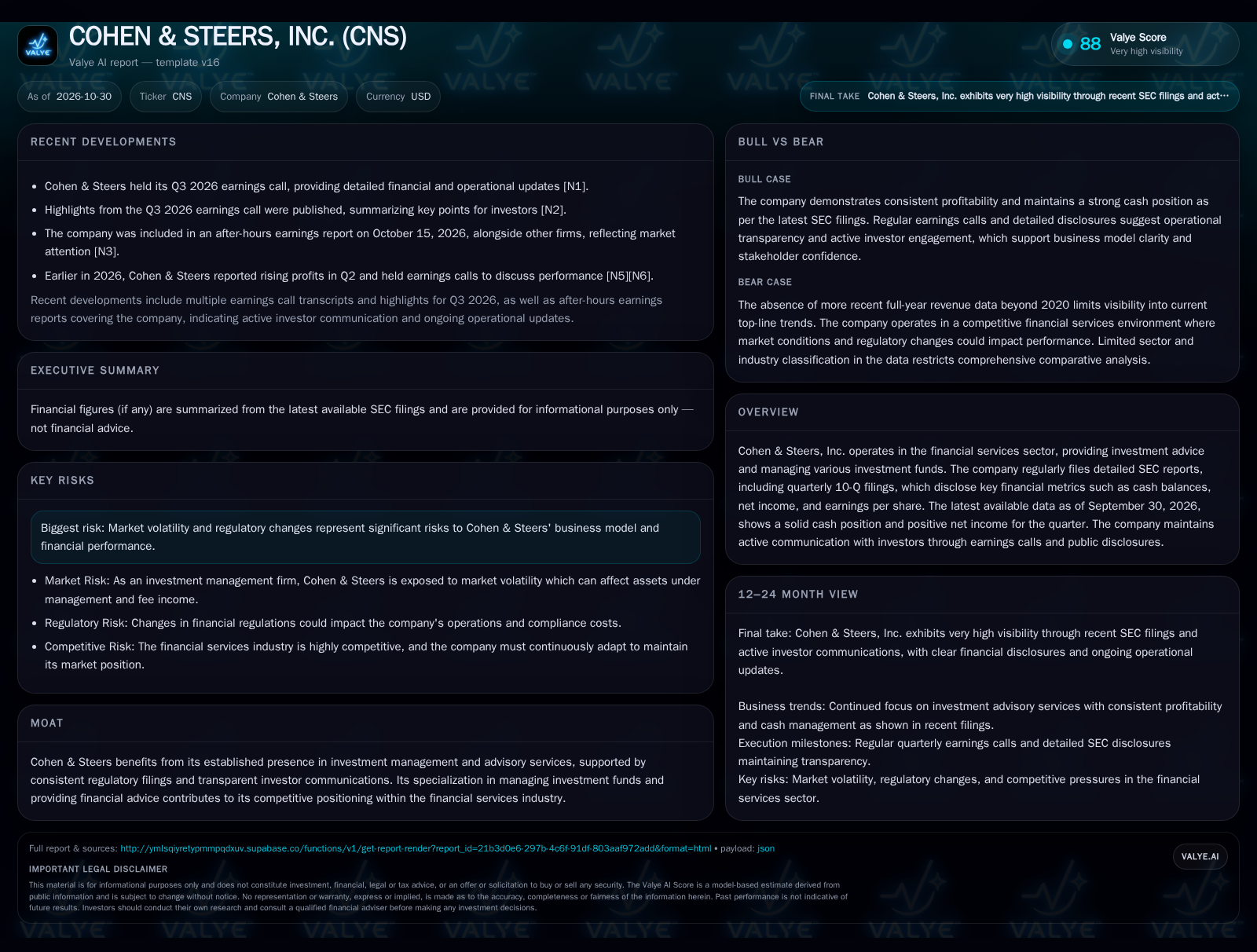
Cohen & Steers, Inc. maintains consistent quarterly profits and a reported cash position as of Q3 2026, underpinned by robust investor communications and regulatory filings. However, the lack of recent top-line disclosure and the competitive, fee-sensitive nature of asset management leave open questions about growth drivers and margin durability.
Cohen & Steers reported Q3 2026 net income of $42.2 million and cash of $66.1 million, demonstrating operational profitability and financial stability. The firm’s regular earnings calls and SEC filings highlight transparency, but limited recent revenue data clouds visibility into current business momentum and fee-growth dynamics in a highly competitive sector. Market volatility and regulatory changes remain key risks for this investment advisor [S2] [N1] [N2].
Cohen & Steers, Inc. stands out in the asset management landscape for its consistent quarterly profitability and reported cash position, as evidenced by its Q3 2026 results. The firm’s transparent disclosure practices and regular earnings communications reinforce stakeholder trust, yet the absence of recent annual revenue data and the inherent cyclicality of financial markets keep the underlying growth story opaque. For investors, the central question is whether Cohen & Steers’ operational discipline and established reputation can sustain margin resilience and client retention in an evolving, competitive environment where fee compression, market volatility, and regulatory shifts loom large.
Earnings Stability and reported cash position Evident in Latest Financials
Cohen & Steers reported net income of $42.2 million for Q3 2026, with diluted earnings per share of $0.81 and cash and cash equivalents totaling $66.1 million as of September 30, 2026 [S2]. The company reported cash and liquidity metrics for the period; these figures do not by themselves establish operating runway, investment capacity, financial flexibility, or financing capacity. The company’s regular earnings calls and detailed SEC filings, as evidenced by recent coverage on major financial news platforms, further support its reputation for operational transparency and investor engagement [N1] [N2] [N3] [N5] [N6]. However, the most recent full-year revenue figure available is from 2020 ($116.5 million), meaning there is limited visibility into how the top line has evolved in the intervening years [S1]. This lack of updated revenue data restricts a full assessment of current growth drivers and business momentum.
Mechanics Behind Converting Assets Under Management into Profits
Cohen & Steers generates revenue primarily through investment advisory fees, which are typically calculated as a percentage of assets under management (AUM). This model creates an inherently variable top line tied to both asset flows (client inflows/outflows) and the valuation of underlying portfolios. Fee rates in the asset management industry have experienced downward pressure in recent years due to increased competition and the proliferation of passive investment vehicles, suggesting that Cohen & Steers’ ability to maintain or grow earnings will depend on a combination of sustained AUM growth, product mix, and operational efficiency.
The company’s cost structure is characterized by a mix of fixed costs (such as compensation, regulatory, and technology expenses) and variable costs linked to performance fees and asset-based expense ratios. Operating leverage can materialize when AUM and revenues grow faster than fixed costs; however, the reverse is also true during periods of asset outflows or market declines. [S2]
Competitive Edge Rooted in Specialization, Brand Strength, and Scale Despite Fee Pressure
Within the asset management sector, Cohen & Steers’ competitive position hinges on its brand reputation, specialized expertise (potentially in real assets, REITs, or other niche strategies), and the trust it has built with institutional and retail clients. These attributes can create switching frictions, particularly for clients seeking active management versus low-cost passive alternatives. However, industry-wide trends—such as the migration of capital to index funds and ETFs, increasing regulatory scrutiny, and the emergence of digital-first investment platforms—are intensifying fee competition and raising client expectations for transparency and performance.
Larger asset managers benefit from scale economies in distribution, technology, and compliance, which may pressure mid-sized firms like Cohen & Steers to differentiate through performance, client service, or unique investment offerings. The company’s regular, detailed disclosures and investor communications suggest a proactive approach to maintaining client trust. Still, the durability of its competitive moat will depend on its ability to retain and grow client assets while defending fee rates and delivering consistent returns in a market increasingly characterized by commoditization and price sensitivity.
Asset Growth Potential Linked to Market Stability and Product Innovation
In a favorable scenario, Cohen & Steers could leverage its established brand and specialized investment expertise to attract net inflows and capitalize on market appreciation, driving AUM growth and higher advisory fee revenues. If the firm successfully launches differentiated products or gains mandates from institutional investors, it may sustain or even expand its fee rates despite industry-wide compression.
Evidence that would confirm this scenario includes a reported increase in AUM, new fund launches or institutional mandates, and rising fee revenue in future disclosures. Announcements of above-peer inflows, expansion into new asset classes, or strategic partnerships would also support the bull case. Conversely, persistent or accelerating fee compression, declining AUM, or flatlining revenue would falsify the upside thesis.
Maintaining Profit Margins Amid Sector Challenges and Moderate Net Inflows
The most plausible case is that Cohen & Steers continues to deliver stable profitability, supported by its core client base and established investment strategies, but faces ongoing headwinds from fee pressure and volatile markets. Margins may remain intact if the firm manages costs tightly and retains existing mandates, but top-line growth is likely to be modest unless there is a significant market rally or a step-change in net inflows.
Confirmation of this scenario would come from quarterly earnings that show steady net income and EPS, stable or slightly fluctuating AUM, and operating expenses that do not outpace revenue growth. If disclosed, details on client retention rates, average fee rates, and product mix would help validate the sustainability of the current profitability profile. A significant deviation in these metrics—such as a sharp drop in AUM or a spike in expenses—would challenge the base case.
Earnings Vulnerability from Market Fluctuations and Fee Reductions
Adverse conditions—such as a broad market downturn, accelerated client outflows, or intensifying fee competition—could result in declining AUM and revenues for Cohen & Steers. In this scenario, the company’s fixed cost base would magnify the impact on earnings, potentially leading to lower profitability, margin contraction, or even net losses if asset declines are severe or persistent.
This scenario would be confirmed by disclosures of significant AUM declines, negative net flows, reduced fee rates, or a sharp drop in net income and EPS. Announcements of client mandate losses, product closures, or restructuring efforts would further support the downside case. The absence of new product launches or innovation, combined with rising regulatory costs, would also be red flags for the company’s future earnings power.
Events and Developments That May Alter Cohen & Steers’ Outlook
Quarterly updates on assets under management (AUM)—if disclosed—would provide direct insight into client flows and market impact.
Trends in average advisory fee rates and product mix, as these determine revenue sensitivity to AUM changes.
Client retention and mandate win/loss rates, which would clarify competitive dynamics and switching frictions.
Operating expense discipline and investments in technology or distribution, signaling cost control or growth initiatives.
New product launches, fund registrations, or expansion into adjacent asset classes that could diversify revenue streams.
Evidence of regulatory changes affecting compliance costs or product offerings.
Announcements of strategic partnerships, acquisitions, or distribution agreements that might impact scale or capabilities.
Disclosure of performance versus benchmark for flagship strategies, as investment returns remain a core driver of client loyalty and AUM growth.
Disclaimer: This is research-only, informational analysis and not investment advice. It may include AI-generated interpretation and general industry context. Always verify important details using primary sources.

Comments