
Avalanche Treasury Corp Faces Capital and Token Restriction Headwinds in Emerging Digital Asset Sector
Avalanche Treasury Corp’s latest quarterly filing reveals nascent staking revenue generation amidst significant liquidity challenges and multi-year token restrictions that shape its growth trajectory and operational risks.
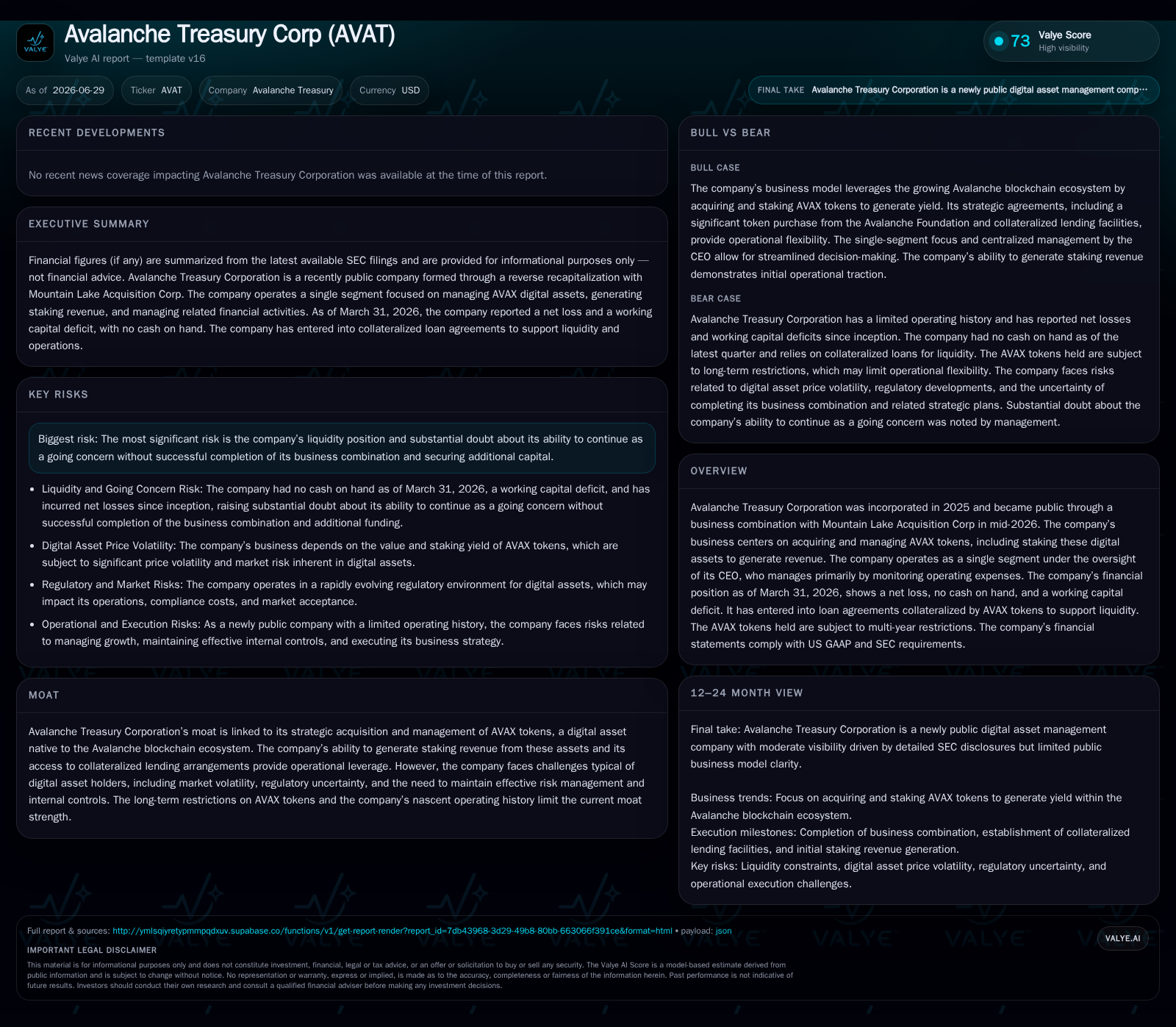
Avalanche Treasury Corporation (AVAT), newly public via a mid-2026 business combination, reported initial staking revenue of $2.06 million net of fees in Q1 2026 but simultaneously disclosed substantial net losses and a working capital deficit indicating liquidity strain. The company’s core business revolves around strategic acquisition and staking of AVAX tokens, yet these digital assets are subject to multi-year lock-ups constraining flexibility. To manage liquidity, AVAT has engaged in collateralized lending secured by its AVAX holdings, underscoring reliance on volatile asset prices and counterparty arrangements. While the staking revenue points to operational potential aligned with industry models, the nascent scale, persistent losses, and regulatory uncertainties present ongoing financial and execution risks. The near-term outlook hinges on successful capital raises, management of token restrictions, and growth in blockchain adoption driving demand for native staking opportunities.
Quarterly Update Unpacks Early Staking Revenue Against Pressing Liquidity Constraints
Avalanche Treasury Corporation’s first substantive quarterly filing following its June 11, 2026 business combination highlights an operation at the crossroads of nascent yield generation and acute liquidity pressure. For Q1 ended March 31, 2026, AVAT recorded staking revenue net of fees totaling approximately $2.06 million [S2]. This metric signals early traction in its core thesis: monetizing Avalanche’s native AVAX cryptocurrency through strategic deployment in staking protocols designed to generate consistent yield.
However, this revenue coexists with a stark net loss of roughly $26.78 million over the same period [S2], underlining elevated operating costs typical in early-stage digital asset treasury firms before scale benefits materialize. Most concerning from a liquidity standpoint is the cash balance hovering around $1.22 million accompanied by a negative net working capital position near $9.06 million [S2], [F1]. This working capital deficit effectively marks immediate cash burn pressures surpassing liquid resources, demanding urgent capital solutions.
These figures exemplify the classic challenge for crypto treasury operators: converting digital asset holdings into sustainable operating cash flows amid volatile markets and high upfront expenses such as legal compliance and custody fees. The tension between burgeoning staking income streams versus negative earnings frames AVAT’s fragile financial footing entering public markets.
Token Restriction Durations Alter Avalanche Treasury's Operational Flexibility Landscape
A critical structural dynamic disclosed is the presence of multi-year restrictions on much of AVAT’s AVAX holdings [S2]. Such lock-ups are common in digital asset treasury setups where tokens acquired through private sales or founder allocations come with vesting or trading limits embedded either contractually or via network governance mechanisms.
These token restrictions severely constrain Avalanche Treasury’s ability to monetize assets outside of earn-through-staking avenues until restrictions lapse. This limits tactical options like market sales or collateral expansions during periods of tightening liquidity or market downturns. From an operational strategy perspective, the company must reconcile pursuing staking yields on locked tokens—a relatively passive revenue path—with anticipating future liquidity access tied to unlocking schedules.
The influence of these restrictions reflects wider sector norms where treasury managers’ profiles are shaped not just by how many tokens they hold but significantly by when those tokens become liquid or deployable for other corporate actions. It amplifies both counterparty risk (in lending structures) and governance complexity.
Collateralized Lending Underscores Liquidity Strategy But Raises Risk Considerations
In response to capital constraints imposed partly by token lock-ups, Avalanche Treasury has entered collateralized lending arrangements secured by pledged AVAX tokens [S2], [S16]. Notably, it executed a $25 million open loan facility bearing an annual fee near 7%, under which approximately 5.6 million AVAX serve as collateral held securely by Anchorage Digital Bank.
This approach aligns with emerging best practices among crypto treasury managers leveraging tokens as collateral to enhance liquidity without forced spot market sales that may depress prices [S16]. Yet it introduces new layers of exposure: if AVAX prices fall below defined margin call thresholds (notably 180% collateral ratio limit), the lender can demand additional collateral or declare defaults at lower ratios (160%)
Such facilities increase financial flexibility but also embed volatility risk inherent to the underlying crypto assets—a stark contrast from traditional fixed-asset-backed lending models. Prudent risk management here is critical; the company's ability to maintain collateral ratios will be tested amid fluctuating AVAX valuations.
Comparative Industry Context Places AVAT Among Crypto Asset Managers With Nascent Scale
Within the broader digital asset treasury management landscape populated by more mature firms like Coinbase Global—an established custodian offering integrated staking—and Galaxy Digital Holdings—a diversified crypto asset investment and lending player—Avalanche Treasury stands at an embryonic scale stage.
Its single-segment model focused almost exclusively on acquiring/staking a known blockchain ecosystem token (AVAX) contrasts with peers offering broader product suites spanning multiple cryptocurrencies or active investment strategies.
Liquidity weaknesses and ongoing net losses highlight its early development phase; unlike larger peers that can weather volatility via diversified portfolios or deeper balance sheets, AVAT's operational runway depends heavily on successful fundraising rounds tied closely to overcoming token restrictions impacting deployable assets.
This peer comparison underscores differentiation challenges in attracting institutional investors who favor entities demonstrating proven scaling capacity alongside sound risk frameworks in staking yield generation and collateralized financing.
Growth Catalysts Stem From Expanding Blockchain Adoption And Staking Demand Yet Face Hurdles
Industry-tailwinds boosting Avalanche Treasury’s prospects include rising institutional appetite for native blockchain exposures amid proliferating decentralized finance applications enhancing token utility. As real-world adoption expands across DeFi protocols built on Avalanche’s blockchain ecosystem, demand for staking—both as a governance mechanism and yield source—is expected to grow structurally.
AVAT's model leverages this macro trend by focusing capital deployment into staking pools generating recurring rewards net of fees—one of the few directly monetizable activities within fixed token lock-up periods.
Nonetheless, growth faces headwinds from market volatility impacting asset valuations and regulatory uncertainty concerning crypto custody policies that may complicate operational scalability or prompt cost escalations.
Key Risks Highlight Capital Raising Imperatives And Regulatory Ambiguity Threats
Foremost among risks is Avalanche Treasury's current precarious liquidity highlighted in filings illustrating substantial doubt about continuing operations absent new financing or consummation of awaiting business combination closure conditions involving shareholder approvals [S2], [S6]. Failure here could severely hinder executing growth plans or meeting obligations under loan agreements.
Regulatory ambiguity remains another significant challenge; evolving crypto asset regulations may impose additional compliance burdens or limit certain transactions crucial to business operations such as cross-border token transfers or staking delegation structures.
Additionally, recurring losses underscore the imperative for successful capital raises potentially dilutive to existing shareholders per recent equity issuance plans detailed around post-merger strategies [S3]. Managing dilution alongside operational scaling will be pivotal for maintaining stakeholder confidence.
"Watching the Road Ahead": Milestones And Execution Markers To Monitor
Key upcoming markers include announcements detailing progress on securing additional capital injections essential for improving cash buffers beyond currently stressed levels. Close attention should also focus on disclosures regarding unlock timing for restricted AVAX tranches enabling enhanced liquidity deployment capabilities beyond passive stake-holding positions.
Monitoring quarter-over-quarter growth trends in net staking revenue will help validate if yield generation can scale sustainably alongside operating expense controls—as this conversion efficiency largely determines longer-term viability.
Finally, observing progress in addressing regulatory risks through robust governance enhancements or clarifications will be critical given ongoing industry-wide scrutiny impacting digital asset custodian entities analogous to Avalanche Treasury’s role.
This analysis is based exclusively on publicly disclosed data from Avalanche Treasury Corporation's SEC filings as of June 29, 2026 ([S2], [S3], [S6]) coupled with sector insights into digital asset treasury management strategies and associated risks. It aims to provide an informed view of AVAT's operational positioning amid early-stage financial dynamics without making any investment research views.
Disclaimer: This is research-only, informational analysis and not investment advice. It may include AI-generated interpretation and general industry context. Always verify important details using primary sources.

Comments