
Franklin Ethereum Trust’s EZET ETF Advances Passive Ether Exposure with Low Fees and Institutional Custody
EZET operates as a regulated, passive Ethereum trust offering cost-effective crypto exposure via traditional brokerage accounts.
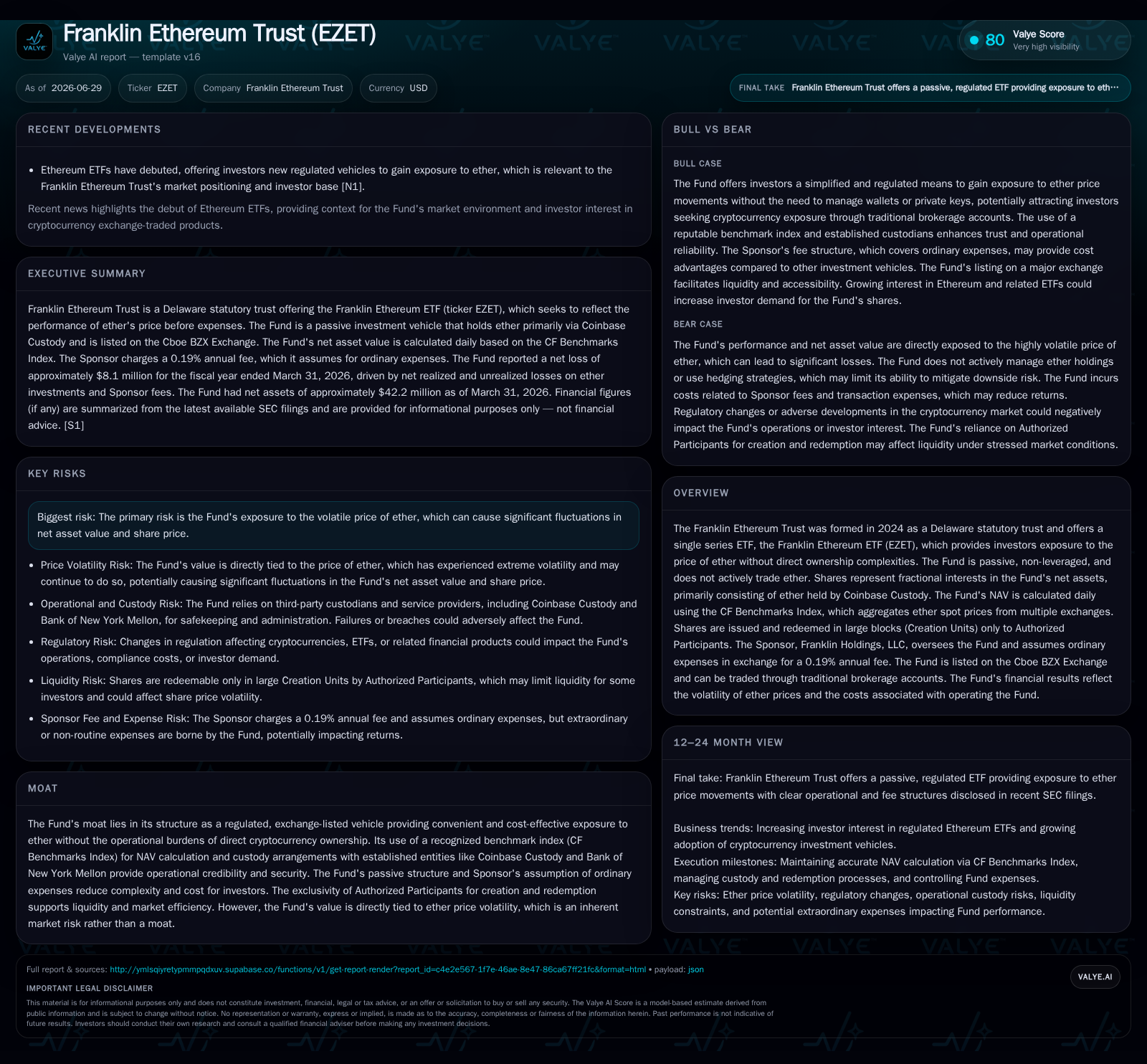
The Franklin Ethereum Trust's Franklin Ethereum ETF (EZET) provides investors passive exposure to ether price movements without the complexities of direct cryptocurrency ownership. Custody by Coinbase Custody and administration by Bank of New York Mellon support operational integrity, while Authorized Participants facilitate liquidity through creation and redemption of shares in blocks of 50,000. The Fund charges a competitive 0.19% annual fee on assets under management, which is the primary revenue source for the Sponsor. NAV calculations rely on the CF Benchmarks Index to maintain pricing transparency. Recent filings confirm EZET remains non-leveraged and passive, with key performance drivers including ether market volatility, liquidity provision by Authorized Participants, and custody security.
Recent Operating Update
The Franklin Ethereum Trust’s latest quarterly filing dated February 17, 2026 confirms that EZET continues to operate as a passive investment vehicle structured as a Delaware statutory trust [S2]. Retail investors access liquidity through secondary trading on the Cboe BZX Exchange under ticker "EZET" [S1].
A May 8, 2026 8-K filing announced executive appointments at Franklin Holdings LLC, the Sponsor of the Fund, reflecting strengthened operational oversight but no changes in business strategy or fee structure [S3]. The annual report filed June 29, 2026 reconfirms EZET’s passive approach without leverage or active portfolio management—ether sales occur solely to meet redemptions or pay expenses [S1]. This reinforces EZET's positioning as a low-touch product designed for investors seeking ether price exposure without direct custody responsibilities.
Business Model Overview
EZET generates revenue primarily from an annualized Sponsor fee of 0.19% on net assets under management (AUM), payable quarterly in arrears [S5]. This fee is competitively positioned relative to many cryptocurrency trusts that typically charge higher expense ratios, thereby enhancing cost efficiency for investors seeking liquid crypto exposure through traditional brokerages.
Shares represent fractional undivided beneficial interests in ether held directly by the Fund. Coinbase Custody Trust Company LLC serves as the ether custodian, providing institutional-grade security for digital asset holdings [S1,S28]. Unlike actively managed funds or derivatives-based products, EZET does not engage in speculative trading but seeks to track the underlying asset’s performance minus fees.
NAV calculation occurs daily based on the CF Benchmarks Index, which aggregates spot prices from multiple exchanges into a reliable valuation metric [S11]. This approach mitigates concerns around pricing opacity prevalent in digital asset markets by anchoring valuations to an independent benchmark.
Creation Units are issued or redeemed only with Authorized Participants—including market makers such as Jane Street Capital LLC and Citadel Securities LLC—who transact directly with the Fund exchanging cash for ether or vice versa [S4]. This creation/redemption mechanism supports arbitrage activity that keeps secondary market prices aligned closely with NAV.
Operationally, Coinbase Inc., an affiliate of Coinbase Custody, acts as Prime Broker managing off-chain transactions between the Fund’s Trading Balance (held in omnibus wallets) and Vault Balance at Coinbase Custody. This separation facilitates efficient settlement cycles while maintaining risk controls during creation and redemption processes [S27,S28]. Bank of New York Mellon acts as Administrator and Cash Custodian handling accounting, transfer agency services, and regulatory compliance [S1,S25]
Industry Structure and Competitive Position
Cryptocurrency ETFs like EZET serve a critical role bridging volatile digital asset markets with traditional finance by providing regulated investment vehicles that reduce operational friction for investors unfamiliar with direct crypto custody. Competitors include trusts such as Grayscale Ethereum Trust and Bitwise Ethereum Fund that vary somewhat in fee structures, custody arrangements, or regulatory status but share this core function.
Reliance on reputable service providers (Coinbase Custody for digital assets; BNY Mellon for administration) underscores operational credibility essential in an industry still navigating custody risks and evolving regulation. Listing on Cboe BZX Exchange offers broad distribution access through established brokerage platforms compared to proprietary crypto exchanges.
Price discovery depends heavily on Authorized Participants’ effective engagement in creation/redemption activities; their participation helps minimize premiums or discounts that can arise when secondary market liquidity is constrained [S4]. EZET benefits from partnerships with leading market makers ensuring tighter spreads
Growth Drivers
Institutional interest in regulated crypto investment tools continues to expand demand for trusts like EZET that offer convenient exposure without requiring investors to manage private keys or interact with unregulated exchanges. Regulatory clarity enhancing ETF eligibility further supports product expansion potential within crypto asset classes.
Advances in custody technology reduce operational risks deterring conservative investors; Coinbase Custody’s institutional-grade security bolsters confidence. Expanding authorized participant networks can improve liquidity provisioning capacity enabling larger capital inflows.
Broader blockchain adoption trends coupled with increasing digital asset market capitalization provide structural tailwinds supporting sustained investor appetite across both retail and institutional segments.
Risks and Watchpoints
Performance is inherently exposed to significant volatility tied directly to ether’s market price; fluctuations will be promptly reflected in NAV and share prices impacting returns [S6]. Regulatory developments remain a key risk area that could alter fund structure requirements or investor access rules.
Custody risks persist despite professional safeguards given cybersecurity threats endemic to digital asset storage. Liquidity risk arises if Authorized Participant engagement diminishes temporarily restricting creation/redemption flows thereby affecting share price alignment with NAV.
Tracking error depends on functioning market efficiency mechanisms including benchmark index reliability; the Sponsor retains discretion over fair value determinations if benchmarks become unreliable [S11].
Fee waiver policies are discretionary; consistent application affects long-term investor costs.
What To Watch Next
Subsequent quarterly filings will reveal trends in AUM growth reflecting investor inflows or outflows signaling demand trajectory. Announcements regarding new Authorized Participants would indicate improved liquidity provisioning.
Technological enhancements from custody or administrative partners could lower transaction costs or enhance security frameworks strengthening operational resilience.
Regulatory updates from SEC guidance on cryptocurrency ETFs might open avenues for broader product offerings beyond ether supporting growth opportunities.
Monitoring premium/discount trends will provide insight into market pricing efficiency crucial for maintaining investor confidence in passive tracking products.
Financial Profile Discussion
Net assets totaled roughly $67.6 million at fiscal year-end reflecting combined capital inflows from share creations partially offset by redemptions [S16]. Liquidity relies primarily on cash balances held at prime broker accounts supported by efficient off-chain settlement processes facilitated by trusted custodians [S9,S12].
Ordinary expenses including audit and administrative fees are absorbed by the Sponsor reducing dilution impact on shareholders except when extraordinary costs arise which remain infrequent [S5,S25]. The Fund employs no leverage aligning with conservative risk posture typical of cryptocurrency ETFs emphasizing transparency and safety over return enhancement strategies [S1,S28].
Overall, EZET exhibits early-stage growth characteristics typical of emerging cryptocurrency trusts: limited operating income but strong alignment between AUM growth prospects driven by asset appreciation plus subscriptions balanced against manageable fixed fees underwritten principally by the Sponsor.
Disclaimer: This is research-only, informational analysis and not investment advice. It may include AI-generated interpretation and general industry context. Always verify important details using primary sources.

Comments