
XTL Biopharmaceuticals Expands Psychedelic Therapeutics Portfolio Amid Ongoing Liquidity Strains
The company finalized its Psyga Bio acquisition to bolster its IP asset base but faces continued cash flow challenges with substantial going-concern risks.
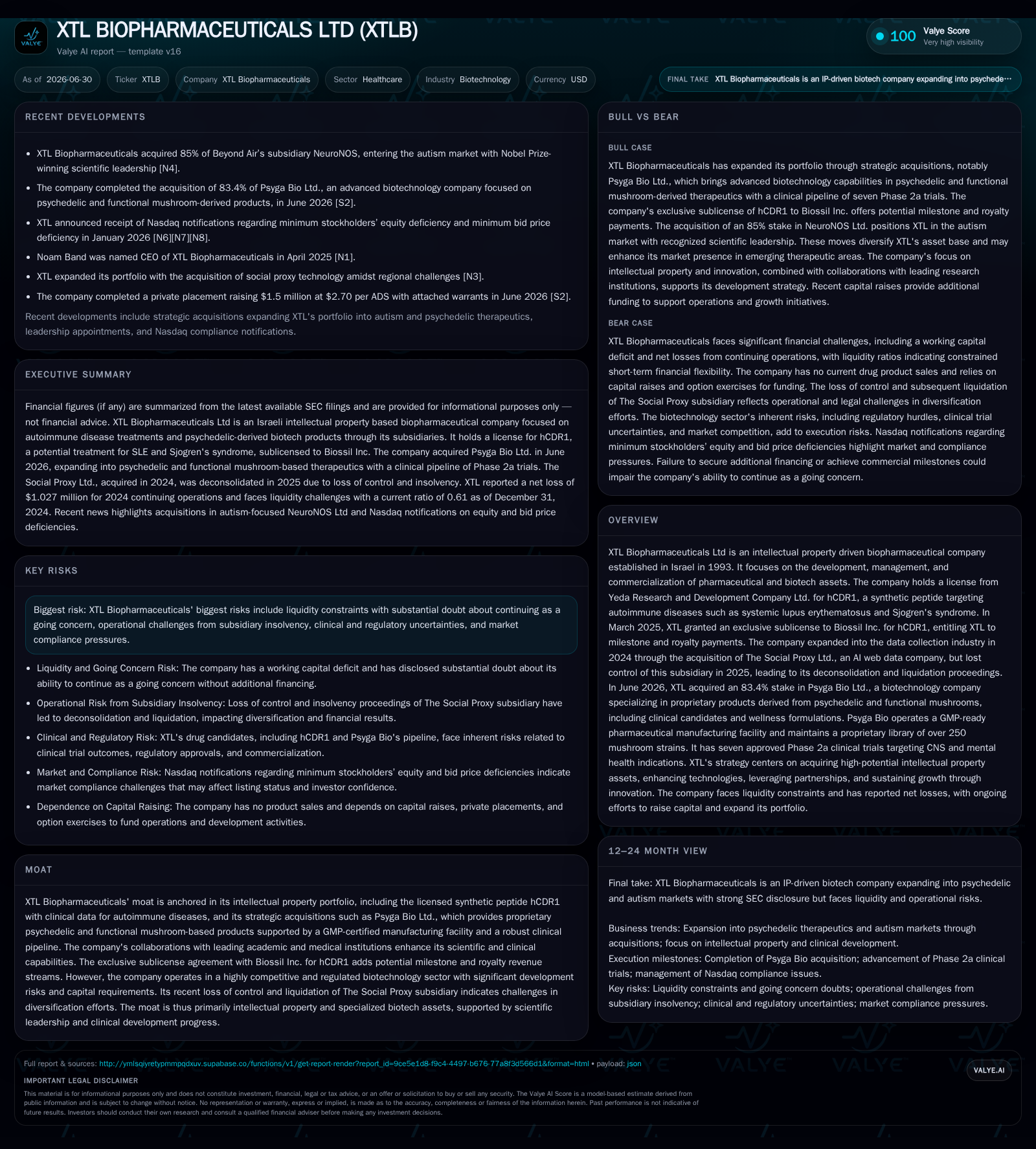
XTL Biopharmaceuticals Ltd completed the acquisition of an 83.4% stake in Psyga Bio Ltd., marking a strategic expansion into psychedelic and functional mushroom-derived therapeutics. This complements its legacy autoimmune disease assets like the synthetic peptide hCDR1, sublicensed to Biossil Inc. Despite enhancing its pipeline with clinically advanced candidates and GMP manufacturing capabilities, XTL faces persistent liquidity constraints and negative cash flows, raising substantial doubt about its ability to continue as a going concern without additional capital. The liquidation of its prior data analytics subsidiary, The Social Proxy Ltd., has narrowed focus back to core biotech development and milestone-dependent royalty models.
Recent Operating Developments
In June 2026, XTL Biopharmaceuticals Ltd completed the acquisition of an approximately 83.4% ownership stake in Psyga Bio Ltd., an Israeli biotechnology company focused on proprietary products derived from psychedelic and functional mushrooms [S2]. This transaction is a strategic pivot designed to expand XTL’s asset portfolio beyond its traditional focus on autoimmune diseases. The deal was executed primarily through issuance of American Depositary Shares (ADS), resulting in roughly one-third dilution of existing equity holders. Additional milestone warrants linked to clinical achievements align incentives toward advancing Psyga’s therapeutic pipeline.
Alongside the acquisition, XTL raised approximately $1.5 million through a private placement involving existing insiders and new investors, supporting near-term liquidity needs related to integration and ongoing research activities [S2][S3]. Shareholders approved these corporate actions at an extraordinary meeting held in late June 2026, which also authorized a near doubling of authorized share capital to accommodate financing requirements [S3].
Business Model Overview
XTL operates primarily as an intellectual property-based biopharmaceutical developer focused on acquiring, managing, and commercializing drug candidates through licensing arrangements. Its most notable asset is the synthetic peptide hCDR1 targeting systemic lupus erythematosus (SLE) and Sjogren's syndrome (SS). In March 2025, XTL entered into an exclusive worldwide sublicense agreement with Biossil Inc., granting them rights to develop and commercialize hCDR1 while entitling XTL to milestone payments and royalties [S1]. This structure shifts downstream development costs and commercialization responsibilities away from XTL but leaves it reliant on partner execution for future revenue realization
The acquisition of Psyga Bio significantly diversifies XTL’s portfolio into the emerging field of psychedelic therapeutics. Psyga Bio develops clinically researched candidates targeting neuropsychiatric conditions such as ADHD, anxiety, addiction, trauma-related disorders, and neuroplasticity enhancement. It operates GMP-certified manufacturing facilities enabling pharmaceutical-grade production of active compounds like psilocybin and ibogaine under stringent quality controls—a competitive advantage given regulatory demands in this space [S21]. Its pipeline includes seven approved Phase 2a clinical trials indicating mid-stage clinical validation uncommon for many early-stage biotechs
The company has retreated from non-core software ventures following loss of control over The Social Proxy Ltd., which filed for insolvency in early 2026 [S1][S9]. This divestiture eliminates operational distractions outside biotech development focus
Industry Structure and Competitive Position
XTL occupies an early-to-mid stage position in the biotechnology value chain characterized by high capital intensity and regulatory complexity. Its business model mirrors that of many biotechs focusing on intellectual property origination combined with licensing deals that provide milestone-triggered payments instead of immediate product revenues.
Within psychedelic therapeutics—a rapidly evolving niche—XTL benefits from Psyga Bio’s proprietary fungal strain library coupled with GMP manufacturing capacity and clinical programs addressing unmet medical needs with microdosing approaches. Few competitors currently combine these capabilities at comparable clinical advancement levels.
However, lack of direct product sales anchors XTL among early-stage biotechs facing sustained burn rates without near-term revenue inflection points while navigating high trial failure risks common in CNS drug development.
Growth Drivers
Key growth catalysts include:
- Successful completion of Phase 2a studies by Psyga Bio validating safety and efficacy necessary for progression to later-stage trials or commercialization partnerships.
- Achievement of sublicense milestones triggering ADS issuances or royalty streams under agreements such as Biossil’s for hCDR1.
- Expansion of intellectual property portfolios via strategic acquisitions or internal research diversifying risk beyond singular product lines.
- Increasing acceptance by regulators and markets of microdosing therapies within medicinal psychedelics expanding addressable patient populations.
- Continued investor support through capital raises enabling sustained R&D investment critical for competitive differentiation.
Risks and Watchpoints
Monitoring should focus on:
- Updates on cash runway extension efforts or new financing commitments.
- Milestone announcements related to both peptide programs and Psyga’s clinical progress.
- Regulatory filings or approvals signaling commercialization potential.
- Changes in share structure affecting dilution or governance given significant insider holdings including Mr. Alex Rabinovich.
What to Watch Next
Upcoming milestones critical for assessing execution include:
- Progress in patient enrollment and data readouts from Psyga Bio’s seven Phase 2a trials measuring clinical validation [S21].
- Recognition of milestone payments linked to Biossil’s development progress on hCDR1 [S1].
- Cash flow impact from recent private placement proceeds supporting integration costs [S2][S3].
- Developments regarding Nasdaq compliance deadlines influenced by equity raises or operational restructuring [S18].
Financial Profile Discussion
Financial data through December 31, 2025 reflects pre-acquisition conditions but provides context on XTL’s underlying financial health before integrating Psyga Bio. There were no revenues reported during this period; general administrative expenses rose significantly to approximately $1.44 million driven by higher executive salaries, professional fees, stock option compensation expenses, and bad debt provisions. Research expenses remained modest (~$28 thousand), centered mainly on consulting work related to hCDR1 development [S1][S13]. Operating losses exceeded $1.6 million reflecting ongoing pre-commercial R&D burden plus administrative overhead without offsetting income. Net losses ballooned close to $7 million largely due to discontinued operations related to The Social Proxy wind-down [S1].
The infusion from the June 2026 private placement tied to the Psyga acquisition provides some financial relief but must be evaluated against expanded operating scope including increased R&D spend required for advancing multiple clinical programs plus integration costs inherent in newly acquired subsidiaries [S2][S3]
In summary, XTL’s recent quarter marks a strategic shift amplifying its pipeline with promising psychedelic therapeutics backed by proprietary IP and GMP manufacturing capacity. However, significant financial fragility imposes steep execution demands dependent on effective capital deployment, milestone achievement, regulatory navigation, and successful integration within one of biotechnology's most volatile subsectors.
Disclaimer: This is research-only, informational analysis and not investment advice. It may include AI-generated interpretation and general industry context. Always verify important details using primary sources.

Comments