
Limitless X Leverages Celebrity Partnerships to Drive Hybrid E-Commerce Growth
Latest quarterly disclosures underscore Limitless X Holdings’ effort to integrate celebrity-driven supplement brands with digital wellness and omnichannel commerce amid operational and liquidity challenges.
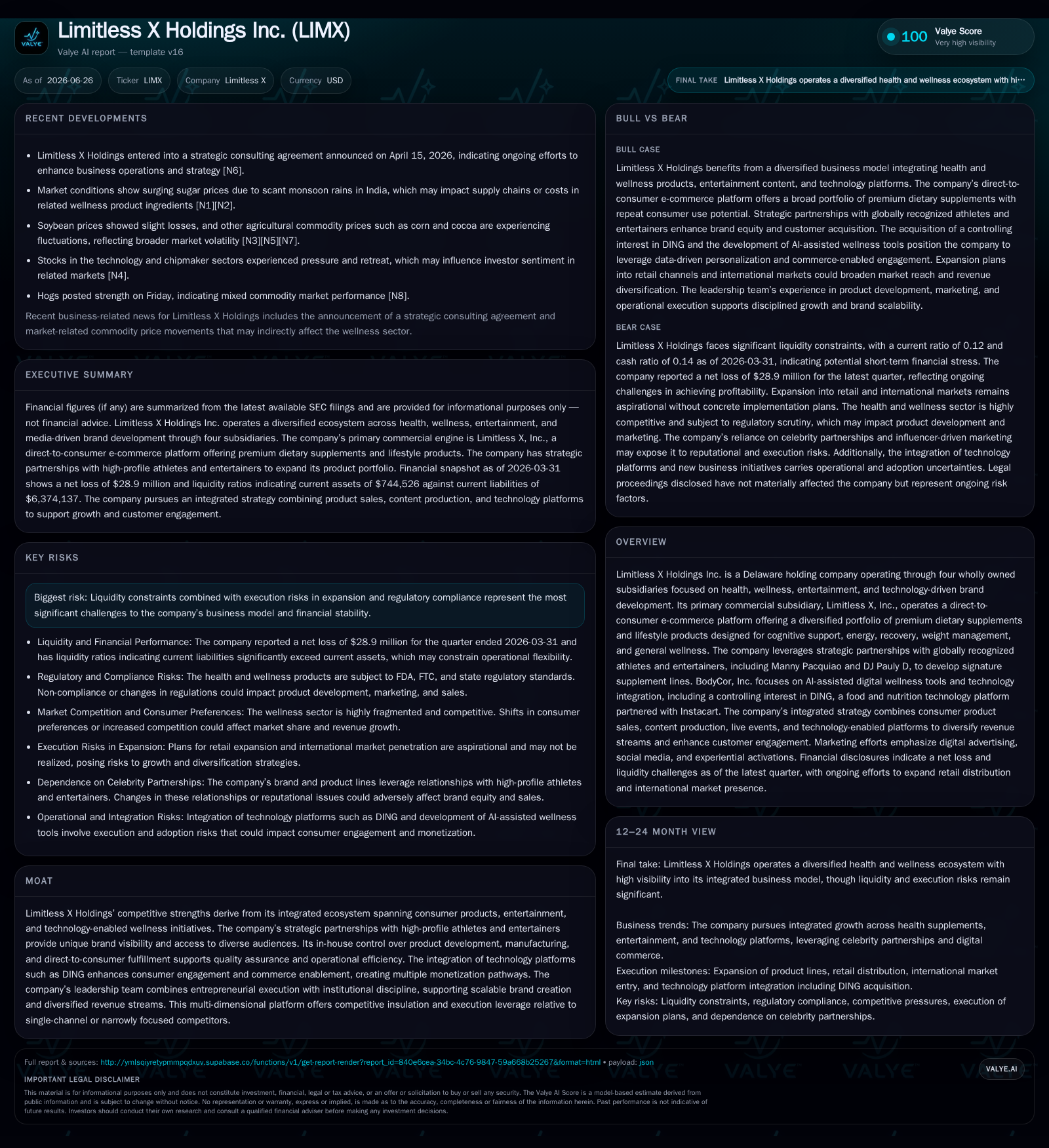
Limitless X Holdings Inc. reported in its June 2026 quarterly filing continuing execution complexities and strained liquidity with a current ratio near 0.12, underscoring tight near-term financial constraints. The company’s business model hinges on a hybrid ecosystem combining premium dietary supplements sold direct-to-consumer and via retail, technology-enabled AI wellness platforms under BodyCor, and celebrity partnerships with Manny Pacquiao and DJ Pauly D that enhance brand reach. Their acquisition of a controlling interest in DING adds commerce enablement through Instacart, extending monetization beyond product sales. Growth efforts focus on expanding subscription and repeat purchase rates, international market entries, and leveraging data-driven engagement; however, regulatory compliance and supply chain execution remain notable risks.
Latest Quarterly Update: Operating Highlights and Near-Term Pressure Points
Operating losses persist as the company continues investing heavily in building its multi-dimensional brand ecosystem. Although no material changes in risk factors occurred since the prior annual report ([S2]), the fragile liquidity profile necessitates close monitoring of cash flow generation relative to ongoing capital requirements.
Business Model Nuances: Integrated Consumer Products and Digital Wellness Platform Synergies
LIMX operates through four wholly owned subsidiaries spanning health supplements, entertainment content, athlete-driven brand development, and digital wellness technology ([S1],[S4]). The primary commercial engine is Limitless X Inc., offering a diversified portfolio of premium dietary supplements including the flagship NZT-48 line (Original, Lion’s Mane variant, For Her formula) alongside functional formats such as pre-workout shots and gummies targeting cognitive support, energy enhancement, recovery, weight management, and overall wellness.
Crucially, the company employs a vertically integrated approach maintaining direct control over formulation oversight, contract manufacturing relationships compliant with cGMP standards, fulfillment managed via its Shopify-based DTC platform supported by ShipStation logistics ([S12],[S17]). This ownership grants quality control advantages amidst an industry susceptible to product efficacy skepticism.
Complementing physical goods sales is BodyCor Inc., launched in mid-2025 to develop AI-assisted digital wellness tools aimed at personalized nutrition guidance, consumer education, habit formation support, and engagement ([S11]). BodyCor also holds a controlling stake in DING—a technology platform partnered commercially with Instacart—which embeds commerce enablement capabilities directly linking digital nutrition engagement to grocery fulfillment ([S7],[S11]). This permits multiple monetization pathways beyond traditional product sales: subscription services for personalized nutrition plans are planned but currently nascent.
Celebrity partnerships form another strategic pillar. Endorsements evolve into authentic brand collaborations with Manny Pacquiao—the legendary eight-division boxing world champion—and DJ Pauly D—well-known entertainer—helping LIMX penetrate diverse lifestyle segments globally ([S11],[S22]). These long-term relationships are designed not as transactional influencer endorsements but structural brand amplifiers fostering sustained customer acquisition via shared cultural credibility.
Repeat purchase models drive customer lifetime value (CLV), which management estimates at approximately $90 per customer currently with ambitions to scale beyond $270 through subscription optimization and SKU expansion ([S15]). This illustrates reliance on retention KPIs coupled with effective digital marketing strategies underpinning scalable growth.
Competitive Positioning: Brand Partnerships and Channel Strategies in Context
Within the broader health and wellness e-commerce landscape—which includes players like Herbalife Nutrition known for multi-channel distribution strategies or Hims & Hers focused on digitally native health brands—LIMX attempts to carve differentiation through its unique integration of athlete-driven branding combined with technology-enabled commerce platforms ().
President Daniel Sanders’ appointment adds significant experience in scaling product lifecycle operations for consumer health brands distributed via top-tier U.S. retailers including Walmart and Costco ([S3],[S17]). Under his leadership LIMX is pursuing retail channel penetration alongside continued growth of its direct-to-consumer base—a dual approach essential for broadening market reach.
While competitors such as Noom exemplify successful digital wellness engagement through personalized coaching apps and Peloton merges tech with lifestyle fitness products, LIMX’s incorporation of a food-tech commerce platform (DING partnered with Instacart) uniquely integrates physical product sales with data-driven meal planning and grocery fulfillment—a relatively uncommon omnichannel capability in this sector ([S7],).
Growth Drivers: Scaling Subscription Models, Geographic Expansion, and Technology Integration
Management identifies several key growth catalysts supporting its strategic agenda:
- Rising global health awareness fuels demand for cognitive support supplements like NZT-48 lines backed by research-driven positioning.
- Subscription retention enhancements aim to increase repeat purchase rates elevating CLV across existing consumers via personalized bundles.
- International expansion targets high-potential emerging regions including MENA markets (Middle East), the Philippines, and India aligning with accelerating middle-class wellness consumption ([S1],[S15]).
- Technology integration through BodyCor’s AI tools plus the DING platform promotes personalized nutrition guidance linked directly to Instacart-enabled consumer purchasing behavior—driving deeper engagement than standard e-commerce strategies allow ([S7],).
These drivers correspond to measurable KPIs such as subscription retention rate improvements alongside increased digital platform user engagement metrics anticipated by leadership as signs of scalable demand capture ([S4],[S15]).
Risks and Constraints: Liquidity Stress, Regulatory Compliance, and Execution Challenges
Regulatory risks permeate all aspects—from stringent FDA oversight on supplement ingredient claims to FTC enforcement actions against unverifiable marketing assertions—requiring careful compliance especially given past industry actions against peers lacking substantiation ([S5],[S21]). The company emphasizes its compliance-first product development process governed internally by experienced legal operations leadership aiming to mitigate such risks ([S14],[S21]).
Execution risks stem primarily from scaling omnichannel distribution infrastructure under new President Sanders who must navigate complex supplier/manufacturer validation processes while expanding retail presence without overextending operational capacity ([S3],[S17]). Dependency on celebrity partnerships’ continued resonance represents an intangible but meaningful risk should public personas change or contractual terms evolve.
Data privacy regulations impacting AI-personalized services also pose emergent supervisory demands potentially increasing operating costs related to cybersecurity governance prominently overseen by both management teams and board committees employing AI analytics for threat detection ([S1],[S23]).
What to Watch: Key Milestones, Consumer Engagement Metrics, and Expansion Signals Ahead
Investors should monitor LIMX’s ability to improve subscription retention rates—which currently stand around mid-tier performance levels—and track repeat purchase trends specifically for NZT-48 core SKUs that drive direct-to-consumer revenue proportionally.
Digital platform user engagement metrics originating from BodyCor’s AI wellness offerings plus traffic conversion on the integrated DING commerce storefront represent early indicators of technology adoption success influencing longer-term monetization potentials ([S2],[S7]).
Progress reports on retail channel penetration trials alongside revenue contributions from growing international markets such as the Middle East or Philippines will signal commercial viability outside established U.S. geographies where competition intensifies ([S15]). The pace at which operational teams can scale supply chain oversight balancing quality assurance alongside more automated inventory turnover efficiency will be critical execution signals under new management regimes ([S3],[S12]).
Financial Summary: Current Liquidity Landscape and Capital Structure Context
There have been no material risk factor revisions acknowledged during the latest quarterly disclosure,[S2] while the company's governance protocols emphasize proactive cyber risk management suitable for protecting intellectual property asset integrity amid growing reliance on AI-powered platforms.[S1]
This analysis is based solely on public SEC filings dated up to June 26, 2026 [S2] combined with validated financial metrics [F1]. It aims to provide an informed perspective without investment advice or forward-looking forecasts.
Disclaimer: This is research-only, informational analysis and not investment advice. It may include AI-generated interpretation and general industry context. Always verify important details using primary sources.

Comments