
Groove Botanicals’ Strategy Shifts from Legacy Operations to Norwegian Tech Licensing
Groove Botanicals is pivoting to license early-stage Norwegian IP but faces no current licensing deals or proprietary assets, underscoring execution and capital challenges.
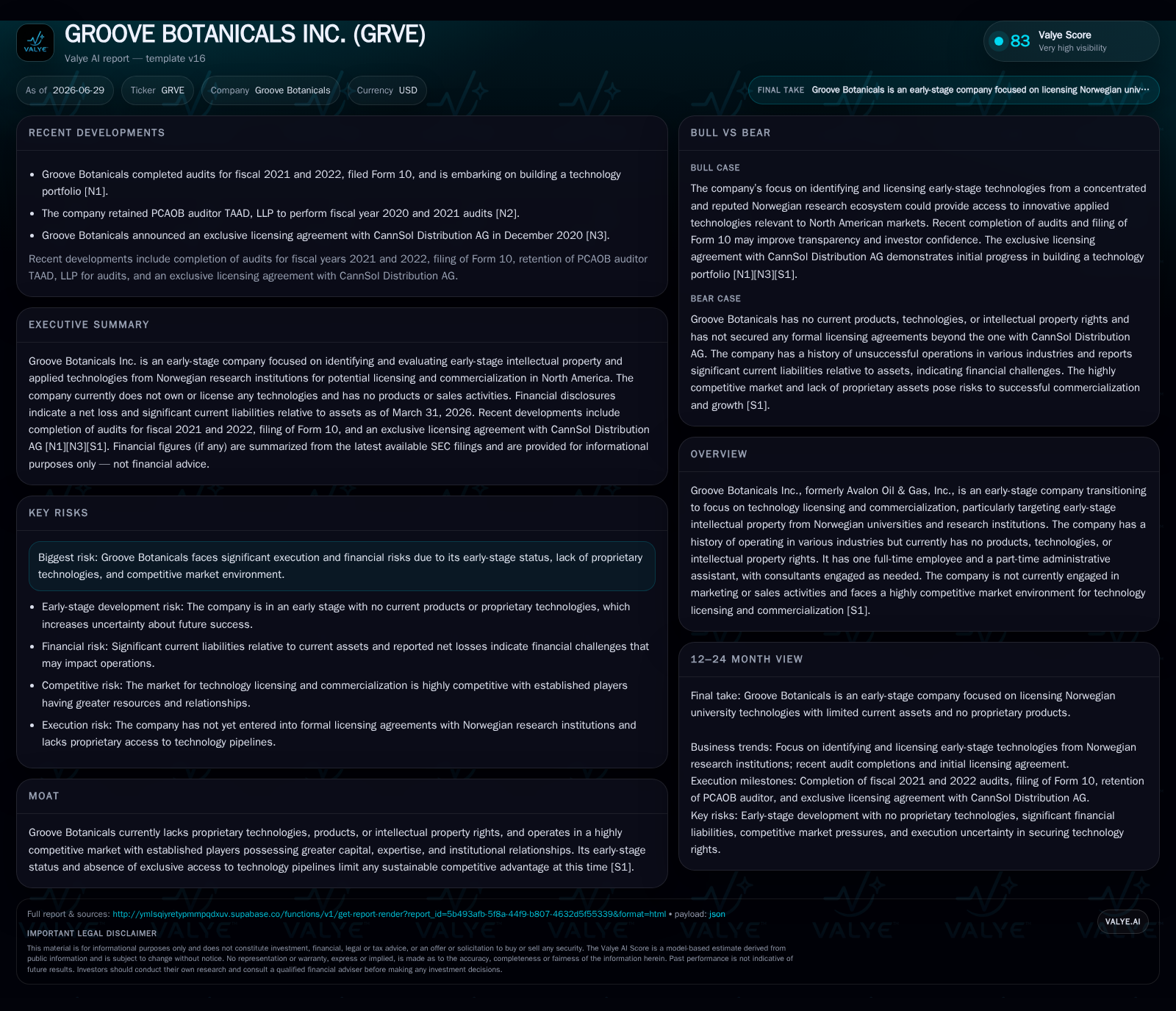
In its latest 10-Q filing, Groove Botanicals reported no intellectual property rights or licensing agreements, confirming the company's early-stage status amid a strategic pivot toward technology licensing focused on Norwegian research institutions. The business model revolves around sourcing promising early-stage technologies from Norway and commercializing them through licensing agreements and partnerships in North America. However, Groove's competitive position is constrained by a lack of proprietary assets, limited institutional relationships, minimal staffing, and significant capital needs estimated up to $5 million. Near-term value drivers hinge on the successful identification and licensing of technologies, yet operating expenses continue with no revenue generation to date. The company must navigate a competitive landscape dominated by more established technology transfer offices and commercialization platforms with deeper resources. Monitoring progress on deal signing, partnerships, and funding will be critical to assessing execution viability.
(1) Latest Quarterly Operating Position Highlights Status Quo Risks and Growth Ambitions
Groove Botanicals’ most recent quarterly report filed on February 20, 2026 reaffirms the company’s continued nascent stage in its strategic transformation from legacy operations. As of the quarter-end, Groove reported no ownership or licensing of intellectual property (IP), nor had it executed any licensing agreements indicative of tangible commercial traction [S2]. This absence of near-term revenue generation points to fundamental challenges in translating its pivot into measurable progress. Additionally, governance changes including an auditor transition announced in an 8-K dated May 22 underscore ongoing organizational adjustments reflecting the company’s repositioning efforts amidst operational uncertainties [S3].
(2) Business Model Focus: From No Assets to Technology Licensing Pipeline Development in Norway
Groove Botanicals is repositioning as a technology licensing entity focusing on the identification and evaluation of early-stage applied technologies emerging primarily from Norwegian research ecosystems such as the University of Oslo, Oslo University Hospital, SINTEF, NTNU, and University of Bergen [S1],[S5]. The core business model centers on sourcing these nascent innovations—likely spanning sectors including energy offshore tech, maritime applications, aquaculture, carbon capture, health sciences, and digital industrial solutions—and then assessing their suitability for licensing or further development aimed at North American markets [S6].
Revenue prospects hinge on eventual licensing agreements that could generate upfront fees, milestone payments linked to development progress or regulatory approvals, and royalties derived from underlying product sales by licensees. However, Groove has not begun marketing or direct sales activity given its purely foundational status. Its expense profile currently reflects technology scouting and evaluation activities rather than product R&D expenditure [S4]. With no proprietary IP or exclusive channel access presently held, the company broadly operates as an intermediary technology scout seeking entry points into defined geographic innovation clusters.
(3) Competitive Challenges in Early-Stage Technology Licensing Without Proprietary IP or Strong Institutional Ties
The market segment Groove targets—early-stage university technology transfer—is highly competitive and dominated by well-funded players including university technology transfer offices (TTOs), venture-backed commercialization platforms, strategic corporate licensors with deep institutional ties, and specialized licensing firms possessing broader deal flow access [S1],[S5]. Groove’s lack of proprietary technologies or any contractual exclusivity creates significant barriers to differentiation.
Lacking these assets or significant capital pools constrains Groove’s ability to outbid competitors for premier inventions or develop licensed assets further. This dynamic establishes a high execution risk threshold impacting potential for sustainable competitive advantage.
(4) Key Operational Metrics: Absence of Licensing Agreements Impacts Near-Term Value Creation Potential
Standard industry KPIs such as the number of signed licensing agreements—both leading to immediate fees and triggering milestone payment schedules—and royalty income remain absent due to Groove’s early-stage status [S1],[F1]. The company reports no milestone payments received nor royalty revenues generated currently.
Its pipeline consists primarily of broad thematic technology scanning rather than specific contractually secured projects; this indicates a developmental phase focused on opportunity identification rather than monetization. Operating expenses center on scouting and evaluation efforts; however, without concrete milestone achievements demonstrating deal flow conversion into revenue streams, intrinsic valuation pressures persist given elongated path-to-cash timelines.
(5) Growth Opportunities: Leveraging Norwegian University Innovation Clusters Amid Market Complexity
Norway’s research institutions represent a relatively concentrated cluster with recognized strengths in applied technological fields relevant for export into North American commercial sectors [S5]. Focused specialization in ocean industries, environmental tech such as carbon capture solutions, medical technologies through hospital-affiliated research organizations, and digital industrial advances offers targeted niches wherein Groove aims to carve out opportunities.
Government incentives promoting technology transfer in Norway support increased innovation output while growing corporate demand for external sourcing fosters upside potential for intermediaries capable of bridging these geographically distinct pipelines. Groove’s decision to concentrate on Norway intends to streamline evaluation efficiency versus dispersed global scouting but does not mitigate overarching execution risks tied to deal flow volume or exclusivity.
(6) Risks & Constraints: Capital Deficiency, Execution Challenges, Market Entry Barriers Highlighted by Filing
Groove faces acute vulnerabilities stemming from its undercapitalized balance sheet juxtaposed against operational ambitions. Cash balances at December 31, 2025 total approximately $1.5K while current liabilities exceed $1.4 million—a ratio suggesting material liquidity constraints absent near-term capital raises [F1]. Operating losses reinforce the need for incremental funding exceeding initial estimates ranging between $500K and $5 million depending on realized growth strategies [S5].
The extended timeline inherent in converting identified technologies into licensed products compounds risks tied to securing exclusive deals amid heightened competition from better-resourced institutions. Moreover, absence of proprietary IP portfolio means reliance on third-party research pipelines where allocation decisions favor incumbent transferees limits bargaining leverage.
(7) Near-Term Watchpoints: Milestones on Licensing Deals, Capital Raises, Strategic Partnerships Execution
Investor focus should center on several critical developments that could validate Groove’s strategic trajectory: First-license agreement signings with Norwegian academic bodies would concretize operational progress beyond scouting phases. Formation of strategic alliances facilitating downstream commercialization in North America constitutes another key growth enabler validating cross-border business models [S3],[S5].
Disclaimer: This is research-only, informational analysis and not investment advice. It may include AI-generated interpretation and general industry context. Always verify important details using primary sources.

Comments