
Sify Technologies’ Capital-Intensive Expansion and AI Integration Amid Rising Data Center and Network Demand
Sify Technologies reported fiscal 2026 revenue growth driven by network and data center services but faces margin pressure from rising interest and depreciation costs.
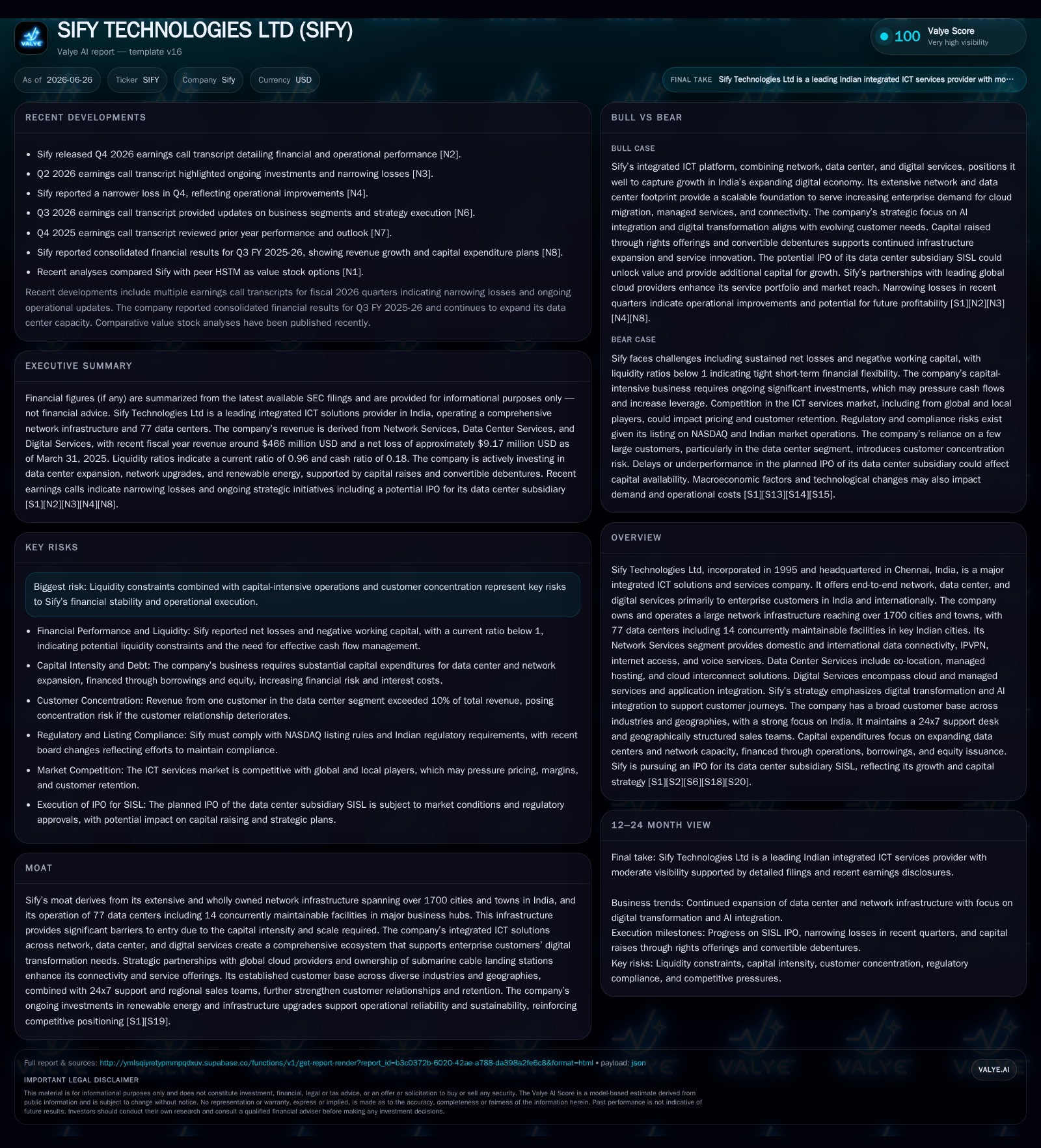
In its latest fiscal year ended March 31, 2026, Sify Technologies Ltd demonstrated 13% revenue growth primarily fueled by expanded capacity utilization in network and data center segments. However, losses widened due to increased interest expenses and depreciation reflecting capital-intensive investments in infrastructure, including renewable energy-powered data centers. Sify’s extensive wholly owned network spanning over 1700 cities and its ownership of 77 data centers—including 14 concurrently maintainable facilities—underpin its moat in India’s integrated ICT services sector. The company is evolving its strategy to embed AI across offerings helping enterprise digital transformation, while navigating liquidity pressures typical of infrastructure-heavy operators.
Recent Operating Update
Sify Technologies announced its consolidated results for the fiscal year ended March 31, 2026 [S2]. The company posted revenues of ₹44,877 million (about $466 million), reflecting a healthy 13% increase over the prior year. Growth was largely fueled by Network Services (+₹1,853 million) and Data Center Services (+₹3,323 million), offset partially by a decline in Digital Services (-₹186 million) [S20]. However, Sify recorded a loss before tax of ₹941 million versus ₹286 million last year, mainly due to higher interest expenses and increased depreciation stemming from substantial capital investments in expanding network and data center infrastructure [S7].
The recent filing underscores the intensifying capital intensity as Sify deepens its footprint in critical Indian digital infrastructure. The firm is advancing AI integration across its service portfolio—a strategic pivot designed to enhance customer-centric digital transformation during increasing cloud adoption [S1]. This positions Sify at the convergence of traditional ICT services evolving toward AI-enabled managed offerings.
Business Model Analysis
Sify operates an integrated ICT services business encompassing three core segments: Network Services, Data Center Services, and Digital Services [S15][S19].
Network Services generate revenue primarily through fixed-term contracts offering NLD/ILD connectivity (domestic/international long distance), IPVPNs, internet access, last mile connectivity, and voice termination services [S15]. Revenues derive from usage-measured voice traffic and contracted fixed rates based on service type, capacity commitment, scope, and SLA compliance. The firm owns all network infrastructure extending to over 1700 Indian cities with over 125,000 links granting it full operational control over performance parameters like uptime
Data Center Services entail co-location offerings where customers pay fixed fees based on rack space occupied plus power consumption. This segment also includes managed hosting and cloud interconnect solutions between enterprise premises and major public clouds. Contracts typically run on fixed terms under SLAs guaranteeing availability. With ownership of 77 data centers—including 14 concurrently maintainable facilities across metro hubs like Chennai, Mumbai, Delhi—Sify’s robust physical footprint affords it a significant competitive advantage against third-party operators [S1][S7].
Digital Services include cloud computing (Compute-as-a-Service et al.), managed IT infrastructure services embracing remote/on-site support layers (OS/applications/databases), security monitoring against cyber threats via proprietary frameworks, application integrations mainly focused on AI-driven transformation initiatives. These services underpin customers’ migration journeys from hosted environments towards hybrid/multi-cloud architectures.
The revenue mechanics rely heavily on long-duration contracts with enterprise clients whose needs span reliable connectivity paired with high SLA adherence typical in mission-critical applications—a key differentiation factor promoting sticky customer relationships. The bundled product approach enables cross-selling across network infrastructure, data center colocation capacity, and layered digital solutions enhancing average revenue per user (ARPU).
Industry Structure and Competitive Position
Sify stands among India’s largest integrated ICT service providers operating in a capital-intensive sector that demands heavy investment not only in physical assets but also in technology upgrades aligning with hyperscale cloud readiness [S1]. Its moat is anchored by:
- Wholly owned network infrastructure providing geographical breadth unmatched locally,
- Strategic ownership of high-availability concurrent maintainable data center facilities critical for serving hyperscalers,
- Investment commitments into clean energy power purchase agreements reducing operating risks related to energy costs;
- Expanding AI capabilities integrated into core offerings addressing digital transformation requirements.
Peers such as Tata Communications or Reliance Jio compete on scale but often rely more heavily on leased infrastructure or less integrated ecosystems. Global colocation operators like Equinix remain benchmarks for data center excellence but have limited direct exposure domestically.
Customer mix includes a broad spectrum of Indian enterprises spanning BFSI, manufacturing, IT services alongside wholesale operations serving fellow carriers. While this diversity partially mitigates concentration risk, one customer accounted for more than 10% of total revenue for fiscal 2026 underscoring residual client dependency concerns [S21]
Growth Drivers
Several structural tailwinds underpin Sify’s growth potential:
- Rapid digitization across Indian enterprises driving demand for reliable high-capacity network connectivity paired with resilient colocation hosting.
- Cloud migration accelerating multi-cloud adoption requiring hybrid architectures served through cloud interconnect capabilities.
- Growing enterprise appetite for managed security services given escalating cyber threats.
- Expansion of AI workloads fueling investments in AI-ready hyperscale infrastructure within Sify data centers.
- Government initiatives fostering digital infrastructure deployment including fiber penetration extending last-mile reach beyond metros.
- Sustainability imperatives prompting large-scale PPAs with renewable generators enhancing cost visibility and ESG alignment attractive to hyperscale customers.
These drivers feed into KPIs such as data center utilization rates (rack/power usage), bandwidth throughput increases on owned networks, contract renewal/extension metrics under SLAs—all centrally relevant to sustained financial performance going forward.
Risks and Watchpoints
Despite encouraging growth dynamics, multiple constraints warrant close monitoring:
- Liquidity pressure remains prominent with negative working capital reported; operational cash flows must sufficiently cover ongoing capex plus interest obligations tied to borrowing levels exceeding ₹42 billion including lease liabilities [S3][S4].
- The elevated capital intensity necessitates continuous funding rounds or refinancing efforts risking dilution or cost hikes.
- Customer concentration risk carries potential earnings volatility should key contracts not renew or scale back.
- Rapid technological evolution mandates substantial R&D investment; failure to keep pace may erode competitive positioning.
- Power cost volatility despite renewable sourcing can impact margins given large electricity consumption inherent to data centers.
- Regulatory changes affecting telecom operations or data sovereignty could impose compliance overheads disrupting service delivery.
- Increasing competition from hyperscale cloud providers offering direct-to-enterprise services may compress market share if channel partnerships are insufficiently differentiated.
What To Watch Next
Key milestones that will shape Sify’s near-term trajectory include:
- Quarterly updates tracking revenue mix shifts especially growth rates in Digital Services reflecting successful AI integration adoption.
- Capacity utilization trends across newly commissioned data center assets indicating ability to ramp contracted volumes efficiently.
- Progression of sustainable energy adoption percentages further hardening cost structure resilience amidst inflationary environment.
- Customer contract renewal announcements particularly large accounts critical for revenue stability.
- Management commentary around liquidity improvements or any initiatives targeting working capital optimization.
- Execution status on planned expansions or new greenfield site developments under committed capex pipeline exceeding ₹22 billion [S14]
Financial Profile Synopsis
It emphasizes evidence-based interpretations rooted in reported financials and substantive disclosures concerning business model evolution amid India’s expanding digital economy. Readers should consider this as an informational perspective rather than investment advice.
Disclaimer: This is research-only, informational analysis and not investment advice. It may include AI-generated interpretation and general industry context. Always verify important details using primary sources.

Comments