
PCS Edventures! Advances Hands-On STEM Education Amid Market Seasonality and Customer Focus
Latest filings reveal PCS Edventures!’ strategic focus on curriculum quality, reseller partnerships, and managing seasonal demand within the fragmented STEM education market.
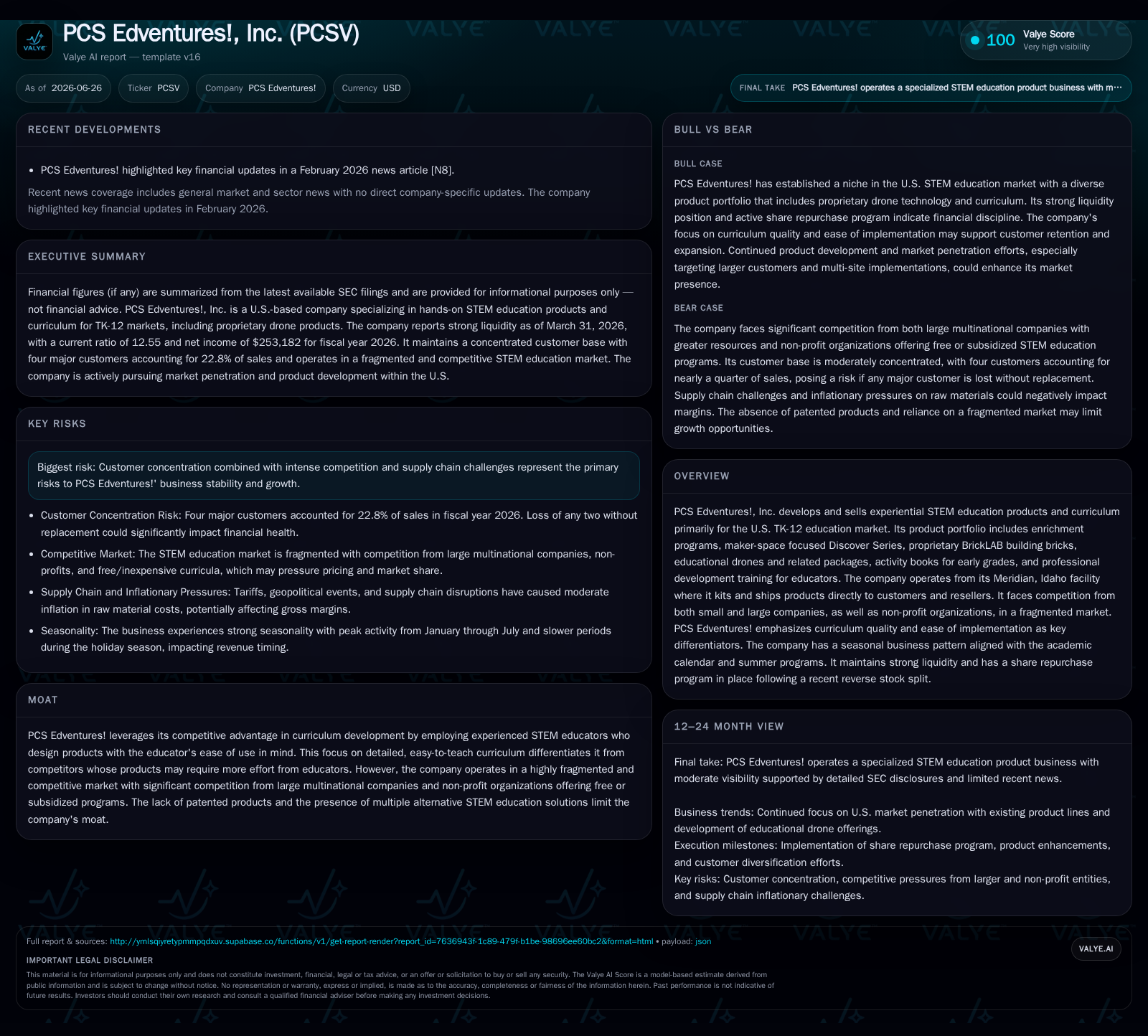
PCS Edventures!, Inc. reported steady progress in its experiential STEM education business in its latest quarterly and 8-K filings, emphasizing its curriculum-driven advantage and reseller channel strength amid strong seasonality tied to the academic calendar. The company’s Idaho-based kitting operation enables direct-to-customer shipments primarily across the U.S. TK-12 market, while it continues a share repurchase program reflecting confidence in its capital allocation. Despite risks from customer concentration and intense competition—including non-profits and large multinational educational publishers—PCS is pursuing growth through larger customer acquisitions and product enhancements aligned with evolving state education standards.
Recent Operational Highlights and Why They Matter Now
An important operational development is the continuation of PCS's share repurchase program authorized in April 2025 for up to 833,334 shares post-reverse split; by March 31, 2026, it repurchased over half of this allowance (481,561 shares) [S1],[S4]. This indicates management’s commitment to disciplined capital return while enhancing shareholder value.
Customer dynamics remain a focal point. Four major customers each accounted for at least 5% of sales in FY2026 cumulatively totaling approximately 22.8% [S8]. Notably, two are reseller channel partners who aggregate multiple end-user orders and maintain recurring order flow throughout the year [S8]. Management assesses these relationships as excellent with low near-term attrition risk but acknowledges sensitivity if more than one major customer were lost without immediate replacement.
Business Model: Delivering Hands-On STEM Learning at Scale
PCS Edventures! operates predominantly within the U.S. transitional kindergarten-through-12th grade (TK-12) educational market offering experiential STEM education products [S9]. Revenue derives mainly from direct sales to schools/districts and via reseller channels that serve end customers with drop-shipped orders directly fulfilled from PCS’s Meridian, Idaho kitting center [S22]. Product portfolio breadth includes enrichment programs (approx. 36 variants), maker-space focused Discover Series learning kits, proprietary BrickLAB plastic bricks compatible with Lego systems, educational drones developed post-acquisition of Thrust-UAV in 2016 [S17],[S24], STEAM-focused activity books for early grades, and professional development training sessions which support product adoption by educators [S17],[S22].
All curriculum content development is conducted at PCS’s corporate headquarters near the warehouse facility [S26],[S27]. This tight integration facilitates iterative product refinement responsive to educator feedback emphasizing detailed lesson plans that simplify classroom implementation—a critical differentiator versus competitors whose products can be less user-friendly for instructors [S25]. This revenue model is thus shaped by volume (number of schools/customers served), repeat purchases fueled by curriculum quality and educator satisfaction, pricing adjustments aligned with input cost inflation, and reseller contributions.
Competitive Positioning Within a Fragmented Educational Products Sector
The STEM education space is notably fragmented with competitors spanning large multinational educational publishers like Houghton Mifflin Harcourt (focused on curriculum publishing) to specialized hands-on kit providers such as Lego Education and VEX IQ [S25]. PCS occupies a niche by coupling physical kits with comprehensive curricula designed by experienced STEM educators who understand classroom constraints; this focus on ease-of-use stands out amid offerings where product-centric designs place greater instructional burden on teachers.
However, PCS’s lack of patents or proprietary IP limits barriers to entry or sustainable moats; competitors include not only commercial enterprises but also non-profit organizations such as Project Lead The Way that offer subsidized or free STEM resources [S25]. Additionally, multinational companies leveraging economies of scale pose pricing pressures through cost advantages absent at PCS's smaller scale.
Supply chains remain manageable but challenged by inflationary pressures influenced recently by geopolitical risks like the Strait of Hormuz closure affecting raw material costs; PCS responds by bulk purchasing and selective price increases while maintaining inventory buffers [S10]. This dynamic impacts gross margins but appears contained through prudent procurement.
Key Growth Opportunities Driven by Curriculum Quality and Reseller Expansion
Driven by national policy emphasizing STEM education enhancement—especially under new education administration directives encouraging alignment with state standards—PCS aims to adapt its product line to meet evolving local requirements beyond federal grant-linked national standards [S20]. This strategic pivot could unlock additional large customer wins especially within Career and Technical Education (CTE) markets which remain well-funded.
Furthermore, commissioned evidence-based studies slated for delivery in mid-to-late 2026 on flagship drone pathways products will provide objective data demonstrating educational outcomes critical for securing state-sponsored contracts increasingly demanding proven effectiveness [S20]. Subsequent studies are planned for other emerging product lines including Content Creators and AI Innovators.
Professional development services constitute an ancillary growth vector; training sessions enhance teacher competency and increase product stickiness while generating incremental fee income [S17],. Leveraging existing reseller relationships to broaden geographic penetration offers scalable distribution leverage alongside direct sales efforts targeting multi-site school districts requiring customized curriculum adaptations.
Risk Factors: Customer Concentration, Competition, and Seasonality Constraints
A central risk emerges from reliance on four customers accounting collectively for nearly a quarter of revenues—with two being resellers aggregating multiple orders—such that losing two without replacements would materially impair financial stability [S8]. While management rates attrition risk as low short term due to excellent relationships, this remains a watchpoint given the limited overall scale.
Competition intensifies from both commercial peers offering broader portfolios or cost advantages as well as from non-profit subsidized programs diminishing value proposition under budget constraints typical in public education spending environments [S25],. Pricing flexibility is additionally constrained by slow contract negotiations and elongated adoption cycles common in school procurement processes.
Seasonality strongly affects working capital cycles; peak demand aligns with winter/spring ordering ahead of summer camps/programs requiring careful inventory management to avoid excess stock or fulfillment delays impacting customer satisfaction [S12],[S8]. Lastly, lack of patent protections creates vulnerability to imitation limiting long-term differentiation outside curricular excellence.
Catalysts and Metrics to Watch in Upcoming Quarters
Key performance indicators to monitor include growth in overall number of schools/customers served—particularly large multi-site districts—as well as increased uptake through reseller channels tracking order cadence frequency,[S8]. Expansion in professional development session counts will signal deeper classroom integration enhancing retention rates.
Closely watched catalysts include release of commissioned evidence-based validation studies on the drone pathway products expected late summer/fall 2026 with further reports planned towards year-end; positive outcomes may drive state government contracts requiring documented educational efficacy [S20]. Successful new product modifications improving customization for large accounts could also provide measurable traction milestones.
Seasonal Q2/Q3 results will reflect execution against summer program demand—the core revenue driver—while any disruptions in supply chain or customer renewals would manifest here first given compressed selling windows [S8],.
Concise Financial Synopsis: Liquidity Strength and Profitability Landscape
Financially, PCS sustains solid liquidity buffers evidenced by a substantial current ratio of approximately 12.55 as of March 31, 2026 supported by $2.67 million cash alongside current assets exceeding $5.6 million against modest current liabilities near $450k [F1],[S2].
Operating income stood positive at about $217k with net income around $253k for the latest reported quarter reflecting modest profitability within ongoing investments in curriculum development and professional services expansion [F1],[S2]. These metrics reinforce PCS’s financial capacity to fund new initiatives while navigating seasonality-driven revenue swings responsibly.
This analysis synthesizes recent SEC filings up to June 26, 2026 without offering investment research views.
Disclaimer: This is research-only, informational analysis and not investment advice. It may include AI-generated interpretation and general industry context. Always verify important details using primary sources.

Comments