
Lennar’s Land-Lighter Strategy and Margin Pressure Under Rising Rate Cycles
Lennar’s Q2 2026 results reveal ongoing margin compression amid inflation and interest rate challenges balanced against a capital-efficient land control approach.
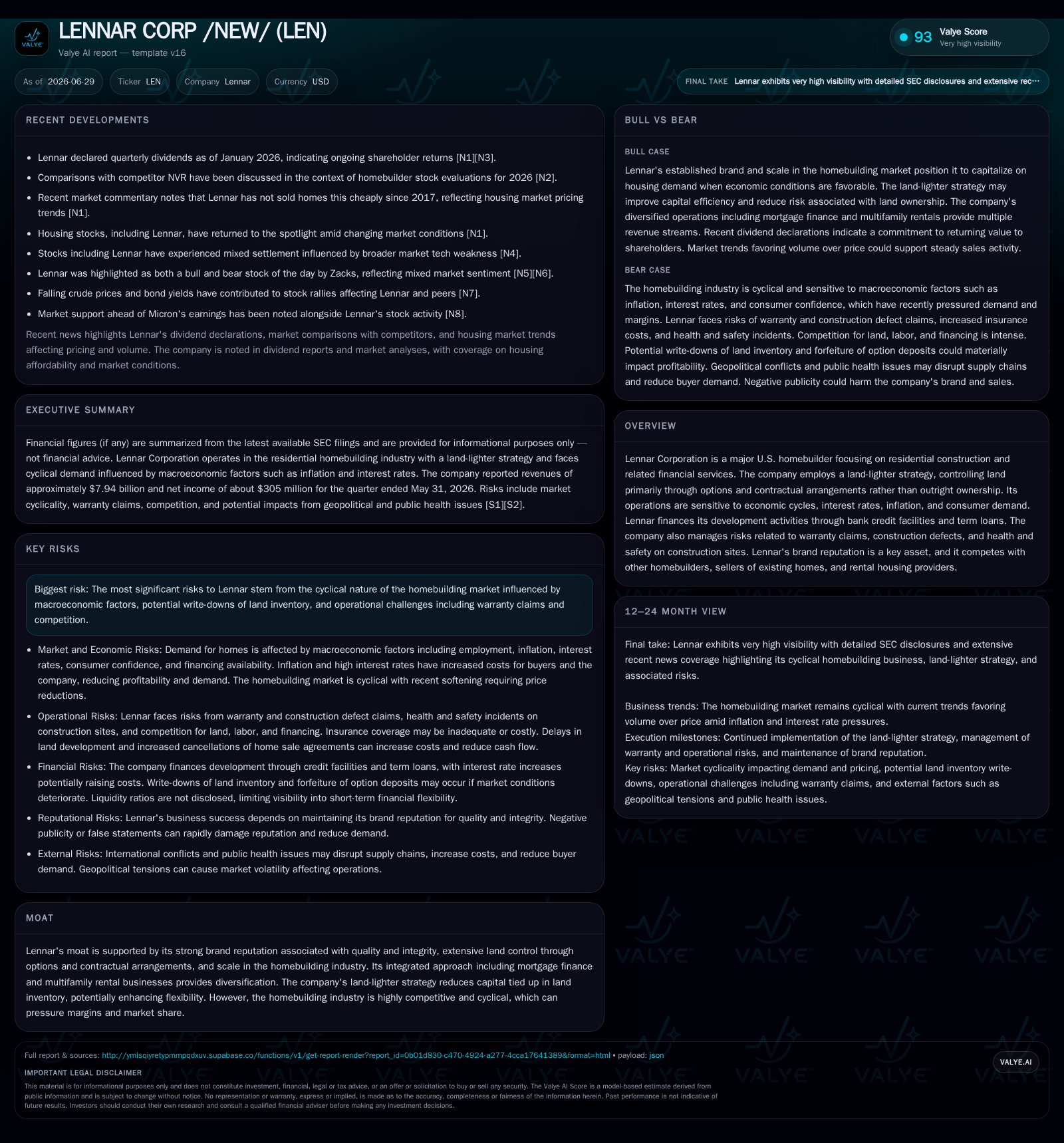
In Q2 2026, Lennar Corp reported sustained home sales volumes despite a challenging macroeconomic backdrop marked by elevated inflation and high mortgage rates. These pressures suppressed gross margins, reflecting cost inflation outpacing pricing power. Lennar’s strategic shift toward a land-lighter model—favoring land options over outright ownership—continues to enhance balance sheet flexibility but may constrain rapid expansion amid cyclical softness. Vertical integration through mortgage financing adds diversification yet ties earnings volatility to credit market conditions. The enduring strength of the Lennar brand provides resilience in customer demand, though affordability headwinds and warranty risks remain key watchpoints. Capital structure remains solid with robust liquidity and covenant compliance, supporting operational stability in uncertain housing markets.
Q2 Home Sales Trends Highlight Persistent Margin Compression Amid Inflation and Rates
Lennar’s latest quarterly filing for Q2 2026 reveals that the company managed to maintain stable home sales volume, but average selling prices (ASP) decreased modestly in real terms compared to prior periods [S2]. This dynamic reflects a weakening pricing environment driven by affordability headwinds from continued elevated mortgage interest rates. Construction cost inflation further exacerbated margin pressures as Lennar was unable to fully pass on higher input costs to buyers given prevailing demand softness. The result is a compressive effect on gross profit per home sold, a critical operating KPI reflecting profitability in residential homebuilding [S1][S2]. Such margin tension is characteristic of cyclical periods where supply-side cost pushes meet demand-side resistance from buyer cost sensitivity.
Despite this, Lennar’s ability to close homes at consistent volumes signals some durability of underlying buyer appetite even under constrained affordability. This points to the company's brand-driven pull and operational reach but raises questions about near-term pricing power sustainability if rates remain elevated or rise further.
Capital Discipline through Land-Lighter Strategy Navigates Inventory Risks but Tests Growth Optionality
Lennar continues to implement its land-lighter approach by controlling sizeable land pipelines predominantly through contractual options rather than outright ownership [S1]. As of November 2025, the company had access to nearly half a million homesites via option contracts backed by non-refundable deposits exceeding $6 billion [S1]. This structure reduces capital intensity on the balance sheet compared to traditional land banking strategies popular among some peers like D.R. Horton that rely more heavily on owned inventory.
The tradeoff is flexibility in capital deployment and reduced risk of impairment during downturns versus potential slower pace in ramping up projects should demand rebound quickly. Option contracts create contingent exposure; failure or delay in exercising options could constrict supply responsiveness or lead to write-offs if market values decline materially [S1]. Given current market softness and inflationary pressures, Lennar's strategy is prudent for capital preservation but may weigh on medium-term expansion capability.
Mortgage Financing Integration Shapes Earnings Volatility in a Credit-Tightening Cycle
The integration of mortgage financing within Lennar’s business model contributes an important revenue diversification stream but also embeds sensitivity to credit markets [S1]. With rising benchmark rates influencing both financing costs for homebuyers and Lennar’s own borrowing expenses via warehouse lines and term loans, earnings from this segment reflect heightened volatility.
The Financial Services segment reported increased operating earnings partly due to improved profit per locked loan despite tighter credit conditions [S1]. However, there remains countervailing risk from funding constraints or mark-to-market losses on mortgage-related securities hedging activities should market conditions worsen. Overall, vertical integration enhances customer offering but demands active risk management amid fluctuating interest environments.
'Lennar Brand' Intact Yet Judged by Affordability Pressures on Consumer Demand and Booking Pace
A core intangible advantage underpinning Lennar's resilience is its strong brand reputation for quality and customer trust built over decades [S1]. Management emphasizes this intangible asset as a key driver allowing maintenance of sales activity even when affordability challenges intensify due to high mortgage rates and inflation-driven price increases.
Backlog levels demonstrate some moderation reflecting cautious buyer behavior; however, deposit trends continue to support reasonable forward visibility into deliveries [S2]. The reputational moat supports moderate pricing premiums relative to competitors sensitive primarily to volume-based discounting.
Brand strength may be tested if negative publicity related to warranty claims or delivery delays arises — a standard sector risk — underscoring the importance of operational execution alongside marketing.
(Re)Establishing Competitive Ties: How Scale, Geography, and Peers Frame Lennar’s Positioning
Lennar operates at national scale comparable with leading peers such as D.R. Horton and PulteGroup while maintaining geographic diversification across growth markets including Texas, Florida, Oklahoma, Alabama, and select midwestern states [S1][S22]. This footprint allows mitigation of regional economic variability typical in housing cycles.
Compared with firms holding larger owned land inventories, Lennar's contractual option focus favors lower capital commitment but parallels some contemporary homebuilders shifting away from heavy balance sheet exposure amid cyclical uncertainty. Integration of mortgage financing alongside homebuilding also differentiates Lennar's offering versus pure builders reliant solely on transaction volume.
Together these elements position Lennar competitively for capturing outsized returns during eventual recovery phases while sustaining operational agility during downturns.
(Sustainably) Growing Demand: Household Formation Trends versus Macro Rate Constraints
Longer-term demand fundamentals for new housing remain intact given demographic tailwinds such as millennials progressing into prime homebuying ages coupled with sustained low unemployment levels driving household formations [S1]. Urbanization trends favor suburban single-family developments aligning with core product offerings.
Nevertheless, elevated mortgage interest rates act as an intercept on near-term demand realization as higher monthly payment burdens reduce effective purchasing power. The resultant dampening effect on housing starts and backlog formation tempers revenue growth expectations despite positive structural drivers.
Continuous monitoring of these macro inputs alongside tracking building permit issuance will provide leading indicators for future volume inflection points.
Constraints on Near-Term Expansion: Interest Rates, Inflation, Warranty Claims & Regulatory Risks
Several capex and operating risks temper Lennar's near-term prospects. Rising input costs driven by inflationary labor and materials trends challenge margin preservation efforts absent corresponding price increases [S1]. Interest rate volatility affects both buyer willingness and Lennar's financing expense profile.
Warranty claim liability exposures inherent in construction projects present contingent cost risks compounded by potential reputational damage if not managed effectively [S24]. Regulatory hurdles including zoning changes or permit delays can lengthen cycle times impacting delivery scheduling.
These factors collectively underline the complex interplay between external economic forces and internal operational execution required for sustained profitability.
(Investor Lens) Financial Flexibility & Covenant Compliance Support Stability Amid Market Uncertainty
This conservative capital posture shields operations from refinancing risks prevalent during tightening credit cycles while preserving capacity for opportunistic investments or share repurchases.
This analysis synthesizes SEC filings through June 29, 2026 combined with sector insights relevant to residential homebuilding dynamics without forward-looking projections beyond disclosed information. It highlights how Lennar navigates cyclical margin pressures via strategic capital allocation centered on a land-lighter model balanced against macroeconomic headwinds in interest rates and inflation impacting housing affordability.
Disclaimer: This is research-only, informational analysis and not investment advice. It may include AI-generated interpretation and general industry context. Always verify important details using primary sources.

Comments