
Kroger Leverages Private Labels and Retail Media Amid Operating Challenges
Kroger’s Q1 2026 results highlight the interplay between robust private label sales, expanding retail media revenues, and operational pressures from labor and supply chain dynamics.
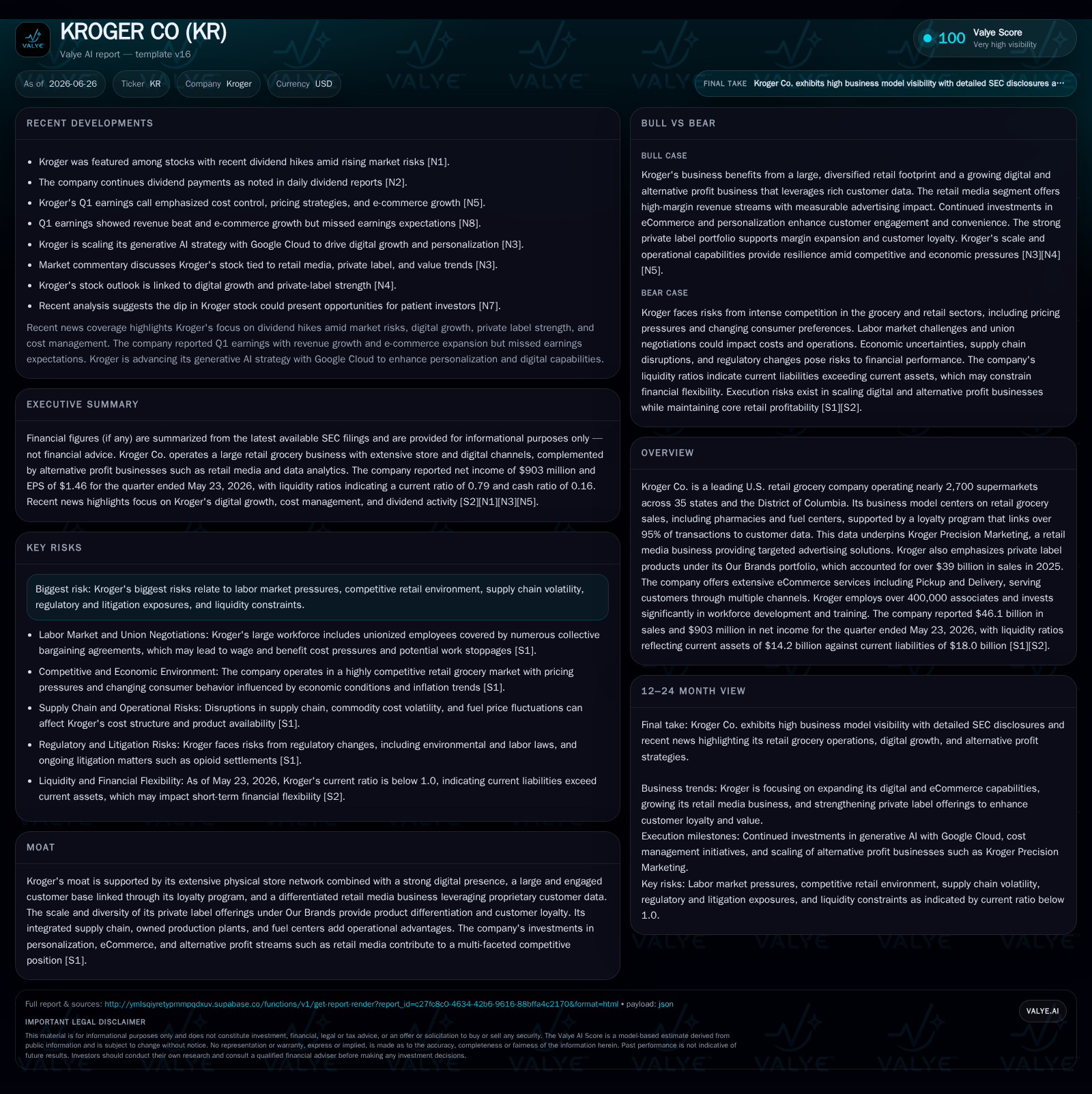
In its latest quarterly filing for the period ended May 23, 2026, Kroger reported $46.1 billion in sales and $903 million in net income, reaffirming its status as a major U.S. supermarket operator with a diverse revenue base. Key updates include segment reporting alignment with management decision-making and the reclassification of pension and interest expenses affecting comparability. Kroger continues to drive growth through its Our Brands private label portfolio and Kroger Precision Marketing retail media business powered by an extensive loyalty program covering over 95% of transactions. However, the company faces margin headwinds from inflationary labor costs and supply chain volatility while investing heavily in omnichannel capabilities such as pickup and delivery services. Its competitive position reflects scale advantages balanced against intense competition from discount and online players.
Quarterly Operating Update: Key Changes and Impacts
Kroger’s first quarter results for the fiscal period ended May 23, 2026 revealed ongoing operational complexity amidst strategic growth initiatives. Total sales reached approximately $46.1 billion with net income of $903 million [S2]. The company refined its segment reporting structure during the quarter to align with the Chief Operating Decision Maker's (CODM) approach—focusing exclusively on its consolidated retail operations segment that encompasses supermarkets, pharmacies, and fulfillment centers across the U.S. This recasting improved clarity on operating unit performance by geography while consolidating all material profitability metrics within this segment framework [S2]. Additionally, reclassifications were applied moving accumulated other comprehensive income items into interest expense and non-service pension costs. These accounting shifts affect comparability but reflect management's intent to present clearer operating earnings insight [S2].
Notably absent were explicit same-store sales figures in this filing; however, industry commentary around stable traffic offsetting some ticket pressure suggests pricing strategy adjustments are ongoing to balance competitive positioning and inflationary inputs [N1][N2]. The firm also acknowledged persistent cost pressures from tight labor markets and supply chain disruption in its MD&A commentary—a critical factor influencing gross margin management going forward.
Business Model Overview: Revenue Streams and Product Differentiation
Kroger remains a dominant supermarket operator with almost 2,700 stores serving 35 states plus D.C., integrating pharmacies at about 83% of locations and fuel centers at roughly 64% of stores as of early 2026 [S1]. This comprehensive physical footprint blends deeply localized banners reflective of regional consumer preferences with centralized supply chain coordination. Core revenues derive from grocery product sales across fresh foods, packaged goods—including a strong emphasis on its Our Brands private label portfolio which generated over $39 billion in annual sales in FY2025—pharmacy prescriptions and retail merchandise, fuel sales through operated fuel centers, and growing eCommerce channels encompassing pickup and delivery service options [S1].
Crucially intertwined is the Kroger Plus loyalty program which captures over 95% of transactions providing rich behavioral data fed into Kroger Precision Marketing. This retail media arm leverages proprietary insights for targeted third-party advertising solutions delivering a high-margin ancillary profit stream reinvested into core store operations and innovation efforts [S1]. The omnichannel ecosystem facilitates frictionless shopping whether customers engage digitally or onsite via ExpressLane or curbside pickup options enhancing convenience—a key driver amid shifting consumer habits toward hybrid grocery fulfillment patterns [S1][N9].
Workforce investment is integral to maintaining service quality within this labor-intensive model. Kroger disclosed wage increases resulting in average hourly pay exceeding $20 with comprehensive benefits pushing total hourly compensation averages beyond $26—marking a steady upward wage trend reflecting broader industry tightness that feeds into operational costs [S1].
Competitive Positioning within Retail Grocery Sector
Kroger sits within a national supermarket tier alongside Walmart’s unmatched scale advantage combining broad general merchandise assortments with grocery leadership buttressed by sophisticated omnichannel capabilities. While Walmart leverages membership programs like Walmart+, Kroger’s loyalty program offers equivalent customer lock-in emphasizing fresh food quality, private labels breadth under Our Brands aligning somewhat with Albertsons’ regional focus on private-label differentiation.
In digital grocery commerce and retail media arenas where Amazon leads through deep platform integration plus an expansive Prime customer base, Kroger has made strategic investments aiming to advance comparable capabilities—especially through enhanced personalization fueled by loyalty-linked data insights underpinning retail media growth potential. This differentiated mix provides multiple points of competitive leverage though it must contend tactically with intense pricing pressure from discount retailers (including dollar stores) as well as warehouse clubs like Costco maintaining membership-driven economics.
Fulfillment cost control remains a balancing act in competing against pure online models requiring extensive logistics networks; however, Kroger’s hybrid stores coupled with dedicated fulfillment centers enable flexible last-mile solutions capturing diverse shopper preferences across urban/rural geographies.
Growth Drivers Shaping Future Demand and Margins
Key growth pillars identified include ongoing new store openings expanding market reach particularly in existing territories as well as new geographic zones which promises volume uplift alongside better fixed-cost absorption supporting returns on invested capital [S1]. Increasing penetration of high-margin Our Brands products has been pivotal in strengthening overall gross margin profiles while enhancing shopper loyalty through exclusive assortment breadth not replicable easily by competitors.
Retail media revenue represents an accelerating alternative profit stream benefitting directly from an engaged loyalty ecosystem enabling Kroger Precision Marketing to monetize customer proximity data with precision-targeted campaigns attracting brand advertisers seeking measurable ROI beyond conventional channels [N9]. Fuel centers contribute additional incremental revenue streams capturing affinity behaviors around convenience fueling tied integrally into overall shopping trips—while also mitigating commodity price volatility impacts through calibrated margin management.
Investment continues robustly into fresh/prepared foods responding to evolving consumer tastes prioritizing convenience without sacrificing quality—a segment where Kroger seeks differentiation relative to discount grocers focused primarily on price-sensitive baskets.
The company also focuses on personalization features powered by machine learning applied at checkout/online platforms enhancing basket sizes (ticket) through curated offers capitalizing on loyalty insights driving deeper engagement.
Risks and Constraints Moderating Expansion Prospects
Operating realities confront several headwinds including sustained labor market tightness driving wage inflation despite workforce development programs—a factor incrementally constraining margin expansion given grocery’s traditionally low-margin profile [S1]. Supply chain disruptions remain another risk vector impacting inventory turns as well as shrink rates related to spoilage or theft necessitating agile logistics adjustments amidst volatile commodity price cycles particularly reflected in fluctuating diesel costs influencing transportation spend.
Kroger is subject to regulatory scrutiny encompassing food safety laws alongside labor regulations creating compliance burdens compounded by litigation exposure noted broadly across industry peers [S1]. Cybersecurity risks loom large given the vast troves of sensitive customer data underpinning retail media—making robust governance essential lest breaches impair brand trust or incur penalties.
Capital intensity inherent in continuously upgrading store footprints for omnichannel readiness adds financial strain requiring judicious return-focused deployment amidst evolving channel economics impacted by competition from club models emphasizing membership fee offsets.
Commodity price swings particularly in fuel costs introduce unpredictability both at consumption points at pump centers as well as upstream input prices affecting assortment economics.
What to Watch Next: Execution Milestones and Indicators
Upcoming milestones center on management updates expected in subsequent quarterly calls regarding trajectory on same-store sales growth validating effectiveness of pricing strategies balancing traffic versus ticket dynamics along with shifts in basket size metrics reflecting private label adoption gains.
Further KPIs include monitoring increases in eCommerce sales contribution gauging success controlling fulfillment costs which materially impact profitability beneath topline growth narratives.
Retail media revenue growth figures remain pivotal signaling monetization momentum from loyalty data further diversifying Kroger’s margin streams.
Fuel center volume trends coupled with margin compression or expansion will also serve as barometers for ancillary business health complementing grocery core performance.
Alignment on labor cost inflation outlooks supporting strategic workforce retention without eroding competitiveness is another focal point for investors parsing execution capacity amidst tight employment conditions.
Brief Financial Profile Highlighting Current Position
As per the latest quarter ending May 23, 2026, Kroger reported operating income close to $1.89 billion with net income slightly north of $1.02 billion underscoring profitable scale despite inflationary pressures [F1]. Cash balances stood around $2.87 billion providing liquidity buffers even as total debt remains elevated consistent with capital investment cycles; best-estimate net debt stands near $9.2 billion reflecting continuing leverage typical for the sector but manageable given cash flow generation capacity [F1][S2]. The current ratio near 0.79 indicates working capital constraints customary for high-turnover retail trade where efficient inventory control offsets liabilities exposure [F1].
Overall financial posture supports ongoing reinvestment needs aligned with strategic initiatives while delivering shareholder returns sustainably albeit tempered by macroeconomic uncertainties.
This analysis is based solely on publicly available filings up to June 26, 2026 ([S1], [S2], [S3]) combined with recent news commentary ([N1], [N2], [N9]) and contextualized within sector knowledge without any speculative assertions beyond sourced evidence. No investment research views are implied or intended.
Disclaimer: This is research-only, informational analysis and not investment advice. It may include AI-generated interpretation and general industry context. Always verify important details using primary sources.

Comments