
IPO Structure Defines Patriot Acquisition’s Path Amid Time-Constrained Business Combination Quest
Patriot Acquisition Corp. launched a $160 million SPAC IPO with typical unit economics but faces narrow liquidity margins and a ticking clock to complete its business combination.
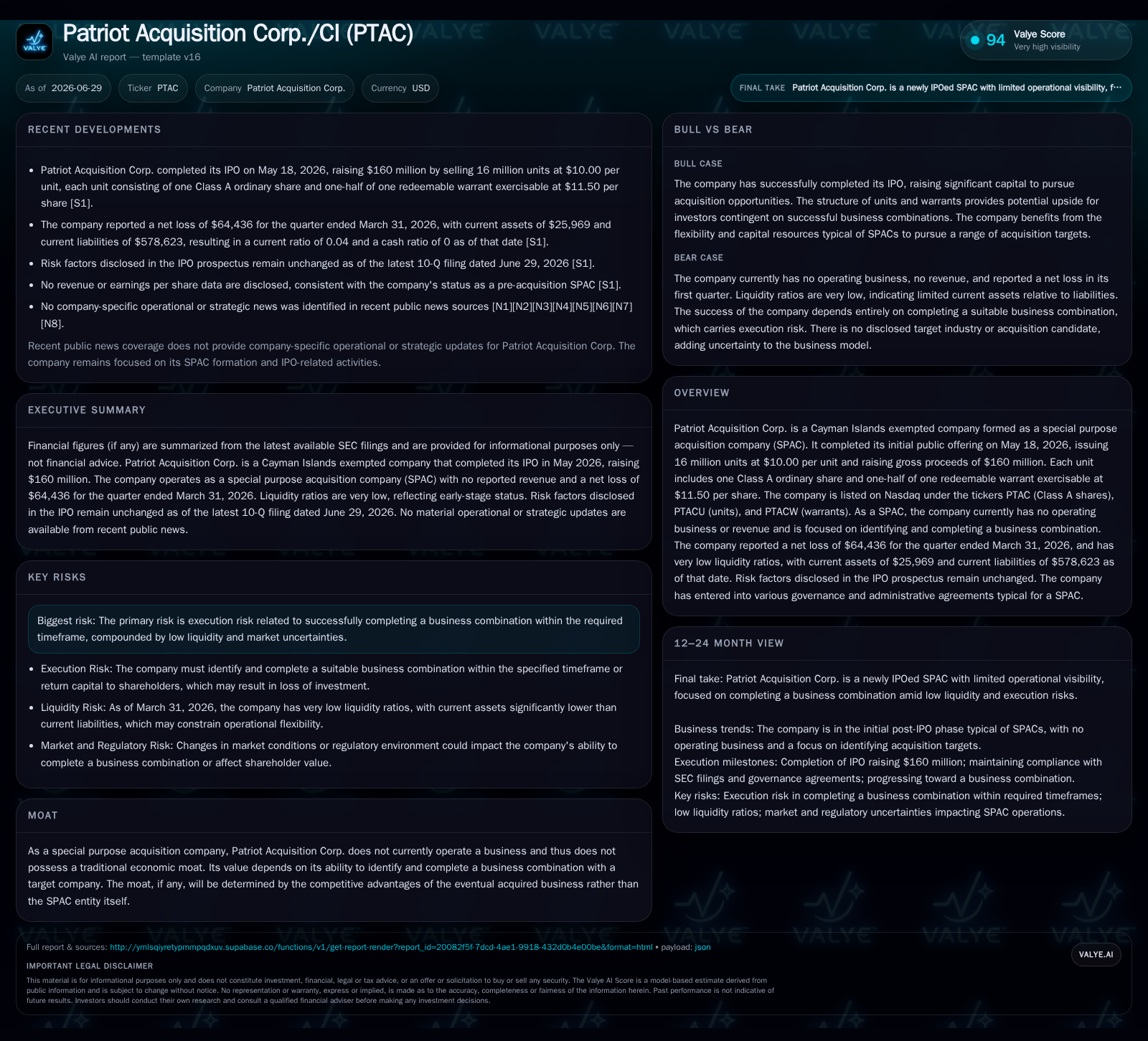
Patriot Acquisition Corp. completed its initial public offering in mid-2026, issuing 16 million units at $10 each, generating gross proceeds of $160 million, supplemented by a partial over-allotment exercise that increased trust account holdings to about $176 million. The SPAC structure includes one Class A ordinary share and half a redeemable warrant per unit, with warrants exercisable at $11.50. As of the first quarter of 2026, the company reported a net loss of $64,436 and exhibited extremely low liquidity ratios, with current assets of only around $26,000 versus liabilities exceeding $578,000, reflecting tight financial positioning before any business combination is completed. The company's success hinges on sourcing and closing an acquisition within the required timeframe while managing shareholder redemptions and dilution pressures typical to SPAC vehicles.
Q1 Operating Update Highlights Tight Liquidity Ahead of Business Combination
Patriot Acquisition Corp.'s Q1 2026 filing reveals the typical financial profile of an early-stage SPAC prior to completing any acquisition. The company recorded a modest net loss of $64,436 driven by standard administrative expenses such as legal and regulatory compliance [F1]. However, its balance sheet shows very limited current assets of just under $26,000 against substantial current liabilities exceeding $578,000 at quarter-end [F1], yielding an exceptionally low current ratio around 0.04. This imbalance underscores the precarious liquidity position outside the segregated trust account where IPO proceeds are held securely pending deployment toward a business combination or shareholder redemptions [S2]. Such constrained working capital necessitates stringent cost controls until transaction completion.
IPO Unit Structure Sets Investor Return Framework and Dilution Potential
The May 2026 IPO issued 16 million units priced at $10 each, with each unit comprising one Class A ordinary share plus half of one redeemable warrant exercisable at $11.50 per share post-combination [S3]. Warrants provide incremental equity upside contingent on share price appreciation after merger completion but also introduce dilution risks as exercised warrants increase share count. The initial gross proceeds totaled approximately $160 million from this offering. Subsequently, Keefe Bruyette & Woods exercised part of its over-allotment option by purchasing an additional 1.5 million units at $10 apiece for roughly $15 million more [S18]. These combined funds—approximately $176 million—are held in a U.S.-based trust account intended to protect investor capital until utilized in an acquisition or returned upon liquidation [S14].
Industry Context: Fundraising Terms Align With SPAC Peers but Sponsor Detail Is Sparse
Patriot Acquisition’s IPO terms mirror industry standards seen among comparable vehicles such as Churchill Capital Corp and Social Capital Hedosophia, which combine shares with subordinate warrants exercisable above fixed strike prices. Underwriting by KBW aligns with common practice where reputable syndicates contribute credibility during capital raises [S3]. Yet unlike some peers with publicly known sponsor track records or announced acquisition pipelines, Patriot has not disclosed specifics on sponsor expertise or target candidates [S2], leaving market participants reliant on execution capability amid competitive deal sourcing environments.
Sponsor Pipeline Quality and Market Conditions Are Critical Execution Variables
SPAC sponsors rely heavily on their networks and sector insights to identify private companies suitable for rapid public listing via de-SPAC transactions. Given market cyclicality affecting SPAC demand and regulatory scrutiny trends, Patriot must capitalize swiftly on sponsor relationships within an approximate 18-month window post-IPO to secure attractive deals [S14]. The absence of visible target disclosures or negotiation updates increases execution uncertainty and elevates investor reliance on sponsor diligence.
Shareholder Redemption Rights Pose Key Funding Uncertainty
A hallmark feature of SPAC structures is public shareholders’ ability to redeem their shares before deal consummation. High redemption rates can substantially diminish cash available for acquisitions from trust accounts—sometimes forcing renegotiations or reliance on supplemental PIPE funding or sponsor capital contributions. While Patriot has yet to report redemption statistics due to its early stage [S2], this factor remains a pivotal risk influencing transaction size and structure.
Over-Allotment Exercise Provides Marginally Enhanced Capital Buffer
The partial exercise of KBW's 15% over-allotment option increased total gross proceeds by approximately $15 million through issuance of an additional 1.5 million units [S18]. This increment modestly boosts trust account balances from roughly $160 million to about $176 million—a slight improvement that offers some additional flexibility for transaction-related costs but does not fundamentally change underlying timing or execution risks.
Regulatory Deadline Imposes Pressure for Timely Deal Completion
Patriot Acquisition operates under regulatory mandates requiring completion of its initial business combination within about 18 months following IPO close; failure results in mandatory liquidation with return of trust funds less expenses to shareholders,[S14]. With its May 2026 IPO only recently closed, this timeline imposes significant urgency on sponsors to deploy capital efficiently while navigating competitive acquisition landscapes amid evolving market conditions.
Administrative Expense Discipline Essential Amid Limited Working Capital
Reported net losses reflect controlled administrative spending appropriate for a non-operating vehicle focused solely on dealmaking activities [F1],[S2]. However, given minimal liquid assets outside the trust account earmarked for acquisitions, maintaining disciplined overhead management is critical to preserve funds for transaction execution costs and avoid operational cash flow pressures that could impair sponsor flexibility.
Investor Watchlist: Deal Announcements, Shareholder Votes, PIPE Financing & Redemption Trends
Key forthcoming milestones include disclosures related to definitive acquisition agreements; proxy filings seeking shareholder approval; arrangements for PIPE investments often necessary to supplement deal financing; and observed patterns in shareholder redemptions during vote periods—all factors that will clarify Patriot’s progress toward completing its business combination amid liquidity constraints,[S2]. Monitoring these events will be crucial for assessing whether the company can navigate its tight timeline while safeguarding investor value.
Disclaimer: This analysis is based strictly on publicly filed regulatory disclosures as well as general industry knowledge pertinent to Special Purpose Acquisition Companies (SPACs). It does not constitute investment advice or research views regarding securities transactions involving Patriot Acquisition Corp./CI (PTAC). Investors should conduct their own due diligence considering individual risk tolerance and seek professional consultation where appropriate.
Disclaimer: This is research-only, informational analysis and not investment advice. It may include AI-generated interpretation and general industry context. Always verify important details using primary sources.

Comments