
AmeriGuard Security Services Advances Federal Contract Moat While Addressing Concentration and Liquidity Pressures
AGSS’s reliance on federal contracts underpins a competitive moat, yet significant revenue concentration and liquidity challenges spotlight near-term operational risks.
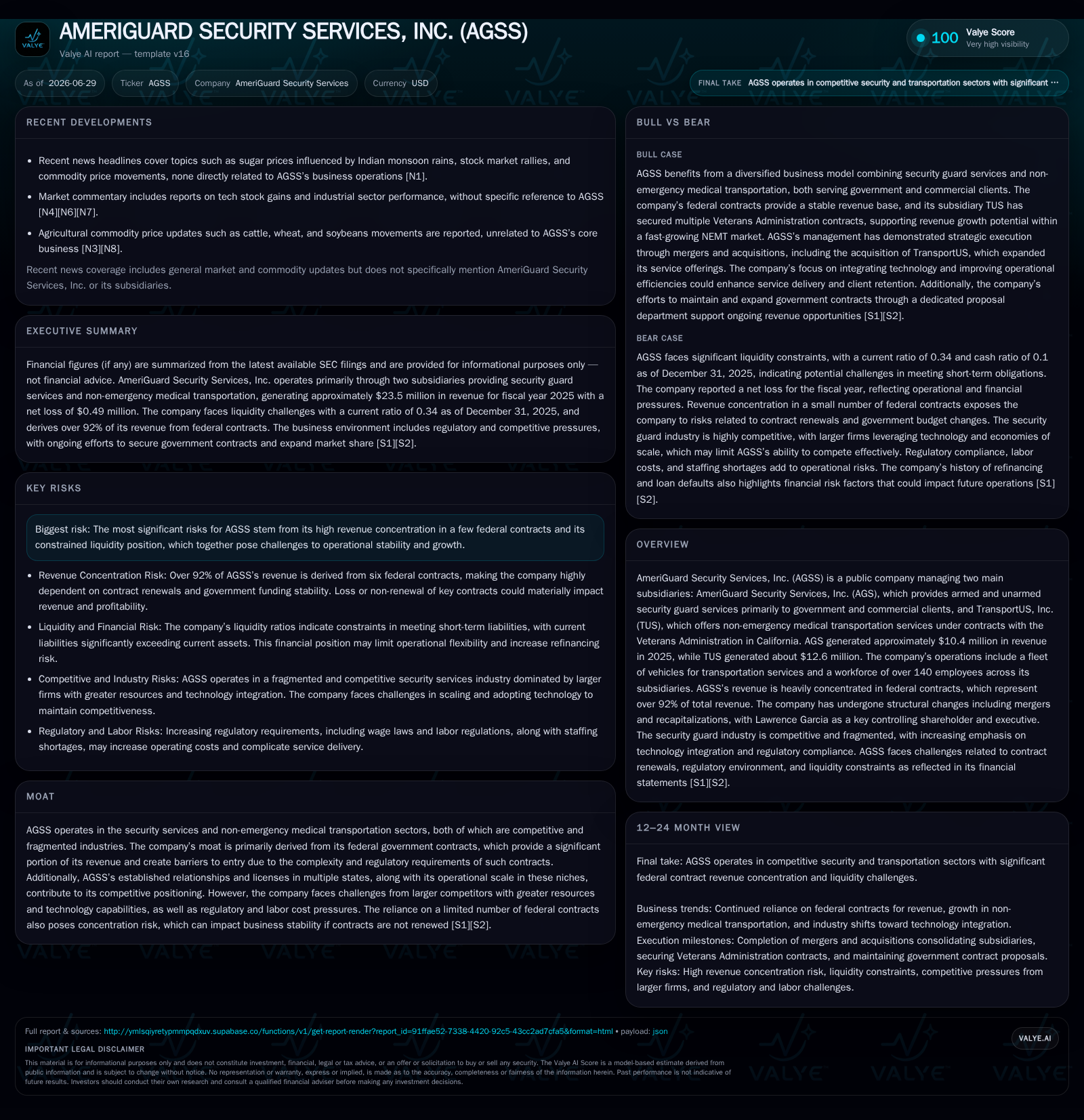
AmeriGuard Security Services, Inc. (AGSS) operates primarily through two subsidiaries providing armed/unarmed security and non-emergency medical transportation services, with over 92% of its revenue derived from a handful of federal government contracts. Recent filings reveal ongoing liquidity constraints addressed partially by a debt-for-equity swap, underscoring the company’s balance between contract-driven revenue stability and financial pressures. The security services market’s fragmentation and growing technology expectations challenge AGSS’s mid-tier scale, while the transportation segment’s fleet utilization remains critical to margin enhancement. Key risks remain contract renewal uncertainty, labor cost inflation, and tight working capital, with future growth dependent on successful contract retention and potential geographic or service expansion.
Capitalize on Federal Contract Strengths Amid Concentration Risk Challenges
AmeriGuard Security Services’ recent disclosures emphasize a business model heavily reliant on a concentrated portfolio of federal government contracts—six major agreements representing more than 92% of total revenues. This concentration creates a strategic moat due to the complexity of regulatory compliance including multistate licensing and security clearances required to serve these government clients across multiple jurisdictions [S1][S24]. Such barriers reduce new entrant threats but simultaneously expose the company to significant client concentration risk if any key contract fails to renew. Historically, AGSS has maintained contract extensions; however, the lack of future renewal guarantees means contract retention rates remain critical KPIs for revenue stability.
Recent corporate actions include issuing common stock to partially convert approximately $2.46 million of outstanding debt into equity, reflecting acute liquidity pressures that could constrain operational flexibility if not further addressed [S3][F1]. This transaction underscores the tension between maintaining a durable federal contract base and managing near-term financial health.
Dual-Service Operations: Workforce Scale Meets Fleet Utilization Demands
AGSS operates through two subsidiaries: AmeriGuard Security Services (AGS), which provides armed and unarmed guard services primarily to government entities and some commercial clients; and TransportUS Inc. (TUS), focused on non-emergency medical transportation under Veterans Administration contracts in California [S25]. In 2025, AGS contributed approximately $10.4 million in revenue while TUS generated about $12.6 million—totaling nearly $23.5 million consolidated revenue [F1].
AGS manages around 39 employees engaged in security roles requiring licenses across seven states plus commercial service provision mainly in California [S23]. Effective workforce management is essential given the high labor intensity of this segment and the impact of labor costs—which constitute the largest share of expenses—on profitability. Compliance with complex regulatory frameworks including minimum wage laws and security clearance requirements further influences labor cost dynamics.
TransportUS maintains an approximately 70-vehicle fleet composed of sedans, minivans, and wheelchair-accessible vans supported by continuous dispatch coverage year-round. Fleet utilization directly impacts profitability since underutilized vehicles represent idle capital costs while efficient scheduling improves margin capture [S25]. These operational differences necessitate distinct management approaches: labor productivity optimization for security personnel alongside logistical efficiency for transport assets.
Competitive Dynamics in Fragmented Security and Transportation Markets
The security services industry is highly fragmented with competition spanning small local operators to large national firms like Allied Universal or G4S that leverage scale advantages including technology-enabled service platforms enhancing client retention rates [S10][S23]. Operating at mid-tier scale with revenues near $10 million for AGS places AGSS among smaller regional players facing pressure to invest in workforce stability and technological integration to maintain competitiveness.
Similarly, the non-emergency medical transportation market experiences consolidation driven by private equity-backed firms capable of managing regulatory complexity alongside expanding geographic footprints [S10]. Competitors commonly deploy integrated talent management systems and fleet tracking technologies setting operational benchmarks that mid-sized players must meet or exceed.
Although licensing requirements create entry barriers favoring incumbents, they also impose ongoing cost burdens that can hinder rapid scaling. AGSS must balance compliance investments against client demands while monitoring competitor contract wins as indicators of shifting market positioning.
Growth Drivers: Contract Expansion & Operational Leverage Potential
Growth prospects hinge on expanding federal/state government contract portfolios through renewals or new awards as well as geographic license expansions leveraging existing multistate authorizations [S1]. Strategic acquisitions or partnerships may also support scaling but depend on improved capital structure following recent debt conversions.
Operational leverage improvements rely heavily on controlling labor costs—especially reducing turnover among security staff—and increasing fleet utilization efficiency within TransportUS’s specialized transport operations [F1]. However, prevailing wage law compliance coupled with tight labor markets present structural challenges limiting margin expansion absent pricing adjustments or technology adoption.
Liquidity challenges are acute as evidenced by a December 2025 current ratio near 0.34 due to current liabilities ($7.66 million) significantly exceeding current assets ($2.58 million) [F1]
Labor-related exposures compound financial strain: Department of Labor investigations into prevailing wage violations have resulted in back wage obligations exceeding $1.3 million with unpaid portions extending into early 2026 [S9]. These obligations threaten cash flow even as settlements may limit disruption.
Additionally settled wage-and-hour class actions highlight persistent regulatory compliance risks inherent in workforce-intensive models typical for this sector [S9]. Together these factors raise execution risks around sustaining contracts amid tighter margins.
Monitoring Priorities: Contract Renewals & Debt Restructuring Impact
Upcoming milestones include several major renewal decisions—particularly TransportUS’s Veterans Administration contracts tied to contingent share issuances—critical for top-line continuity [S25]. Successful renewals will underpin revenue visibility.
Financially, the March 2026 debt-for-equity conversion reduces interest burdens potentially enhancing capital flexibility but will require monitoring for dilution impacts and working capital effects [S3]
Operational KPIs such as employee turnover rates among security guards and drivers influence labor cost efficiency while fleet utilization rates directly affect transport profitability—both warrant close tracking.
These metrics will reveal whether AGSS can leverage its federal contracting advantages while mitigating operational risks amid constrained liquidity.
Financial Profile Discussion
In April 2026, AmeriGuard executed a share issuance exchanging common stock for partial settlement of approximately $2.46 million in outstanding debt—a strategic move aimed at easing liquidity pressures amid significant working capital deficits [S3]. As of December 31, 2025, cash stood at about $729K against current liabilities exceeding $7.66 million resulting in a constrained current ratio near 0.34 signaling tight short-term liquidity requiring active management intervention [F1].
The financial position underscores dependence on fresh capital injections coupled with disciplined expense control; sustained improvements will depend on stabilizing contract income streams alongside optimizing labor productivity and fleet asset utilization—the core levers shaping sustainable cash flow generation within this service-intensive business model.
Disclaimer: This is research-only, informational analysis and not investment advice. It may include AI-generated interpretation and general industry context. Always verify important details using primary sources.

Comments