
Franklin Templeton Holdings Trust’s FGDL ETF Anchored on Responsibly Sourced Gold Amid Rising Market Dynamics
FGDL’s performance hinges on gold price fluctuations and ESG differentiation underpinned by its specialized ETF structure.
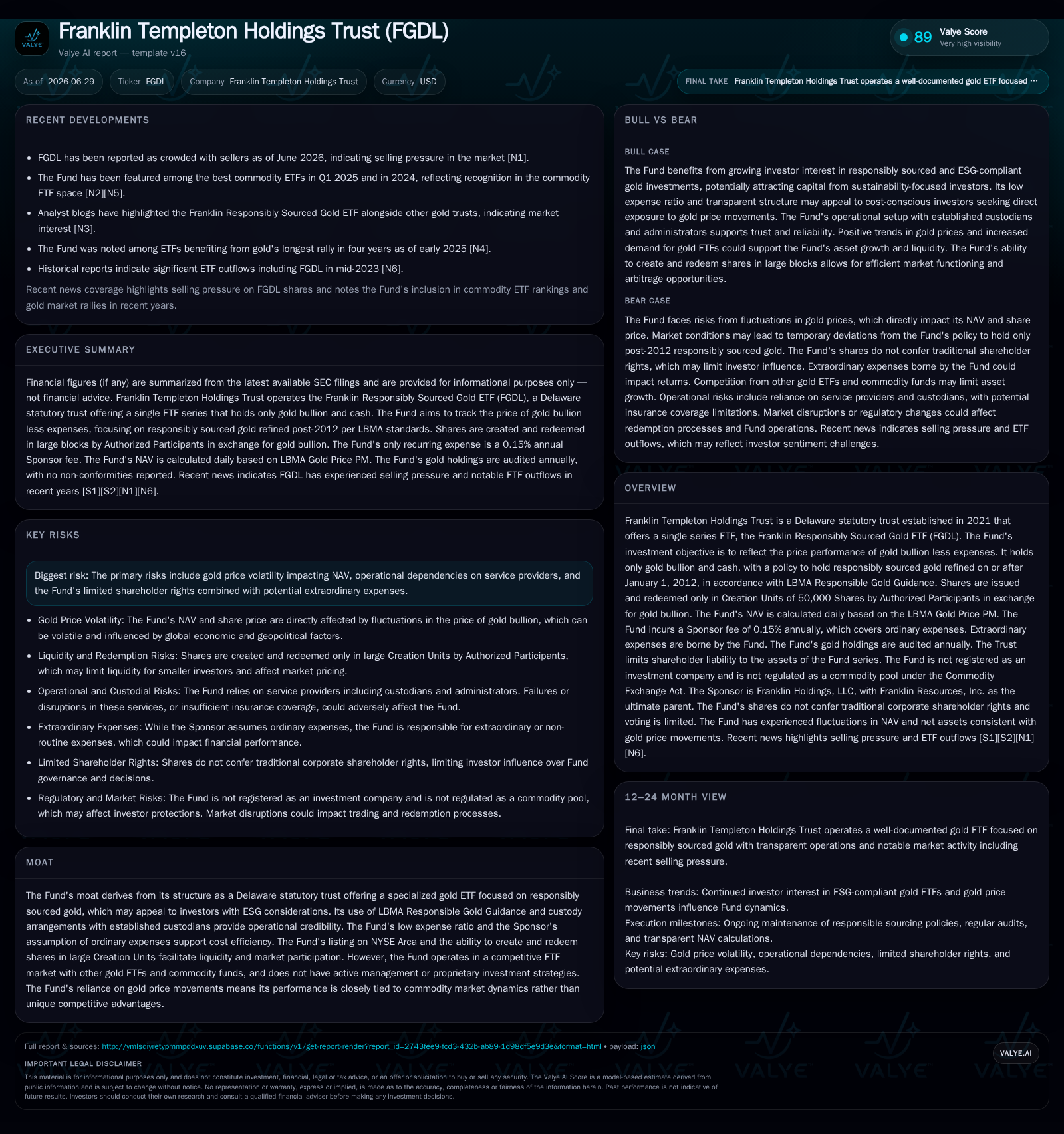
Franklin Templeton Holdings Trust operates a single-series ETF—Franklin Responsibly Sourced Gold ETF (FGDL)—that tracks gold bullion prices adjusted for expenses, focusing exclusively on responsibly sourced physical gold. The latest quarterly results highlight strong NAV growth aligned with rising gold prices and steady issuance activity driven by Authorized Participants. The Fund’s low expense ratio of 0.15% and commitment to LBMA Responsible Gold Guidance enhance its appeal within the competitive gold ETF asset class, particularly for ESG-conscious investors. However, market risks related to gold price volatility and operational dependencies present ongoing challenges. Monitoring AUM trends, creation/redemption volumes, and potential extraordinary expense exposures will be key to assessing sustained growth and investor confidence.
Recent Operating Update: Navigating Gold Price Tailwinds and Fund Activity
The most recent quarterly filing dated February 17, 2026 [S2] confirms that FGDL experienced meaningful net asset value (NAV) growth aligned closely with an approximate 38% rise in the LBMA Gold Price PM during 2025. Specifically, the Fund’s NAV per Share advanced from $41.54 to $57.39 over nine months ending December 31, 2025 [S8]. This price appreciation drove a realized and unrealized gain of around $100 million on held gold bullion despite sponsor fees accruing at the customary annualized rate of 0.15%, which amounted to roughly $343k during this period.
Creation activity was robust with nearly 4 million new Shares issued—in exchange for approximately 52,646 ounces of physical gold—while redemption was modest at 350,000 Shares returned for about 4,667 ounces of gold [S8]. This issuance-to-redemption dynamic boosted net assets under management (AUM) towards $465 million by period end, signaling both investor appetite for physical gold exposure and effective market mechanisms for share liquidity through Authorized Participants.
Subsequent event filings from May 2026 [S3] show personnel additions within Franklin Holdings LLC aimed at strengthening accounting and financial operations support for the Trust’s Sponsor entity. No material legal proceedings or adverse claims were reported through the annual filing dated June 29, reinforcing operational stability [S5].
Business Model: Specialized Physical Gold Exposure With an ESG Focus
Franklin Templeton Holdings Trust operates under a Delaware statutory trust structure offering the Franklin Responsibly Sourced Gold ETF (FGDL). Its core investment objective is to provide returns that reflect movements in the market price of physical gold bullion less applicable expenses [S1]. FGDL diverges strategically by exclusively holding ‘‘responsibly sourced’’ London Good Delivery gold bars refined on or after January 1, 2012 in accordance with LBMA Responsible Gold Guidance—a globally recognized framework that verifies traceability and ethical extraction standards [S1]. This explicit ESG alignment taps into growing investor demand for commodities with verifiable sustainability credentials.
Shares represent fractional undivided interests in the underlying allocated gold bullion held securely in vaults via JPMorgan Chase Bank’s London branch acting as the Gold Custodian [S25]. Cash holdings are minimal and managed by BNY Mellon as Cash Custodian and Administrator [S25]. All Fund transactions occur exclusively through Authorized Participants authorized via a Participant Agreement who create or redeem shares in Creation Units consisting of 50,000 Shares each—a structure common among commodity ETFs that supports institutional liquidity while limiting retail-level issuance/redeem activity [S1], [S2].
Revenue is generated primarily from Sponsor Fees equal to an annualized 0.15% of daily NAV accrued daily and paid monthly in arrears [S2]. The Sponsor absorbs all ordinary operating expenses such as custody fees, listing fees (NYSE Arca), audit costs, SEC registration fees, mailings, trustee fees up to a ceiling of $500k legal annually—and may elect at its discretion to assume excess legal costs—maintaining the expense ratio at a competitive level against peer commodity ETFs [S4], [S23]. This arrangement incentivizes Sponsor cost discipline but leaves extraordinary expenses—legal claims or litigation outside ordinary scopes—directly impacting Fund value.
Importantly, Shares carry limited shareholder rights; voting privileges are confined to matters deemed desirable by the Sponsor who otherwise controls amendments and operational discretion via conversion of trust documents without shareholder consent [S13], reflecting typical statutory trust governance but limiting shareholder activism or recourse beyond investment exposure.
Industry Structure and Competitive Position
Within the broad asset management landscape centered on listed Exchange-Traded Funds (ETFs), FGDL occupies a niche as one of several pure-play physical gold ETFs competing for investor allocations seeking access to bullion price exposure plus ethical sourcing provenance. The ETF industry is highly developed with dominant funds like SPDR Gold Shares (GLD) and iShares Gold Trust (IAU) commanding much larger scale but typically lacking explicit responsible sourcing criteria broadly incorporated by FGDL.
FGDL's use of LBMA Responsible Gold Guidance certification differentiates it amid intensifying investor demand for ESG-compliant products driving premium inflows in commodities investment vehicles that can verify traceability—a feature increasingly critical given supply chain complexities across global mineral markets [S22]. Operationally, FGDL leverages established third-party custodianship systems typical in commodity ETFs; JPMorgan London reliably manages physical bullion safekeeping while BNY Mellon ensures precise NAV calculation tied to twice-daily LBMA benchmark pricing conducted through electronic auctions administered by IBA
Creation/redemption processes relying on Authorized Participants facilitate liquidity akin to other commodity ETFs but also concentrate counterparty risk toward these entities who must maintain pre-approved unallocated accounts facilitating immediate execution—aspects typical across large ETFs but important watchpoints given FGDL's relatively smaller scale makes substantial single-entity redemptions potentially impactful on secondary share liquidity [S21], [S24].
Growth Drivers: ESG Demand and Market Volatility Favor Gold Exposure
Several structural trends support FGDL’s growth potential:
- Rising ESG Awareness in Commodities: Increasing investor preference for sustainable commodities directly supports funds like FGDL that hold transparently sourced bullion certified against LBMA guidance. This can broaden retail and institutional interest beyond typical safe-haven demand.
- Gold Price Volatility: Macroeconomic uncertainty and inflationary pressures typically increase safe-haven demand for physical gold exposure providing tailwinds for NAV growth subject to cyclical swings impacting returns directly.
- ETF Market Expansion: The shift from mutual funds toward ETFs continues across asset classes supporting aggregate inflows into commodity ETFs that offer low-cost transparent access.
- Operational Efficiency & Fee Discipline: Maintaining low expense ratios financed largely through Sponsor assumption of ordinary costs enhances fee competitiveness relative to peers.
- Liquidity Enhancement via Authorized Participants: Expanding AP networks improves creation/redemption efficiency essential for sustaining tight trading spreads and secondary market liquidity.
Monitoring KPIs such as net capital flows measured by creation/redemption volumes alongside average trading volumes on NYSE Arca can provide early indication of shifts in investor interest or liquidity dynamics.
Risks / Watchpoints / Growth Constraints
Key risks embedded within FGDL's business model include:
- Gold Price Volatility: Because holdings mirror changes in spot gold prices nearly one-to-one less expenses, NAV fluctuations can be pronounced impacting investor willingness to accumulate or retain shares especially during downturns or sharp sell-offs driven by macroeconomic shocks or speculative sentiment changes [S23].
- Operational Dependencies: Reliance on external custodians (JPMorgan), administrator (BNY Mellon), trustee (CSC Delaware Trust Company), and Authorized Participants concentrates counterparty risk exposures.
- Regulatory Status: FGDL is a Delaware statutory trust—not a registered investment company under the Investment Company Act nor a commodity pool overseen by CFTC regulations—which curtails traditional investor protections potentially limiting appeal among more regulated institutional mandates [S23], [S24].
- Limited Shareholder Rights: Absence of substantive voting rights or protections against amendments potentially concentrates control risk with Sponsor mitigating collective investor influence over fund decisions.
- Extraordinary Expenses Exposure: While ordinary costs are absorbed by the Sponsor, unexpected extraordinary legal or operational expenses would impact assets directly without reimbursement risk shifting volatility onto shareholders [S4], [S29].
- Liquidity Concentration Risk: Large APs dominate creation/redemption could impair secondary market functioning if significant participants withdraw engagement reducing Trading Volume and widening bid/ask spreads [S24].
This financial configuration supports high return on assets driven primarily by market price appreciation rather than operational leverage yet exposes investors fully to precious metal market cyclicality without diversification buffers inherent in multi-asset strategies.
This analysis synthesizes publicly available SEC filings up through June 29, 2026 combined with industry context reflecting typical asset management ETF dynamics governing physical commodity funds. It does not constitute investment advice but aims to clarify business fundamentals and risk factors pertinent to stakeholders evaluating the Franklin Responsibly Sourced Gold ETF’s operating profile.
Disclaimer: This is research-only, informational analysis and not investment advice. It may include AI-generated interpretation and general industry context. Always verify important details using primary sources.

Comments