
CRESUD's Dual-Asset Model Navigates Argentine Economic Volatility with Strategic Debt Management
The latest quarterly filings reveal CRESUD’s progress on fixed-rate notes repayment alongside robust gains in trading properties, underscoring its asset diversification amid currency and commodity fluctuations.
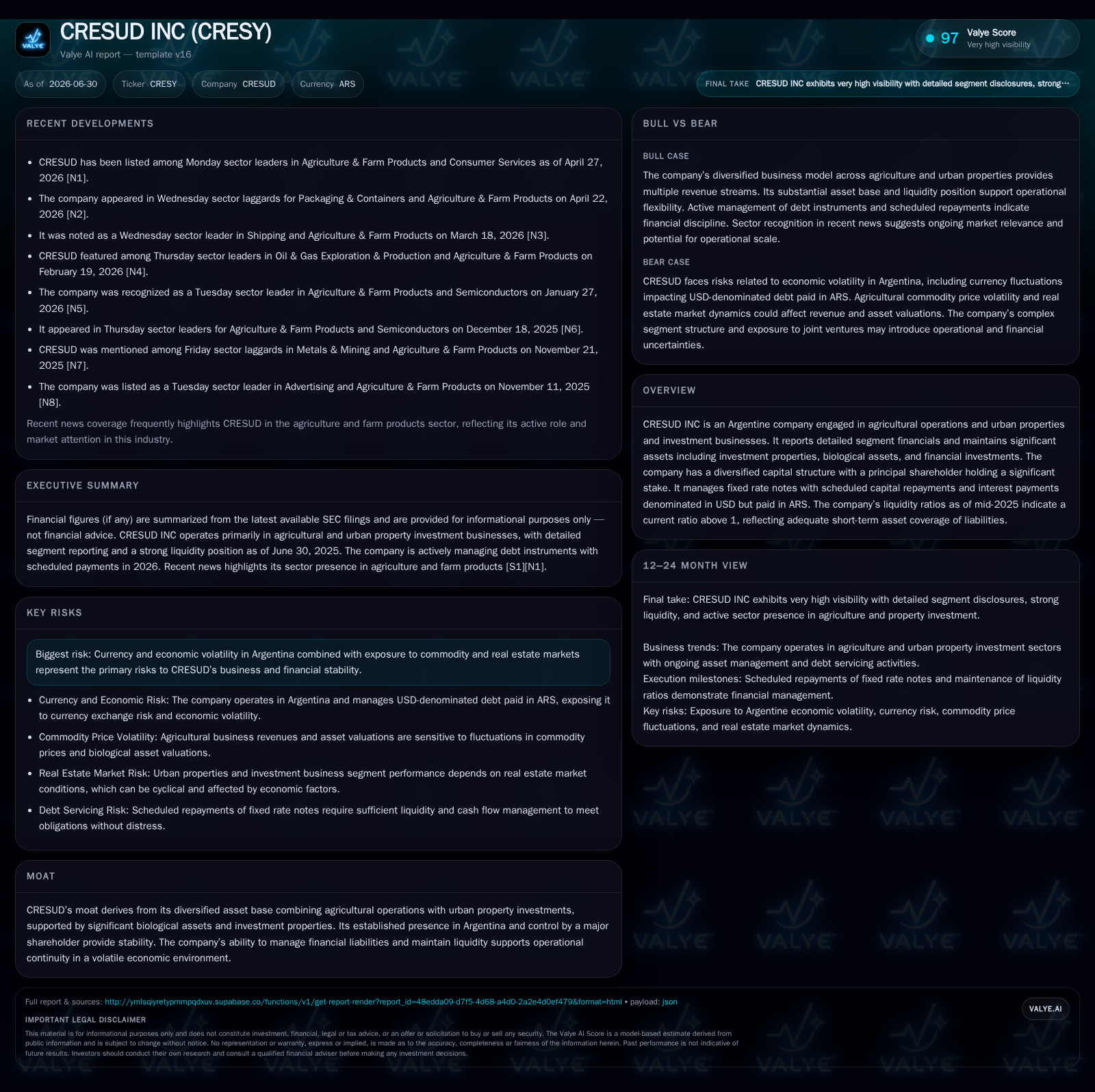
CRESUD Inc continues to balance its agricultural operations and urban real estate investments, leveraging a diversified portfolio that includes biological assets and investment properties. Recent filings confirm the company’s advancement in scheduled USD-denominated fixed-rate note repayments paid in local currency, highlighting effective management of currency risk. Gains from trading property sales demonstrate ongoing asset monetization, bolstering operating income despite Argentine economic volatility. The business model’s strength lies in this diversification, though persistent macroeconomic risks remain significant. Monitoring future crop yields, property valuations, and debt servicing will be key to assessing sustainable growth.
Recent Operating Update
The most immediate development for CRESUD is the commencement on June 22, 2026, of the second installment payment of capital on its USD 38.2 million Series XL Fixed Rate Notes issued in late 2022. Notably, although principal is USD-denominated, payments are made in Argentine pesos at prevailing exchange rates [S2]. This mechanism exposes CRESUD to currency risk but demonstrates active liability management within a challenging local currency environment. Successfully executing this repayment installment without reported disruption signals operational resilience.
Complementing debt management efforts, the company recorded a substantial gain of ARS 4.3 billion stemming from the sale of trading properties amounting to ARS 4.65 billion against associated costs of ARS 344 million during the latest interim period [S3]. This transaction underscores a strategy of monetizing non-core or surplus urban assets to enhance cash flow and profitability.
Business Model Analysis
CRESUD uniquely integrates two distinct yet complementary operational lines: agricultural production and urban real estate investment. The agricultural arm manages extensive biological assets—including planted crops designated for harvest valuation—while the urban segment focuses on investment properties such as shopping malls and office buildings with recurring rental income streams [S3][S11]. This dual-asset approach diversifies revenue sources across volatile commodity markets and relatively stable rental markets.
Revenue mechanics unfold as follows: agriculture revenues derive from crop sales volume influenced by hectares under cultivation and crop yields per hectare; valuation changes in biological assets at harvest add an accounting dimension sensitive to commodity prices [S11][S13]. Urban property revenues hinge on rental occupancy rates, average lease durations, and fair value adjustments of investment properties driven by local real estate demand dynamics [S11][S13]. Trading properties provide an opportunistic channel for capital gains via sales or exchanges.
Margins are shaped by variable agricultural input costs and fluctuating market prices combined with steady operating expenses linked to property management and development. Crop yield improvements can enhance gross margins structurally but are exposed to weather risk. Urban assets benefit from long-term lease contracts offering margin stability but remain sensitive to macroeconomic cycles affecting tenant solvency.
Industry Structure & Competitive Position
A major competitive differentiator is CRESUD’s asset diversification which cushions against sector-specific downturns; agricultural slowdowns can be offset by steady rental income streams. However, local peers may compete aggressively for land acquisition or premium urban tenants amid high land value appreciation trends.
Control by principal shareholder Eduardo Elsztain's consortium owning roughly 39% voting stock consolidates decision-making power but could concentrate governance risks [S3]. The company maintains notable scale with thousands of hectares under cultivation combined with sizable urban property holdings reflecting an integrated asset management profile uncommon among peers.
Growth Drivers
Fundamental growth catalysts include rising global demand for agricultural commodities which can lift crop pricing power benefiting biological asset valuations. Simultaneously, Argentina’s urbanization supports increasing rental demand that drives investment property valuations upward.
Strategic land acquisitions documented in recent quarters indicate efforts to expand productive capacity or unlock new development projects [S26]. Improvements in farming technology or infrastructure could incrementally boost crop yields per hectare—an essential KPI linking physical output improvements directly to revenue growth potential.
Favorable commodity price cycles would amplify agricultural earnings consistency while currency stabilization or risk mitigation through hedging could improve net margins by reducing foreign exchange costs associated with dollar-payments under fixed rate notes [S2][F1].
Finally, diversification into higher-margin real estate segments such as office space redevelopment or retail expansions presents incremental profit opportunities that support longer-term financial sustainability.
Risks and Watchpoints
Agricultural operations face typical sector headwinds including climatic risks (droughts/flooding), which directly affect yields – a primary volume driver translating into revenue volatility. Real estate valuations depend on maintaining healthy occupancy rates amidst tenant bankruptcy risks during downturns.
Regulatory changes concerning land ownership or urban development constraints also have potential disruptive effects on planned expansions or asset repositioning strategies.
Finally, shareholder concentration carries governance risk; investors should watch any shifts in control dynamics that might impact strategic flexibility or minority interests.
What to Watch Next
Key indicators to track include segment revenues broken out between agricultural output volumes/prices and urban rental income trends revealed in upcoming quarterly disclosures. Crop yield statistics per hectare similar to prior measuring periods would indicate operational execution.
Monitoring fair value adjustments on investment properties will clarify whether real estate valuations sustain their recent positive re-ratings or if market headwinds emerge [S11][S13]. Observing progress against scheduled amortization of fixed rate notes through payments made at prevailing FX rates will reveal if currency depreciation accelerates refinancing challenges or liquidity stress points [S2].
Capital expenditure updates linked to both farmland acquisition/improvement and urban property refurbishment projects provide insight into growth investments balancing cash flow priorities [S26]
Additionally, any announced hedging policies or strategic initiatives addressing FX exposure would significantly influence risk profiles going forward.
Financial Profile Discussion
The USD-fixed interest notes represent a critical component of financial liabilities; scheduled capital repayments commenced mid-2026 demonstrating proactive debt servicing yet exposing the company to currency translation risks given peso-based payment mechanics [S2]. Interest rates remain at zero percent nominal for this tranche mitigating carrying costs but shifting FX dynamics dominate credit risk considerations.
Continued focus on balance sheet robustness coupled with disciplined capital allocation toward high-yield agricultural inputs or selective urban developments will be essential for maintaining financial health while navigating macroeconomic uncertainties characteristic of the Argentine operating context.
Disclaimer: This is research-only, informational analysis and not investment advice. It may include AI-generated interpretation and general industry context. Always verify important details using primary sources.

Comments