
Bluemount Holdings’ Shift to Luxury Timepiece Trading Reshapes Revenue Mix and Operational Profile
The company’s latest quarterly filing shows a marked pivot from consulting toward luxury goods trading, with growing investment management fees adding diversity.
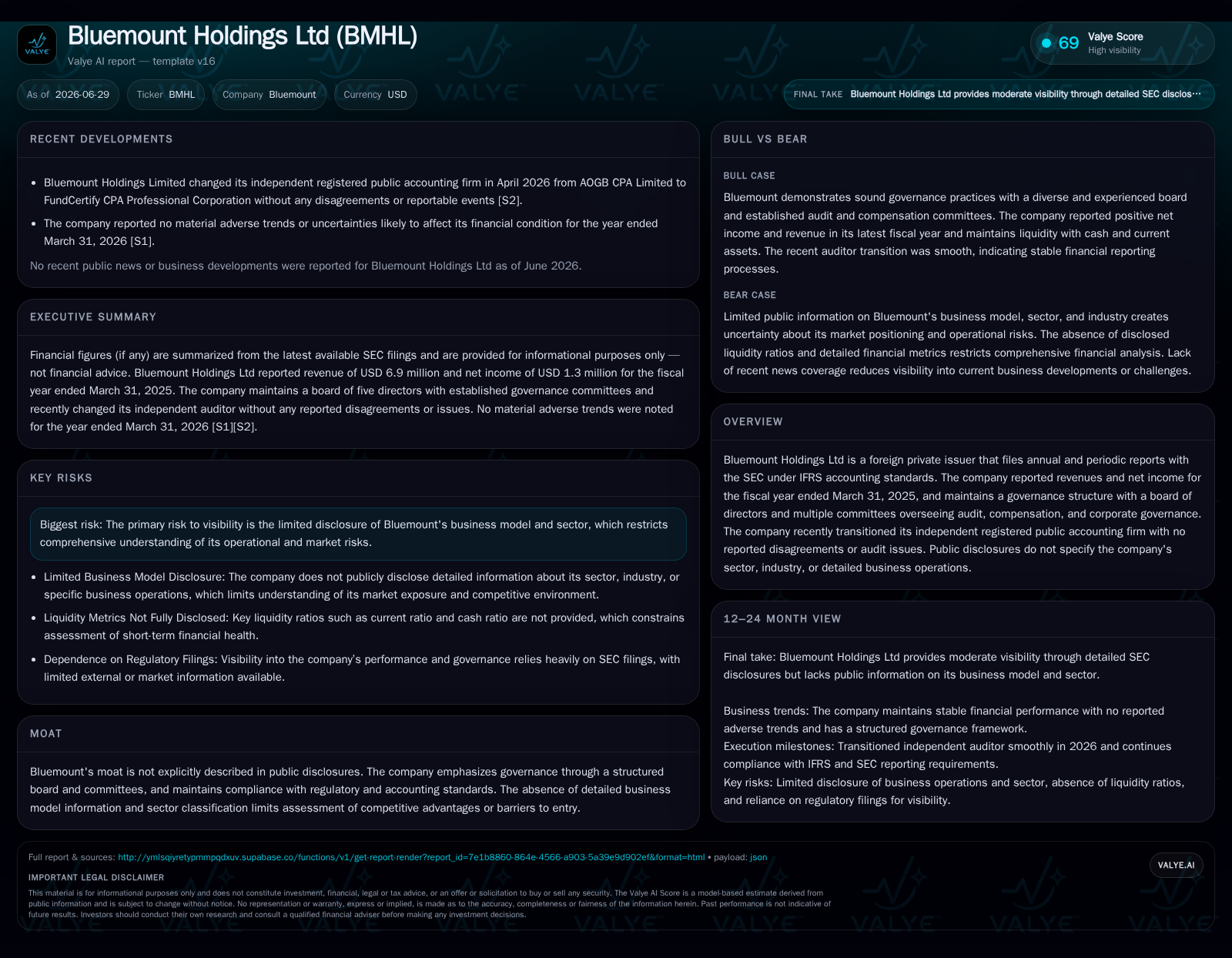
Bluemount Holdings Ltd disclosed a significant shift in its revenue composition for the fiscal year ending March 31, 2026, as revealed in its latest filings. Consulting and advisory services, once the core revenue contributor, have dramatically declined as a percentage of total revenue, yielding dominance to luxury timepiece trading which now constitutes over three-quarters of revenues. Concurrently, financial services income—comprising investment management fees, brokerage, underwriting, and placing commissions—is growing but remains a smaller segment. The company operates within a hybrid industry blending diversified financial services with luxury goods trading, demanding robust client acquisition capabilities and risk management across both sectors. Bluemount’s recent governance enhancements and audit firm transition underscore efforts to strengthen internal controls amid these evolving business dynamics.
Recent Operating Update
Bluemount Holdings Ltd’s latest SEC filing (6-K dated April 20, 2026) signals an important milestone: a seamless transition in its independent registered public accounting firm to FundCertify CPA Professional Corporation with no audit disagreements or reported issues during the prior audits [S2]. This aligns with broader efforts addressing previously disclosed material weaknesses in internal control over financial reporting—a critical governance enhancement given the company's increasingly complex hybrid business model combining financial services with luxury goods trading.
Their fiscal year ended March 31, 2026 (as detailed in the recent annual report dated June 29, 2026) reveals a substantial reshaping of the company’s operating profile [S1]. Total revenues rose by about 15% year over year to HK$62.1 million (roughly US$7.96 million), yet the composition shifted markedly: advisory service income dwindled from dominating at roughly 57% in FY2024 down to only about 8.7% by FY2026. Simultaneously, trading of luxury timepieces tripled in proportional contribution from approximately 40.5% to over three-quarters of total revenues
Business Model Overview
Bluemount derives revenues through three principal lines: consulting/advisory fees primarily linked to business development strategy projects; financial services revenues including underwriting and placement services largely tied to transaction volumes and asset under management; and trading margins on luxury timepieces sourced from secondary markets or suppliers for resale.
The advisory segment historically formed the core but now plays a reduced role as a share of revenue—this indicates either strategic de-emphasis or market-driven contraction in advisory engagements. Conversely, the pronounced growth in luxury timepiece trading points toward aggressive inventory scaling aiming at capturing demand for premium timepieces—a market characterized by high ticket sizes but also significant valuation volatility and inventory holding risks requiring disciplined turnover metrics.
Financial services activity has expanded notably but remains modest relative to dominant segments. Investment management fee income climbed significantly from HK$766K in FY2024 to HK$9.28 million in FY2026 as assets under management grew alongside stable fee schedules ranging from 0.90% to 2.00%, highlighting success in client onboarding and portfolio scaling [S22]. Brokerage commissions remain minimal reflecting limited transactional volume or client breadth.
Revenue mechanics thus combine fixed/performance-linked advisory fees; asset-linked recurring investment fees; transactional brokerage/underwriting commissions correlated with market activity; plus luxury timepiece gross margins sensitive to pricing power and inventory turnover efficiency.
Industry Structure and Competitive Position
Operating at the intersection of diversified financial services and luxury goods retailing places Bluemount within a unique niche demanding dual expertise: rigorous regulatory compliance for securities-related activities overseen by Hong Kong’s Securities and Futures Commission (HKSFC), coupled with operational excellence managing high-value inventory susceptible to economic cycles affecting discretionary spending.
Peers span traditional advisory firms like Moelis which focus purely on financial fees, contrasting with luxury specialists such as Watches of Switzerland that emphasize inventory optimization. Bluemount’s hybrid model aims for diversification benefits but faces execution challenges balancing capital sensitivity in inventory against regulatory capital requirements for financial subsidiaries—several of its operating entities maintain capital well above minimum HKSFC thresholds [S5][S10].
Retail demand shocks could impair luxury sales volumes while market volatility directly impacts asset management fee income through NAV fluctuations [S1]. The company must navigate risks stemming from currency exchange exposures (though HKD peg mitigates USD/HKD FX risk), credit exposure on trade receivables—amplified by recent impairment upticks—and cybersecurity threats given sensitive client data handled via financial transactions
Growth Drivers
Bluemount’s revenue trajectory is propelled principally by:
- Continued expansion of asset base driving investment management fee growth where retention rates and AUM yield sustain top-line momentum.
- Robust increasing demand for collectible luxury timepieces evidenced by steep year-on-year growth (+147% from FY24 to FY25; +44% from FY25 to FY26) which fuels gross margin gains albeit at elevated capital intensity.
- Incremental brokerage/underwriting service offerings offering moderate potential scale through heightened transaction volumes.
- Strategic client acquisition efforts seen in enhanced investment fund clientele underpinning fee income expansion.
Operating cash flows have been uneven: positive net inflow turned sharply negative in FY2026 driven mainly by working capital swings including substantial drawdowns on trade receivables juxtaposed against sizeable reductions in payables and client bank balances suggesting aggressive collection efforts or contract timing effects [S7]. Financing activities saw net inflows primarily due to equity issuance totaling approximately US$5 million mirroring recent IPO proceeds that injected fresh capital for expansion initiatives [S7][S19].
Cost structure challenges remain due largely to higher cost of sales attributable to increased luxury goods transactions alongside rising staff-related expenditure supporting advisory segments creating upward pressure on operating expense ratios [S22]. Given these factors, forward operating leverage depends heavily on continued top-line growth especially within lucrative investment fee income coupled with improved receivables collection efficiency mitigating impairment risk impacts.
Disclaimer: This analysis is based exclusively on publicly available SEC filings dated April and June 2026 combined with curated sector knowledge about diversified financial services integrated with luxury goods trading businesses relevant to Bluemount Holdings Ltd. It refrains from speculative forecasts or investment research views.
Disclaimer: This is research-only, informational analysis and not investment advice. It may include AI-generated interpretation and general industry context. Always verify important details using primary sources.

Comments