
Franklin Solana Trust Offers Passive Regulated Access to Solana with Integrated Staking via SOEZ ETF
The Trust operates a single ETF providing exposure to Solana cryptocurrency and staking rewards, emphasizing operational integrity and regulatory clarity in a nascent crypto ETF market.
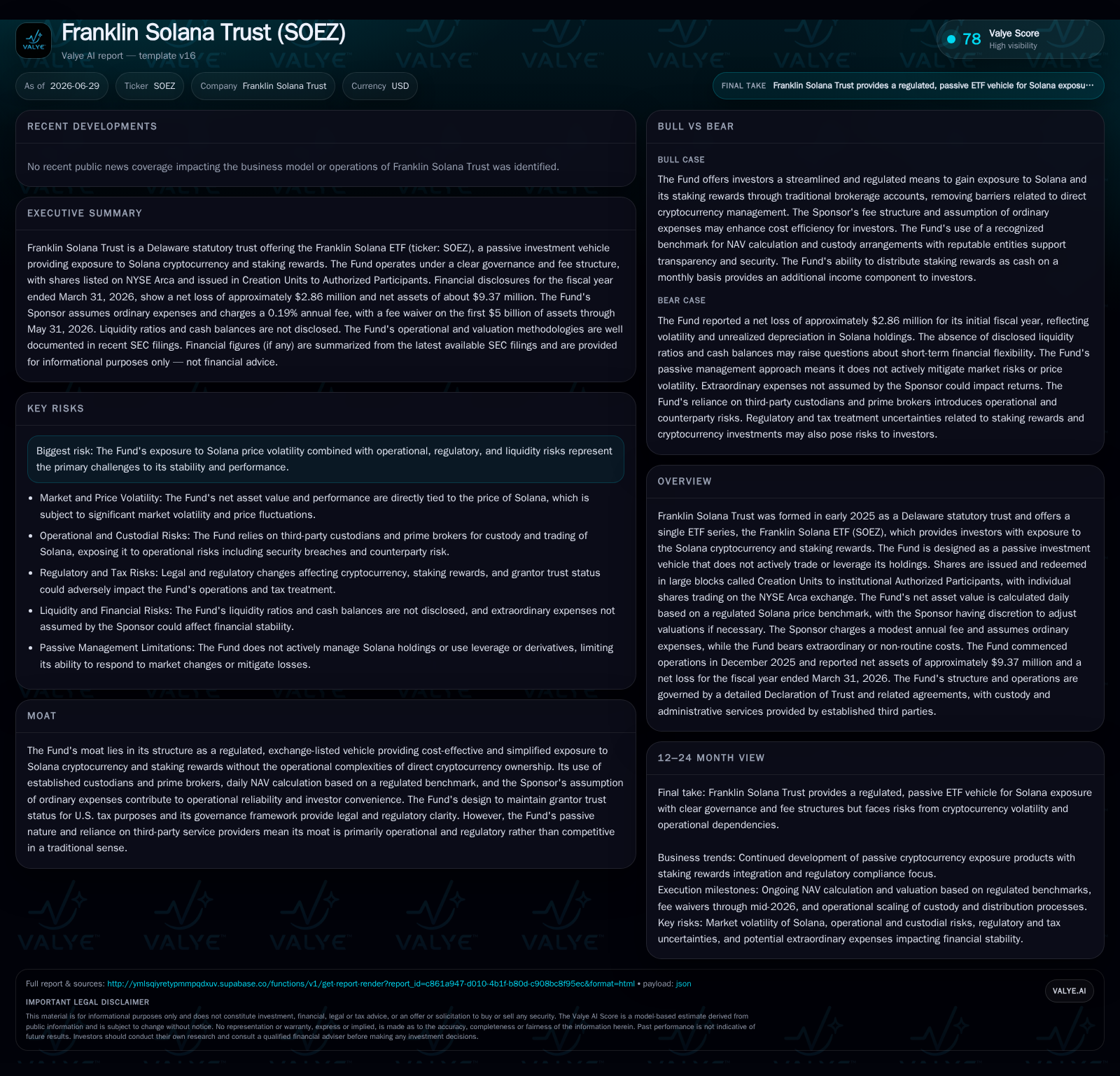
Franklin Solana Trust, launched in early 2025, administers the Franklin Solana ETF (ticker SOEZ), a passive investment vehicle that delivers regulated exposure to Solana cryptocurrency and staking rewards without direct ownership complications. The Fund uses established custodians including Coinbase Custody and BNY Mellon for asset safekeeping and daily NAV calculations, while Authorized Participants facilitate liquidity through creation and redemption of large blocks called Creation Units. The Sponsor assumes ordinary Fund expenses and waives fees on assets up to $5 billion initially, aiming to enhance investor convenience amid regulatory uncertainties and operational risks inherent in crypto ETFs. Key growth drivers include rising institutional interest in crypto via regulated vehicles and expanding infrastructure for staking. Risks center on price volatility, liquidity constraints, custody counterparty exposure, and evolving tax or regulatory treatment.
Recent Operating Update
Franklin Solana Trust's latest quarterly filing dated February 17, 2026 provides critical insight into the Fund's current operating profile. The Trust continues to offer a single ETF series—Franklin Solana ETF (SOEZ)—which passively tracks the price performance of Solana cryptocurrency combined with staking rewards. As of the quarter end March 31, 2026, the Fund held approximately $9.37 million in assets under management (AUM) reflecting its initial growth stage since operations commenced in December 2025 [S2][F1]. The Fund’s net income showed a loss of nearly $2.85 million over this period primarily reflecting market valuation changes combined with start-up operational costs [F1].
Significantly, Authorized Participants transact solely in Creation Units of 50,000 shares or multiples thereof at net asset value (NAV), facilitating efficient institutional liquidity while individual shares trade freely on the NYSE Arca exchange. The process involves converting cash flows into Solana tokens or vice versa mediated by prime brokers such as Coinbase Prime Broker Service and market makers including Jane Street and Virtu Financial under formal agreements executed by the Trust [S9][S22]. This creation/redemption mechanism ensures alignment between share prices and underlying asset values even as market volatility impacts Solana prices.
The Sponsor has also instituted a fee waiver for Sponsor fees on assets totaling up to $5 billion until May 31, 2026 historically signaling willingness to foster adoption without burdening shareholders prematurely—a notable competitive feature among crypto ETFs whose fee structures vary widely based on operational scale [S17]. Ordinary ongoing expenses such as administration fees paid to BNY Mellon and custody fees are borne by the Sponsor up to $500K annually but extraordinary or unusual expenses would be charged directly to the Fund [S1][S17].
Business Model Overview
Franklin Solana Trust operates within the emerging niche of cryptocurrency-based ETFs structured as passive investment vehicles. Its business model centers on holding actual Solana tokens secured via reputable custodians rather than using derivatives or futures contracts. Revenue derives primarily from management fees tied to net assets; however, recent waivers imply limited revenue realization at nascent scale [S17]
The Fund makes use of creation/redemption transactions involving large block sizes (Creation Units) executed by Authorized Participants—typically registered broker-dealers—that bear responsibility for maintaining secondary market liquidity. This dual-channel approach balances institutional-level NAV-based transactions with retail aftermarket trading on NYSE Arca.
Notably, the Fund seeks to maximize staking participation—earning incremental return from network consensus activities—by delegating staking operations entirely to Coinbase Crypto Services under contract. While staking enhances yield potential relative to pure price exposure ETFs, it introduces additional fee deductions (~8% of gross staking rewards) and regulatory complexity regarding classification as a grantor trust for tax purposes [S1][S17][S22].
The Fund’s passive nature means it does not actively trade held tokens based on price outlooks or employ leverage—a strategic choice reinforcing simplicity but exposing investors fully to Solana price fluctuations. This structure appeals particularly to investors desiring regulated access to crypto exposure without direct wallet management burdens or counterparty settlement risks common in unregulated digital asset platforms.
Industry Structure and Competitive Position
The Exchange-Traded Fund industry has increasingly embraced cryptocurrency exposures through specialized vehicles offering better-regulated access than unhosted wallets or proprietary exchanges. Franklin Solana Trust competes alongside other single-crypto ETFs such as Grayscale Bitcoin Trust (GBTC) that focus on Bitcoin exposure but differs by offering unique stake-enhanced returns on an altcoin (Solana).
As one of only a handful of ETFs providing fully backed digital asset exposure combined with integrated staking rewards under a Delaware statutory trust framework, SOEZ positions itself in an underserved segment seeking legitimacy amid regulatory scrutiny towards digital asset funds. Its use of well-established financial infrastructure providers like BNY Mellon for administration/custody alongside Coinbase Custody aligns it strongly with best-practice operational standards essential for investor confidence.
However, compared with more prominent traditional equity or bond ETFs—which benefit from decades of scale economies—the small AUM base limits fee revenues today while exposing the fund’s economics to fixed cost pressures typical for start-up crypto products. Competing crypto-tracking products that rely on futures or less direct synthetic exposures may offer lower cost structures or different risk-return profiles but lack physical backing advantages.
Growth Drivers
Key tailwinds underpinning Franklin Solana Trust’s growth trajectory include:
- Institutional Demand: Growing investor appetite for diversified regulated access points into cryptocurrency markets fuels demand for vehicles like SOEZ that remove custody/technical barriers.
- Staking Yields: Participation in network staking creates incremental income streams above pure token price appreciation—a critical differentiator enhancing total returns if appropriately managed.
- Regulatory Clarity: As U.S regulators incrementally clarify permissible structures around crypto ETFs and related tax treatments, fund designs compliant from inception stand poised for adoption advantages.
- Infrastructure Maturation: Continued enhancements in custody technology, prime brokerage services, and exchange mechanisms reduce operational frictions crucial for scaling creation/redemption processes.
- Passive Investment Trend: Rising capital flows into passive strategies support broad ETF growth including novel asset classes like cryptocurrencies.
Monitorables include updates from company periodic filings discussing regulatory developments affecting staking eligibility, evidence of any material service disruptions reported by custodians or brokers during quarterlies, shifts in AUM trends driving Sponsor fee revenues post-waiver expiration.
What To Watch Next
Investors tracking SOEZ should prioritize several near-term markers:
- Quarterly filings detailing changes in net assets under management beyond initial startup phase driving improved economics for Sponsor fees.[S2]
- Market liquidity indicators such as average daily trading volume on NYSE Arca reflecting broadened retail investor engagement.
- Updates pertaining to enhancement or diversification of prime broker agreements potentially reducing counterparty concentration risk.[S9]
- Possible expansions of stakeable assets within the fund increasing catchment beyond sole reliance on Solana.
- Regulatory commentary specifically addressing approval statuses or restrictions impacting staking reward distributions.
- Monthly distributions reflecting actualized staking income passed through after relevant lag periods evidencing yield contribution.[S24]
Franklin Holdings LLC’s staffing changes at CFO/Treasurer level reported May 8th potentially indicate efforts to bolster financial controls aligned with scaling operations [S3].
Financial Profile Discussion
While detailed financial tables are excluded per policy, it is notable from the latest fiscal year ending March 31, 2026 that Franklin Solana Trust reported a net loss approximating -$2.85 million driven largely by unrealized losses amid volatile underlying asset prices combined with initial operational outlays typical for new fund launches [F1]. The modest net asset base near $9.37 million highlights early-stage fundraising reflective of nascent investor adoption curves seen across emerging digital asset products [F1].
From an expense perspective, ordinary ongoing costs are controlled via Sponsor assumption capped at $500K annually covering administration, custody fees, exchange listing costs etc. Any non-routine expenses fall onto the Fund—a structure aiming partly at predictable cost absorption yet leaving margin pressure potential should extraordinary events arise unexpectedly [S17]
Importantly, Sponsor fees annually accrue at a fixed rate of approximately 0.19% NAV but were fully waived through May 31, 2026 for first $5 billion of assets suggesting limited near-term revenue generation despite escalating operating commitments linked to regulatory compliance maintenance and continuous NAV reporting demands.[S17] This fee strategy signals prioritization of AUM growth before monetization ramps occur.
It is not investment advice or a research view._

Comments