
Luda Technology’s Strategic Expansion into AI Data Centers Amid Industrial Hardware Revenue Contraction
Luda Technology Group Ltd reports FY2025 revenue decline driven by China manufacturing sales drop but moves into AI infrastructure with acquisition.
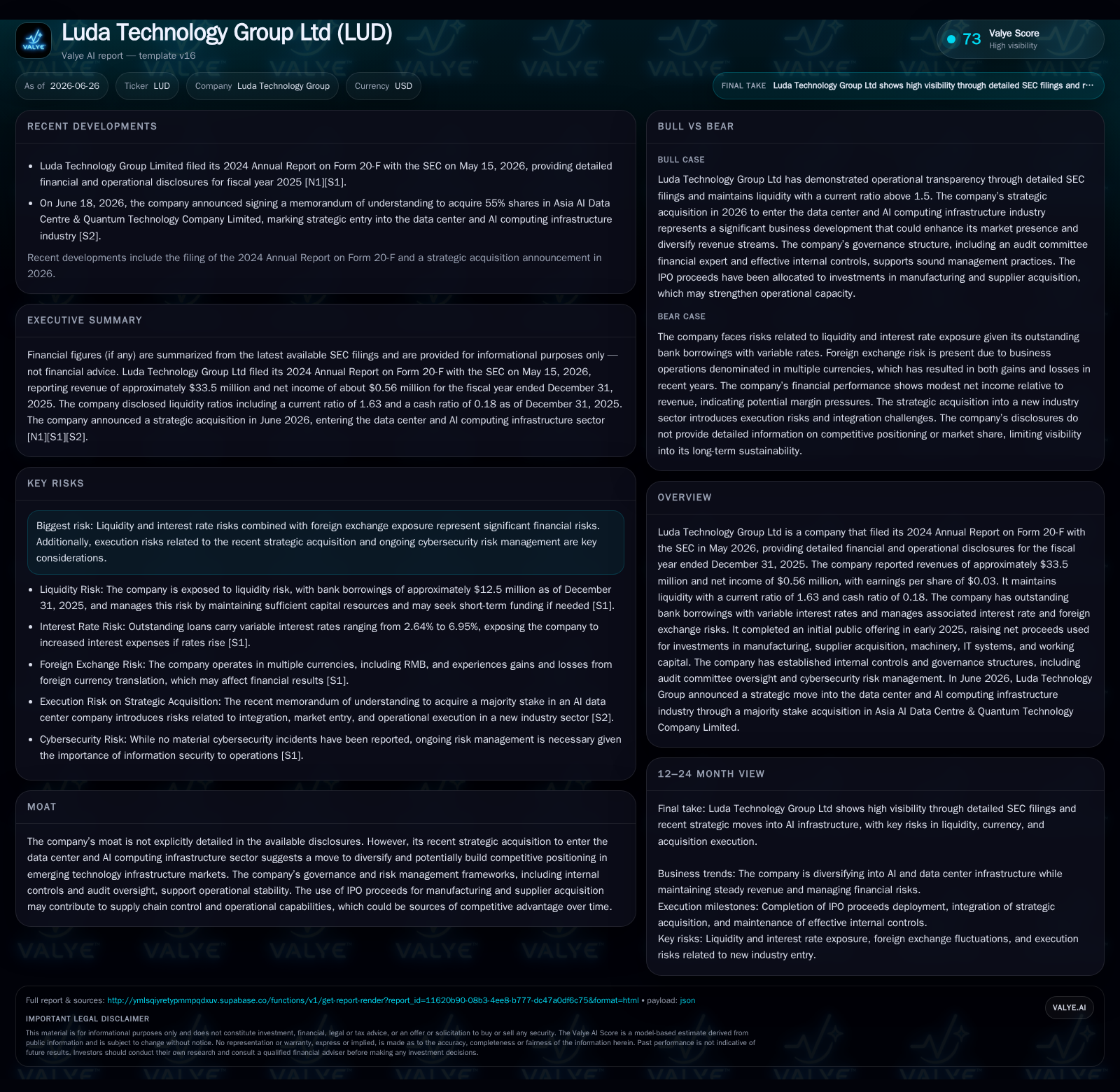
Luda Technology Group Ltd experienced a 25% revenue decrease in FY2025 primarily due to weaker sales in its core PRC manufacturing segment. Despite this contraction, the company returned to net profitability aided by other income gains and cost control. Recently, Luda signed a memorandum of understanding to acquire a controlling stake in a data center and AI technology company, signaling an ambitious diversification beyond its traditional stainless and carbon steel flanges and fittings business. The current industrial hardware market remains challenging amid lower demand and pricing pressure, but the strategic acquisition leverages growth in emerging technology infrastructure sectors. Going forward, operational execution on the acquisition and margin recovery amid steel price and currency risks are key performance watchers.
Recent Operating Update
Luda Technology Group Ltd's latest filings reveal a notable shift in its near-term operating narrative. On June 18, 2026, the company announced signing a memorandum of understanding to acquire a majority stake (55%) in Asia AI Data Centre & Quantum Technology Company Limited, marking a strategic pivot into the fast-growing data center and artificial intelligence computing infrastructure industry [S2]. This move signals Luda’s attempt to diversify its historically industrial-hardware-focused business into adjacent technology infrastructure markets that have structural growth drivers rooted in digital transformation.
Simultaneously, there was a board reshuffle with the resignation of Director Ms. Liu Liangping from the board position while retaining her COO role focusing on merger and acquisition efforts—underlining management's commitment to executing this strategic expansion [S3].
The most recent annual data for fiscal year ended December 31, 2025 shows revenue contracted sharply by over 25% year-over-year from $44.9 million to roughly $33.5 million, mostly driven by reduced sales at Luda’s PRC manufacturing arm which accounts for approximately three-quarters of total revenues [S1]. Despite this top-line pressure, Luda returned to profitability with net income of approximately $0.56 million compared to a net loss the prior year [F1,S19]. The profit rebound was helped by substantial other income related largely to realized and unrealized gains on financial investments alongside cost controls reducing selling expenses notably [S19].
Business Model and Revenue Mechanics
Luda operates primarily in two segments: manufacturing stainless steel and carbon steel flanges and fittings within its Chinese factory operation (Luda PRC), which generates roughly three-quarters of revenues; and trading operations via Luda HK consisting mainly of sourcing and reselling complementary steel pipes, valves, and tubing products internationally [S1]. This bifurcated model generates revenue predominantly through direct product sales where customers—industrial manufacturers or traders—in chemical, petrochemical, maritime and general manufacturing industries pay for finished components. Pricing is influenced by raw material steel costs, product mix between carbon vs stainless steel items, volume orders aligned with industrial capital spending cycles, and geographic distribution.
Margins tend to be higher in the manufacturing segment due to value-add processes including forging or machining flanges compared with the trading segment which provides complementary offerings but at lower margins [S1,S4]. The gross margin compression from 25.4% in FY2024 to 17.7% in FY2025 reflects both volume declines amid weaker industrial demand especially within China and some pricing erosion consistent with commodity steel price fluctuations impacting cost absorption dynamics [S4,S12]. Other operating expenses such as selling commissions linked to bid consultation fees also fell sharply (-$4.5 million) reflecting reduced commercial activity
Internally generated R&D spending remains stable at about $1.45 million annually focused on process improvements rather than disruptive innovation—a typical feature of industrial hardware manufacturers operating within mature product lines subject to incremental engineering enhancements rather than new product launches [S4,S6]
Industry Structure and Competitive Position
The industrial hardware sector is capital intensive requiring investments in foundry equipment, machining capacity, quality control systems, and supply chain reliability—aspects crucial given end customers’ stringent specifications for high-integrity components used in infrastructure projects or chemical processing plants.
Within this market context, Luda faces competition both from domestic Chinese manufacturers competing on cost efficiency as well as global suppliers emphasizing quality certification or delivery capabilities. Peer companies such as Bonney Forge Corporation or Anvil International serve as illustrative comparators offering similar portfolios but often benefiting from broader scale or more diversified downstream integration that can provide pricing leverage.
Luda’s integrated model—combining manufacturing foothold with trading platforms based out of Hong Kong—allows it some operational flexibility across channels but also exposes it to cyclical demand swings tied heavily to upstream raw steel prices and capital expenditure trends among chemical and maritime sectors which are primary end markets.
Growth Drivers
Despite recent top-line contractions, several underlying growth levers exist:
- Industrial infrastructure development initiatives particularly within emerging economies support steady demand for high-quality steel components like flanges and fittings.
- Geographic expansion beyond China into South America (20% revenue share FY2025) and Asia ex-PRC has increased steadily signaling diversification away from reliance solely on domestic Chinese markets where slowdown pressures occurred [S1].
- Strategic acquisitions such as the recent AI data center stake aim to capture higher-growth adjacent sectors less correlated with cyclicality inherent in traditional hardware supply chains.
- Incremental efficiency gains through manufacturing process improvements coupled with supply chain vertical integration pursued post-IPO enhance unit economics over time.
Expansion via acquisition into AI data center infrastructure is especially notable given global surges in computation needs for cloud services and quantum technologies—a marked departure from commodity-based hardware manufacturing toward technology-enabled infrastructure services that may command better margins long term if successfully integrated [S2].
Risks and Growth Constraints
Key risks include:
- Raw material price volatility: Steel prices significantly influence cost structure; adverse movements compress margins absent timely pricing pass-through.
- Foreign exchange exposure: Revenue denominated partly in RMB while reporting currency is US dollars introduces FX translation volatility; although FY2025 saw favorable gains ($0.6 million), adverse shifts can exacerbate earnings swings [S19,S23].
- Interest rate sensitivity: Bank borrowings totaling approximately $12.5 million carry floating rates exposing finance costs to rate hikes though current impact is moderate [$32k incremental expense per +1% rate rise] [S7,S23].
- Execution risk on new acquisitions: The recently announced acquisition into AI data center space entails integration challenges including technological complexity outside core competency.
- Liquidity management: Capital-intensive industry demands ongoing working capital funding especially amidst spending on new ventures and equipment upgrades.
- Competitive pressures remain intense from low-cost Chinese producers impacting market share gains.
- Customer concentration risk linked to industries sensitive to global trade patterns adds uncertainty.
What To Watch Next
Investors should monitor:
- Progress on closing the acquisition of Asia AI Data Centre & Quantum Technology entity including financing terms and timeline.
- Quarterly updates on integration milestones signaling whether Luda can establish foothold beyond industrial hardware.
- Operational metrics such as order backlog shifts particularly within PRC manufacturing segment indicating demand recovery or further softness.
- Gross margin trends reflecting ability to manage raw material inflation alongside pricing discipline.
- Foreign currency translation impacts especially if RMB experiences rapid devaluation or appreciation relative to USD.
- Capital expenditure plans following IPO proceeds deployment targeting plant expansion or supplier acquisitions that could improve competitive positioning.
- Changes in selling expense ratios as they relate directly to sales effort effectiveness amid market turbulence.
Financial Profile Discussion
As of year-end December 31, 2025, Luda held cash and equivalents of $4.5 million against total debt approximating $1.77 million, resulting in a net cash position of about $2.74 million—indicative of conservative leverage levels despite liquidity pressures typical for mid-sized industrial manufacturers [F1,S7,S15]. The current ratio was 1.63 based on current assets and liabilities at that date
Capital expenditures were modest at under $0.5 million for FY2025 consistent with maintenance plus incremental IT system enhancements; however significant investing activities included short-term investment purchases likely related to IPO proceeds management [S16,S18]. Interest expense stayed stable near half a million despite varying debt levels aligning with prevailing floating rates exposure.
It aims to offer an informed perspective without any investment research view or prediction about future stock performance.
Disclaimer: This is research-only, informational analysis and not investment advice. It may include AI-generated interpretation and general industry context. Always verify important details using primary sources.

Comments