
Aperture AC’s SPAC Journey: Internal Control Challenges and Initial Business Combination Deadline
The newly public Aperture AC contends with internal control material weaknesses and a looming deadline to complete a business combination.
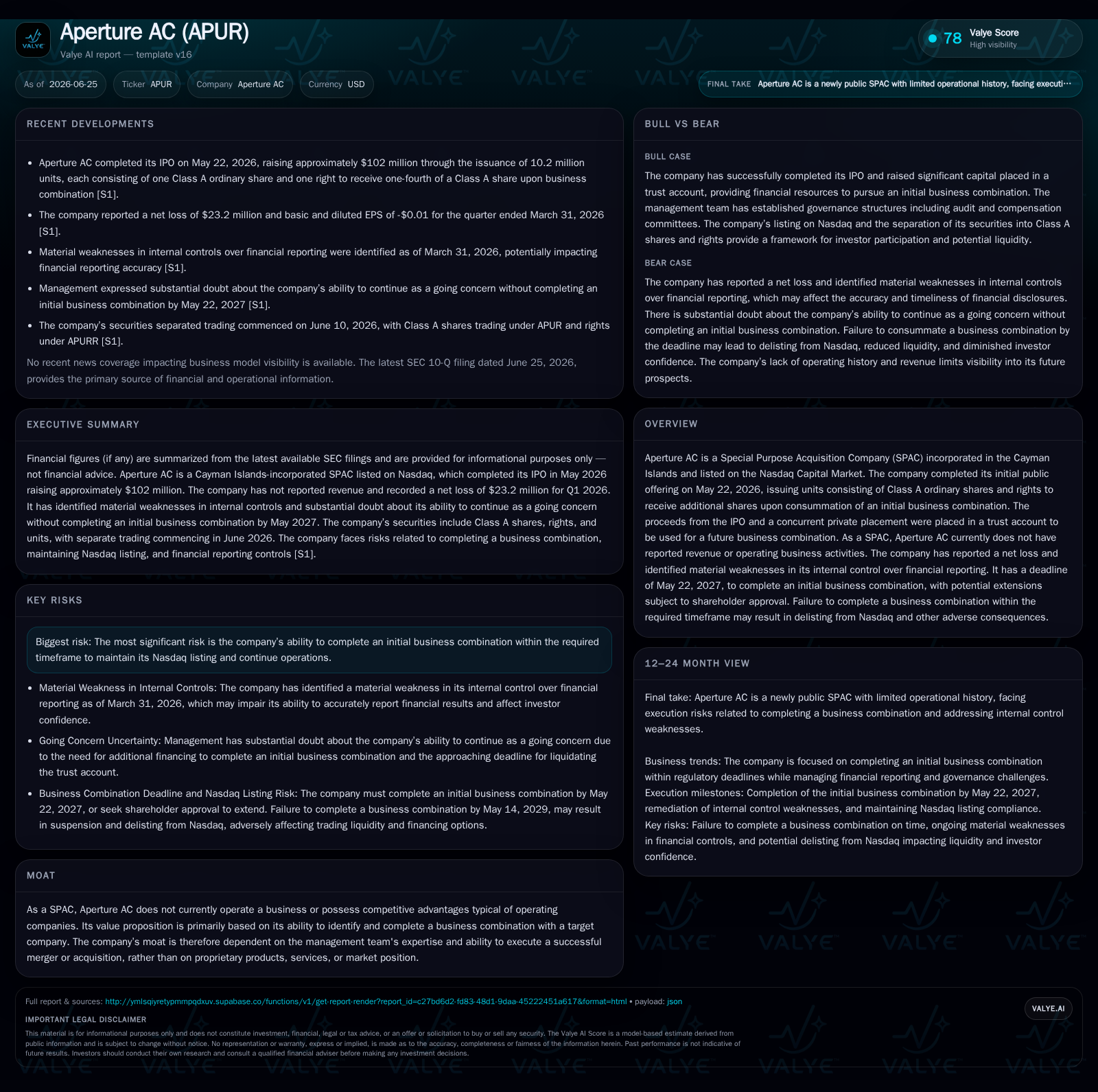
Aperture AC is a Cayman Islands-registered Special Purpose Acquisition Company (SPAC) that recently completed its initial public offering, raising over $102 million placed in a trust account. The company faces material weaknesses in its internal controls over financial reporting, raising questions about timely and accurate disclosures. It has until May 22, 2027, to consummate an initial business combination or risk delisting from Nasdaq. Success depends heavily on management’s ability to source and execute an acquisition within this window amid shareholder redemption risks.
Recent Operating Update and Its Implications
Aperture AC took key steps toward fulfilling its SPAC mandate by completing its IPO on May 22, 2026 [S6][S11][S15]. The offering raised roughly $102 million through sale of over 10.2 million units at $10 each, supplemented by a $3.1 million private placement involving sponsor-affiliated investors. Each unit comprises one Class A ordinary share and one right entitling holders to acquire one-fourth of a share upon consummation of the initial business combination. These proceeds were placed into a U.S.-based trust account managed by Continental Stock Transfer & Trust Company, safeguarding investor capital until deployment in a merger or acquisition
On June 10, 2026, the company transitioned to separate trading of Class A shares (ticker APUR) and associated rights (ticker APURR), detaching these from their original bundled unit form [S3][S5]. This separation enhances market liquidity and pricing clarity for each security ahead of anticipated shareholder redemption activity or conversion events tied to the business combination process
Business Model Overview: SPAC as Investment Vehicle
Operating solely as a shell entity with no commercial operations or revenues prior to merger completion, Aperture AC embodies the classic SPAC model. It raises capital through an IPO with proceeds held in escrow while management seeks a private target company to merge with within a specified timeframe—here set at approximately two years from IPO close.
Value creation depends entirely on identifying and executing an initial business combination that unlocks public market access for the acquired entity without traditional IPO complexities. Until then, the SPAC incurs administrative expenses associated with regulatory compliance and governance oversight.
Industry Positioning and Competitive Landscape
SPACs act as intermediaries between private companies seeking liquidity alternatives and public investors looking for new investment avenues beyond conventional IPOs or private equity funds. Aperture AC competes against other sector-targeted SPACs such as Pershing Square Tontine Holdings and Social Capital Hedosophia.
Competitive advantages derive primarily from management’s ability to source attractive targets, leverage sponsor networks effectively, and demonstrate governance rigor—all essential given the absence of proprietary products or ongoing operations before de-SPAC transaction closure.
Effective internal controls directly influence investor trust—a critical factor especially amid retail participation—making remediation of disclosed control weaknesses imperative.
Growth Drivers: Timely Execution Amid Favorable Market Dynamics
The foremost growth driver is completing an initial business combination by May 22, 2027. Achieving this milestone transitions the entity into an operating company with traditional revenue streams and profitability prospects.
Investor interest in alternative public listing routes remains strong when traditional IPO windows tighten due to market volatility or regulatory complexity. This environment favors well-positioned SPACs capable of swift deal execution.
Additional tailwinds include regulatory frameworks supportive of SPAC transactions and innovative shareholder incentive structures embedded in rights/warrants that can enhance deal attractiveness.
Emerging sectors present further opportunity where private valuations command premiums justifying public market access via mergers.
Risks and Watchpoints: Internal Control Weaknesses and Deadlines
A critical risk flagged is Aperture AC’s material weakness in internal controls over financial reporting identified as of March 31, 2026 [S2][S16][S18]. This deficiency poses challenges to timely and accurate financial disclosures essential for maintaining investor confidence during deal sourcing phases
Remediation efforts may be costly and time-intensive with no guarantees of success; failure could result in delayed filings or loss of compliance status impacting liquidity support.
Positive signals would be early disclosure of credible targets coupled with demonstrable governance improvements supporting execution credibility.
Financial Profile Discussion
The clean balance sheet lacks debt obligations at this stage given reliance on escrowed funds designed exclusively for merger deployment. Cash burn remains modest but will require prudent management ahead of transaction closure deadlines especially if redemptions accelerate reducing available capital.
This analysis is based solely on publicly disclosed information without speculation on deal pipeline specifics or forward-looking results absent direct evidence. Aperture AC’s future trajectory hinges critically on management’s ability to identify attractive merger opportunities while addressing governance shortcomings within stringent timing frameworks.
Disclaimer: This is research-only, informational analysis and not investment advice. It may include AI-generated interpretation and general industry context. Always verify important details using primary sources.

Comments