
Sumitomo Mitsui Financial Group’s Strategic Income Growth and Risk Management Evolution
SMFG’s recent filings reveal strategic shifts in income composition and risk frameworks underpinning robust operating results amid regulatory complexities.
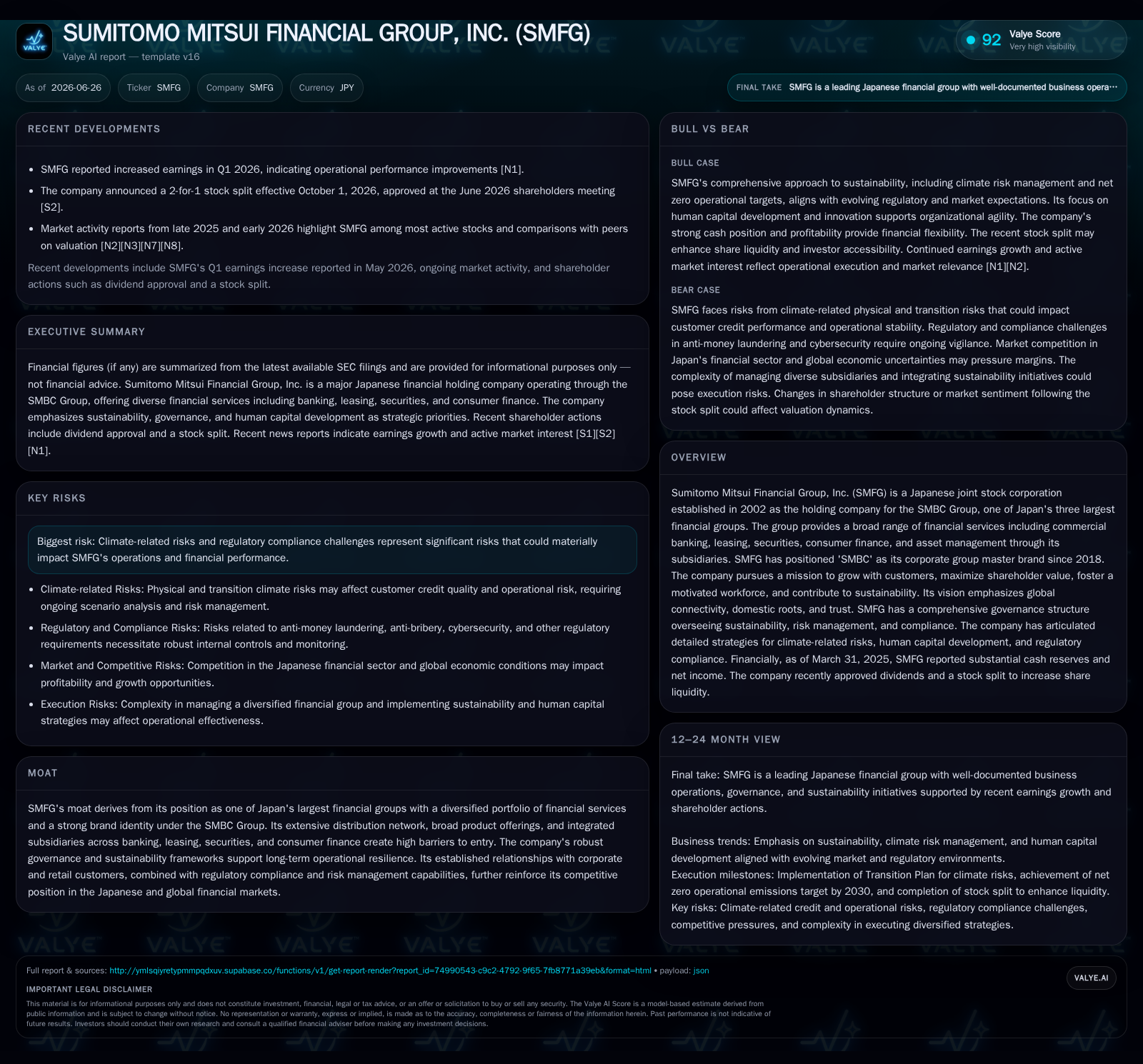
Sumitomo Mitsui Financial Group (SMFG) reported significant operating income growth driven primarily by net interest income and fair value gains on financial instruments, supported by disciplined capital management compliant with Basel III standards. The group’s diversified business model leverages extensive subsidiaries covering commercial banking, leasing, securities, consumer finance, and asset management, enabling revenue stability through fee and commission diversification. Recent interim disclosures highlight IFRS-based accounting changes for certain investment securities that increase earnings volatility measurement and confirm a stable dividend policy accompanied by governance tweaks. Despite sector headwinds, SMFG maintains strong asset quality with controlled impairment charges and prudent liquidity buffers. Digital transformation, enhanced cross-selling within the SMBC Group ecosystem, and ESG integration stand out as emerging growth vectors.
Interim Operating Shifts: Fair Value Accounting Adjustments and Dividend Resolution
Sumitomo Mitsui Financial Group’s latest quarterly disclosure reveals a significant shift in the accounting treatment of certain investment securities under IFRS compared to Japanese GAAP. Unlisted stocks classified as available-for-sale are now measured at fair value using valuation techniques rather than at cost. Additionally, some investment funds previously categorized as available-for-sale are now recognized at fair value through profit or loss [S2]. This change introduces greater earnings volatility linked to market fluctuations of these assets but aligns SMFG's accounting practices with global financial reporting standards. Such reclassification has important implications for revenue quality assessment as it increases variability in reported profits from financial instruments beyond traditional interest income streams
Concurrently, SMFG confirmed an annualized dividend of ¥157 per share (¥79 per share at fiscal year-end), signaling confidence in cash flow generation capacity amid ongoing capital allocation refinement [S3]. Governance updates include revisions to the authority concerning treasury share acquisitions designed to enhance flexibility without impairing credit strength
Diversified Business Model Driving Revenue Stability
SMFG operates as a financial holding company encompassing its flagship commercial bank (SMBC) alongside subsidiaries specialized in leasing (SMFL), securities brokerage (SMBC Nikko Securities), consumer finance (SMBC Consumer Finance), and asset management (SMDAM). This structure facilitates broad revenue streams derived from net interest income on lending activities complemented by fee and commission income from advisory services, asset management fees, transaction processing, and brokerage commissions.
Fiscal 2026 results underscore that net interest income growth—rising to approximately ¥2.83 trillion from ¥2.51 trillion year-over-year—was fueled by loan portfolio expansion amid a rising interest rate environment supporting improved net interest margins [S1][S18]. Fee and commission income also demonstrated resilience with net receipts climbing to nearly ¥1.52 trillion after expenses, underscoring the importance of diversified non-interest revenues that buffer earnings against cyclical lending margin pressures
This revenue mix reflects effective cross-selling strategies enabled by an integrated group platform serving both retail clients requiring wealth management solutions and corporate clients demanding transaction banking products such as trade finance, syndicated loans, derivatives hedging, and cash management services [S10]
Competitive Positioning Within Japan’s Banking Sector
Within Japan's top-tier financial groups alongside Mitsubishi UFJ Financial Group and Mizuho Financial Group, SMFG distinguishes itself through operational efficiency investments focused on IT transformation and broad business diversification mitigating concentration risks inherent in lending-heavy portfolios.
Internationally, SMFG’s footprint spans 143 overseas offices with strategic investments in Asian growth markets enhancing fee-generating capital markets activities—a contrast to peers more domestically concentrated or reliant on wholesale funding models [S9][S10]. Internally, strategic acquisitions such as Fullerton India Credit Company bolster its retail finance platform in high-growth geographies supporting sustainable expansion beyond mature Japanese markets.
Robust Capital Adequacy Supporting Strategic Flexibility
SMFG maintains capital ratios comfortably above regulatory minimums mandated under Basel III guidelines administered by Japan’s Financial Services Agency (FSA). As of March 31, 2026, the consolidated Common Equity Tier 1 ratio stood near 12.41%, with a total risk-weighted capital ratio around 15.69% [S14][S15]. These metrics provide a solid buffer for absorbing credit losses while enabling continued organic growth or selective acquisitions without compromising solvency or triggering regulatory constraints
Capital composition balances common equity with Additional Tier 1 instruments such as perpetual subordinated bonds enhancing loss-absorbing capacity aligned with international best practices.
Stable Asset Quality Amid Portfolio Expansion
Despite expanding its loan book beyond ¥130 trillion as of March 2026, SMFG demonstrated stable asset quality with impairment charges slightly reduced year-over-year—a testament to disciplined credit underwriting supported by sophisticated internal rating systems subject to rigorous validation protocols [S1][S11]. The manageable non-performing loan ratio evidences prudent risk selection amid macroeconomic uncertainties domestically and abroad
Complementary risk management efforts address operational risks including systems failures and cyber threats; conduct risks ensuring fair customer treatment; reputational risk safeguarding stakeholder trust; model risk mitigating erroneous decision-making; and environmental/social risks increasingly relevant under climate change considerations [S1].
Emerging Growth Vectors: Digital Transformation & ESG Integration
SMFG is accelerating digital transformation initiatives emphasizing cloud migration and generative AI adoption across business processes—from enhanced customer onboarding via extended call center hours to backend operational efficiencies. The launch of "Trunk," an integrated digital platform for corporate clients focusing on remote access to cash flow visualization tools exemplifies these efforts aiming at client acquisition cost reduction and improved service delivery [S10][S21]
Cross-subsidiary synergies under the unified “SMBC” brand improve cross-selling capabilities whereby corporate customers accessing trade finance can seamlessly be introduced to leasing or securities products while retail customers gain enhanced omnichannel wealth management options.
Simultaneously, ESG considerations are embedded strategically into credit assessments addressing climate transition risks alongside product development for green finance solutions responding to growing investor demand for sustainability-aligned offerings globally [S1].
Heightened Risk Monitoring Frameworks
Governance structures have intensified focus on climate-related risks including transition impacts from carbon regulation shifts as well as physical environmental hazards affecting borrower viability—integrated within credit risk processes influencing risk weighting and capital allocation decisions.
Conduct risk frameworks ensure compliance with evolving legal standards protecting market integrity and customer interests while reputational risk management policies preserve long-term stakeholder confidence through systematic operational controls.
Key Metrics for Ongoing Surveillance
Critical performance indicators include net interest margin trends sensitive to monetary policy shifts impacting lending spreads; trajectory of fee income reflecting success in diversifying away from interest-dependent revenues; credit loss provisions signaling early asset quality stress; capital adequacy levels revealing capacity for growth or shareholder returns; digital platform user engagement rates indicating technology adoption success; and ESG financing volumes tracking penetration into sustainable finance markets.
Financial Profile Discussion: Profitability & Capital Strength Supported by Stable Asset Quality
Fiscal 2026 saw SMFG’s net profit more than double from approximately ¥516 billion to nearly ¥1.19 trillion driven largely by a ¥1 trillion increase in total operating income anchored in net interest margin expansion complemented by gains on financial assets measured at fair value through profit or loss. Operating expenses rose moderately but were offset by revenue scalability yielding improved operating leverage.
Impairment charges declined marginally despite portfolio growth reflecting effective credit monitoring supportive of sustained solvency while accommodating robust loan demand during economic normalization phases post-pandemic disruptions.
Disclaimer: This analysis is based solely on publicly available information from recent SEC filings provided herein without seeking non-public insights or making investment research views.
Disclaimer: This is research-only, informational analysis and not investment advice. It may include AI-generated interpretation and general industry context. Always verify important details using primary sources.

Comments