
OMS Energy Technologies' Regional Manufacturing Footprint Fuels Niche Strength Amid Concentrated Customer Base
Oms Energy Technologies continues delivering certified surface wellhead systems and tubular goods to E&P operators in Asia Pacific and MENA, with growth shaped by industry cyclicality and customer concentration.
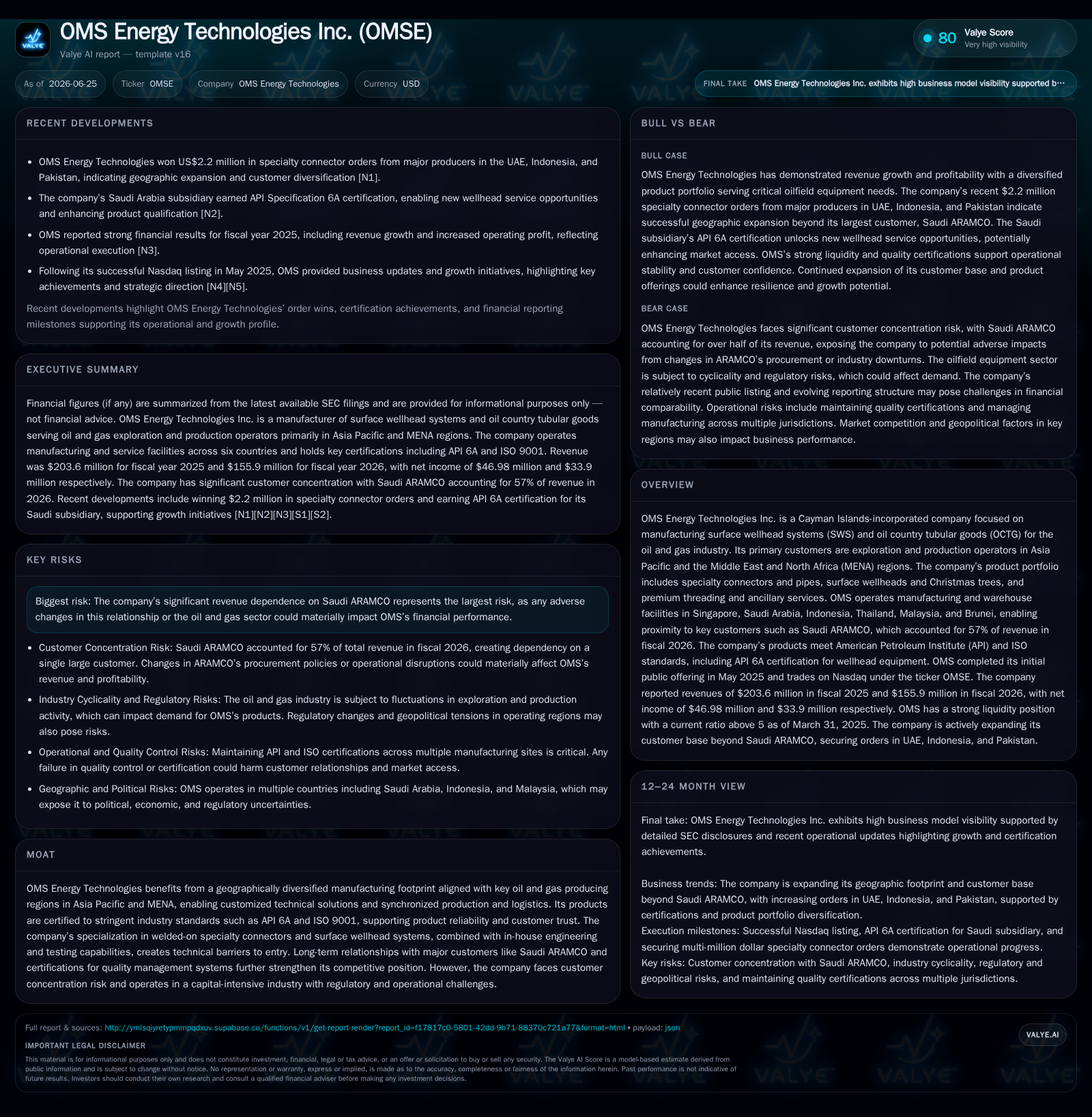
OMS Energy Technologies Inc. specializes in manufacturing surface wellhead systems, specialty connectors, and oil country tubular goods primarily for exploration and production operators in Asia Pacific and MENA. Its strategic proximity to major customers like Saudi ARAMCO supports technical customization and synchronized supply but results in significant customer concentration risk. Fiscal 2026 results revealed a drop in adjusted EBITDA margin from 31.5% to 26.4%, reflecting tightening industry conditions despite higher free cash flow due to disciplined capital spending. The company’s certification credentials and geographic footprint are key competitive moats, though exposure to oil and gas capital expenditure cyclicality remains the primary growth constraint.
Recent Operating Update
OMS Energy Technologies reported its full-year fiscal 2026 financial results on June 25, 2026 [S2]. The company earned an adjusted EBITDA of $41.2 million, down from $64.1 million a year prior, with the margin compressing to 26.4% from 31.5%. Despite margin pressure reflecting softening demand or pricing challenges likely linked to upstream CapEx reductions among exploration and production (E&P) customers, OMS delivered free cash flow of $52.5 million, an increase over the prior year’s $37.6 million [S9], [S19]. This cash generation strength was supported by controlled capital expenditures of approximately $1.6 million combined between property plant & equipment and intangibles—indicative of a disciplined spending approach critical in this capital-intensive sector [S13]. Revenue concentration remains high with the top five customers representing roughly 77% of total sales for FY2026; notably Saudi ARAMCO alone accounted for about 57%, underpinning a dependency risk but also exemplifying OMS’s access to marquee E&P operators [S1], [S14].
Business Model Analysis
OMS functions as a specialized manufacturer of critical upstream oilfield components including surface wellhead systems (SWS), oil country tubular goods (OCTG), specialty connectors and pipes, Christmas trees, along with premium threading services across major producing regions in Asia Pacific and MENA market segments. Their manufacturing footprint—with facilities strategically located in Singapore, Saudi Arabia, Indonesia, Malaysia, Thailand, and Brunei—enables close physical linkage to key clients that facilitates tailored product engineering and logistics synchronization—a competitive advantage given the sector’s emphasis on customization and just-in-time delivery [S1].
Revenue generation is heavily tied to the cyclical capital expenditure patterns of E&P operators investing in drilling completions or infrastructure maintenance. OMS typically contracts with these operators or their affiliates who pay mainly for certified surface wellhead equipment that meets API (especially API 6A) and ISO standards necessary for safety-critical applications under harsh environmental conditions [S1]. This certification compliance acts as a quality gatekeeper protecting margins and customer loyalty while raising switching costs against potential lower-cost regional competitors.
Beyond product sales volume fluctuations aligned with project cycles, OMS supplements income by providing premium threading services—which carry higher margin profiles—and supports associated ancillary services including testing and quality assurance certifications needed for deployment readiness within stringent regulatory frameworks.
Industry Structure and Competitive Position
The Oil & Gas Equipment Manufacturing industry wherein OMS competes is notable for its capital-intensive nature paired with pronounced demand cyclicality paralleling upstream sector CapEx. Key competitors often include large diversified suppliers such as National Oilwell Varco (NOV), Tenaris (specialty steel tubulars), or Weatherford (well completion equipment). OMS’s differentiation comes from its concentrated expertise around welded specialty connectors combined with geographic proximity allowing technical customization tuned per market region requirements.
Certification adherence—API 6A for pressure control equipment—is essentially non-negotiable within this space; non-compliance typically disqualifies suppliers from contracts with major producers like Saudi ARAMCO. Furthermore, by maintaining ISO 9001 quality management certifications across multiple jurisdictions along with extensive in-house engineering capabilities including product testing labs at each facility enhances product reliability credibility.
Despite these strengths, OMS faces notable risks stemming from customer concentration: reliance on a handful of large E&P operators shifts bargaining power away from suppliers given the oligopolistic buyer structure prevalent in oil-rich nations served [S14],. Moreover, geopolitical instability across some MENA countries introduces operational uncertainties unlike more stable counterparts elsewhere.
Growth Drivers
Primary growth levers relate directly to increases in upstream capital expenditures driven by oil price recovery cycles or new regional production expansions especially within Asia Pacific and Middle East markets. Additionally, tightening safety regulations favor replacement cycles wherein aging infrastructure must be retrofitted or upgraded—directly benefiting certified wellhead system providers like OMS.
Selective geographic diversification broadens revenue sources mitigating localized downturns; OMS's presence across six jurisdictions allows it to capture incremental contract wins outside Saudi Arabia while serving established long-term customers [S1]. In parallel technological updates requiring enhanced specialty connector designs or premium threading capabilities present upselling opportunities within existing accounts.
The company also taps into secondary services like threading which may offer higher margins than commoditized pipe products.
Risks and Watchpoints
- Customer Concentration: With nearly 80% revenue dependence on top five customers including one exceeding half overall sales (Saudi ARAMCO), any contract term changes or reduced spend materially impact OMS’s financial profile.
- Industry Cyclicality: Downturns cause abrupt CapEx pullbacks leading to order deferrals; given no guaranteed backlog visibility disclosed this cyclicality creates earnings volatility.
- Regulatory Delays: Indonesian licensing lags pose penalty risks that could disrupt facility operations impacting delivery timelines [S24].
- Geopolitical Risk: Operations across politically sensitive MENA region expose OMS to interruptions beyond firm control.
- Rising Compliance Costs: Post-IPO regulatory environment has elevated general & administrative expenses notably for cybersecurity readiness impacting net margin performance [S23].
- Supply Chain Constraints: Material price volatility could pressure cost structures if not offset by pricing adjustments.
- Currency Fluctuation: Multiregional operations denominated variably expose earnings translation risks managed via ongoing monitoring [S5].
What to Watch Next
Key milestones include monitoring quarterly order inflows or book-to-bill ratios signaling upward or downward trending customer CapEx activity particularly from Saudi ARAMCO; investor focus should center on revenue diversification progress beyond dominant clients and incremental signage of improved gross margins. Regulatory license acquisition status especially in Indonesia will clarify operating risk exposure.
Financially tracking free cash flow sustainability given lower EBITDA margin trends is crucial since consistent operating cash generation supports reinvestment capability crucial for maintaining manufacturing capacity utilization amid cyclical headwinds.
Additionally watching execution on any announced technology upgrades or expanded service offerings such as premium threading consolidation would signal efforts toward margin improvement.
Disclaimer: This is research-only, informational analysis and not investment advice. It may include AI-generated interpretation and general industry context. Always verify important details using primary sources.

Comments