
Peace Acquisition Corp’s IPO Completion and Web of Sponsor Support Shape Early SPAC Outlook
An overview of Peace Acquisition Corp’s recent IPO, capital structure, and operational stance within the evolving SPAC landscape.
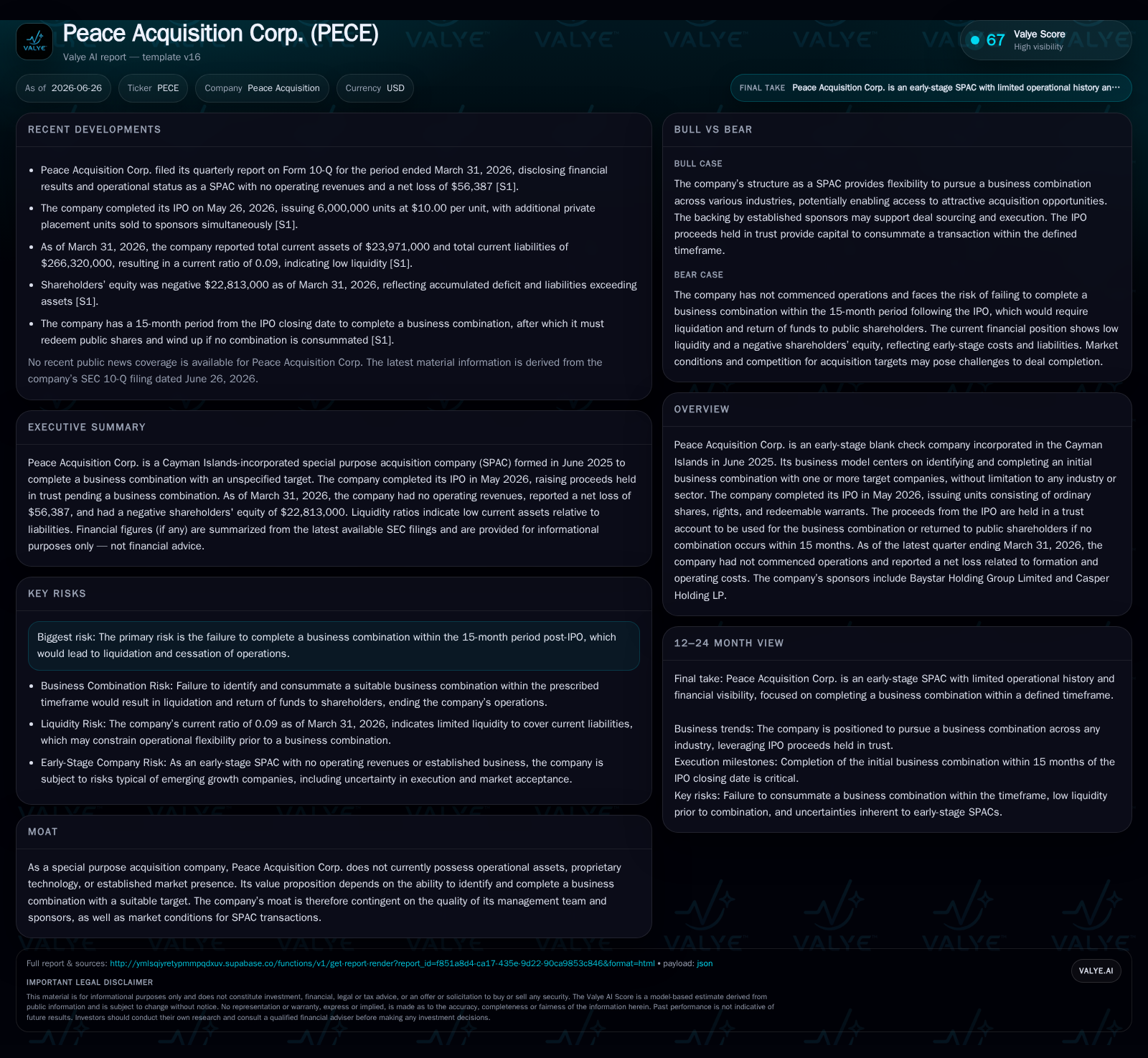
Peace Acquisition Corp completed its IPO in May 2026, raising over $60 million, and secured private placements from sponsors to financially underpin its blank check business model. The company operates with a trust account holding IPO proceeds earmarked strictly for a future business combination, while incurring minimal operating expenses pre-merger. Sponsor-backed loans and private units strengthen liquidity, but the firm faces typical SPAC risks such as timing pressures to consummate a target deal within 15 months. Its strategic geographic focus excludes China, concentrating primarily on Asia. Success heavily depends on sponsor execution and market conditions underlying SPAC transactions.
Recent Operating Update and IPO Close
Peace Acquisition Corp (PECE) consummated its initial public offering on May 26, 2026, issuing 6 million units at $10 each plus an optional overallotment possibility increasing unit count to 6.9 million if exercised. Concurrently, the company closed a private placement of 262,500 units priced identically at $10 per unit purchased by its sponsors Baystar Holding Group Limited and Casper Holding LP alongside EarlyBirdCapital Inc., acting as lead underwriter [S2][S15]. Total gross proceeds exceeded $60 million inclusive of public and private placements.
Pursuant to SPAC structural norms, the gross proceeds were placed in a trust account held by Continental Stock Transfer & Trust Company where they may be invested only in U.S. government securities with horizons up to 185 days or less. Funds held are reserved almost exclusively for the initial business combination or redemption to public shareholders should no combination occur. Outside this trust vehicle exists limited working capital (~$400K), used primarily for deal identification costs including travel, legal due diligence, negotiation efforts, and related taxes not covered by interest income from the trust corpus [S2][S10]. The close timing of the IPO ensures that PECE is now fully capitalized for initial deal sourcing activities.
On June 2, 2026, the company announced commencement of separate trading of ordinary shares (PECE), rights (PECER), and redeemable warrants (PECEW) previously bundled as units (PECEU) [S3]. Each warrant entitles holders to purchase one ordinary share at an exercise price set at $11.50 per share with exercisability beginning one year after closing of the initial business combination or twelve months post-IPO close—whichever is later—and expiring five years thereafter
Business Model Overview
As a special purpose acquisition company incorporated in the Cayman Islands in mid-2025 purely for effecting mergers or acquisitions without operational business lines yet, Peace Acquisition Corp exemplifies typical blank check entities focused on bridging capital from public markets into private companies seeking faster access to liquidity than traditional IPOs offer [S2][F1]. PECE earns no revenues prior to consummating a qualifying business combination; instead it generates nominal non-operating income from interest earned on cash equivalents post-IPO
Revenue creation occurs only after completing a merger or acquisition that results in a publicly traded operating company whose equity trades under an exchange symbol sourced through PECE’s listing on Nasdaq. Thus its intrinsic valuation upside principally derives from sponsor ability to identify attractive private targets and execute accretive transactions that appeal to public market investors.
Principal capital flows originate from issuance of units composed of ordinary shares, redeemable warrants with leverage-effect potential upon exercise, and fractional rights convertible after merger completion. Sponsor-aligned incentives include purchasing private placement units alongside public investors ensuring skin in the game along with registration rights facilitating secondary market liquidity post-combination [S15][S22]. Because warrants can dilute existing shareholders upon exercise at $11.50 above IPO price levels ($10 per unit), they represent both leverage opportunities for investors willing to bet on deal success and dilution risk for other shareholders.
Industry Structure and Competitive Position
SPACs like Peace Acquisition Corp compete directly with traditional IPOs as alternative public market entry vehicles but enjoy quicker timelines between inception and public listing—typically months rather than years required by conventional underwriting processes. However, they operate under intense regulatory scrutiny regarding disclosure requirements related to target selection processes as well as accounting treatment of warrants which frequently leads to complex financial statement presentations.
Within the broader SPAC sector dominated by well-known entities such as Pershing Square Tontine Holdings or Churchill Capital affiliates, PECE remains an early-stage entrant without publicly named target candidates or completed deals yet—a profile shared by most newly listed blank check vehicles. Competition among SPACs centers on sponsor reputation that drives investor confidence during IPO subscription phases as well as prospective target pipelines where sponsor network strength materially affects likelihood of timely successful combinations.
Unlike some SPAC peers scouting globally or focusing heavily on U.S.-based tech sectors, Peace Acquisition Corp explicitly narrows its acquisition screening emphasis geographically to Asia excluding mainland Chinese companies—an unusual stance that likely reflects conscious regulatory risk avoidance but imposes concentrate deal sourcing challenges within fewer jurisdictions potentially less penetrated by western SPAC investors [S4]. This geographical constraint shapes deal flow dynamics distinctly compared with broader peers who might target North America or Europe.
Growth Drivers
Driving growth potential for PECE lies chiefly in global macro trends favoring streamlined routes for mature private companies seeking expedited path-to-public status via business combinations rather than protracted traditional IPO underwriting cycles. The appetite for alternatives gained traction especially amid volatile public equity markets; SPAC formats offer conditional speed advantages if markets remain receptive.
Further growth may be buoyed by sponsors’ proprietary sourcing capabilities leveraging regional networks across Asia—particularly outside China—where innovative firms may prefer merger pathways over local listings or JVs with strategic partners given rising geopolitical uncertainties affecting investment climates.
Investor interest also depends on how market environments post-IPO evolve relative to redemptions rates exercised by shareholders dissatisfied with offered merger prospects versus those holding positions attracted by warrants’ optionality feature supporting upside participation post-business combination completion. Addition of PIPE financing or strategic partnerships post-announcement could also enhance credibility if deployed effectively.
Risks and Watchpoints
The most significant risk inherent in PECE’s model is failure to identify and close an appropriate business combination within the prescribed mandate of fifteen months post-IPO completion. Failure triggers mandatory liquidation procedures requiring distribution back to public shareholders pro rata from trust accounts possibly at levels below earlier valuations depending on market movements—a scenario common among late-stage SPAC dissolutions undermining shareholder value comprehensively.
Subsequent regulatory changes affecting accounting treatment related to warrant liabilities could influence perceived earnings quality once combined operations commence or delay deal completions through added disclosure burdens. Dilution risk persists since all units issued include warrants exercisable above current trading prices potentially exacerbating share count expansion post-event.
Furthermore operational expenses will likely rise materially once merger negotiations begin intensifying legal compliance costs as well as ongoing thorough due diligence needs making tight budget control essential given limited operating funds available externally outside trust accounts [S25]. Redeeming significant portion of shares upon announcement could reduce effective capital available thus constraining transaction size unless supplemented through additional equity raises introducing execution uncertainty.
What To Watch Next
Key monitoring factors include timing updates on prospective target identification announcements along with preliminary terms shaping viability assessments real-time through proxy filings or press releases mandated ahead of shareholder votes. Closely observe redemption patterns following merger disclosures since high redemption rates historically signal investor skepticism diminishing net capital raised for subsequent integration investments.
Sponsor disclosures around private placements beyond the initial setup or strategic alliances enhancing deal pipeline quality will be milestones signaling progress beyond mere formation activities reported so far. Market sentiment toward new Asian-focused SPACs excluding China should be assessed via trading volumes coupled with warrant exercise behaviors impacting dilution calculations long term.
Finally regulatory developments around evolving SEC guidance on SPAC disclosures including controls surrounding pre-combination communications bear watching as they can materially affect timelines indirectly through process friction if tightened further nationally or globally.
Disclaimer: This is research-only, informational analysis and not investment advice. It may include AI-generated interpretation and general industry context. Always verify important details using primary sources.

Comments