
Anteris Technologies: DurAVR’s Clinical Progress, Capital Strength, and the Stakes of Transcatheter Valve Commercialization
Anteris Technologies is advancing its DurAVR transcatheter heart valve through pivotal clinical trials, supported by substantial recent financings and regulatory milestones. The company’s clinical and capital momentum set the stage for potential market entry, but commercial success hinges on pivotal trial outcomes, regulatory approvals, and competitive differentiation in a crowded heart valve market.
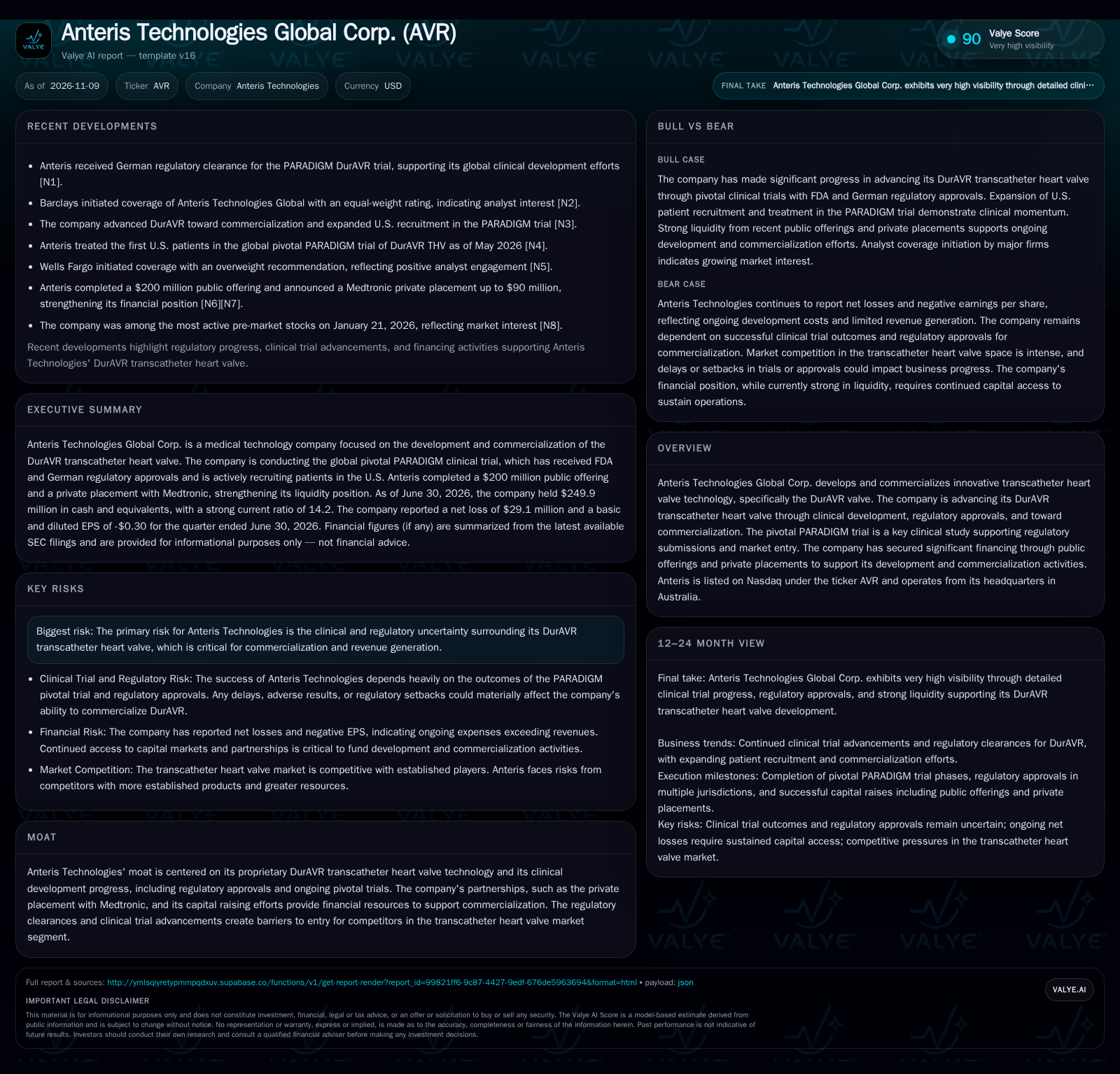
Anteris Technologies is progressing its DurAVR transcatheter heart valve, having expanded the pivotal PARADIGM trial—including first U.S. patients treated—and secured over $290 million in new capital from a public offering and Medtronic placement. [S1] [N3] [N4] [N6] [N7]
Anteris Technologies is at a pivotal juncture as it advances its DurAVR transcatheter heart valve through the global PARADIGM clinical trial, having recently achieved both regulatory clearances and first patient treatments in the U.S. However, the company’s ability to transition from a development-stage entity to a commercial leader will depend on successfully navigating clinical trial outcomes, regulatory approval processes, and entrenched competition in the transcatheter heart valve market. [S2] [N3] [N4] [N6] [N7]
Clinical Milestones and Capital Raise Reshape Anteris’s Near-Term Trajectory
Anteris Technologies has recently reached several material milestones: it expanded U.S. patient recruitment and treated its first U.S. patients in the pivotal PARADIGM trial for the DurAVR transcatheter heart valve as of May 2026, following both FDA and German regulatory clearances for the trial. These clinical developments mark substantial progress toward potential regulatory submission and commercial entry. [N1] [N3] [N4]
On the financing front, Anteris completed a $200 million public offering and secured a private placement with Medtronic of up to $90 million in early 2026. As of June 30, 2026, the company reported $249.9 million in cash and equivalents. This influx of capital provides significant runway for ongoing development, clinical, and commercialization activities. [N6] [N7] [S2]
Despite this, Anteris reported a net loss of $29.1 million and EPS of -$0.30 for the quarter ended June 30, 2026, underscoring its current status as a pre-revenue, development-stage company. [S2]
DurAVR’s Commercial Model: Pathways to Revenue and Cost Structure Implications
Anteris’s revenue model for DurAVR will likely depend on successful regulatory approval and subsequent adoption by interventional cardiologists and cardiac surgeons treating aortic valve disease. In the transcatheter heart valve market, revenue drivers typically include per-procedure valve pricing, procedure volume, and reimbursement dynamics. Leading competitors have established pricing in the $25,000–$35,000 range per device in major markets, but actual realized prices depend on payer mix and regional reimbursement.
The business is capital intensive: substantial fixed costs are tied to ongoing clinical development, regulatory submissions, and the building of commercial infrastructure—including sales, marketing, and field support. Variable costs are dominated by manufacturing, distribution, and post-market surveillance. If DurAVR achieves commercial approval, operating leverage could be substantial, as incremental sales would carry higher margins once fixed costs are absorbed.
The need for continued capital investment will persist until the company achieves meaningful revenue—likely not before pivotal trial readout and regulatory clearance. The recent capital raises alleviate near-term funding risk, but further investment may be required for large-scale commercialization, especially if market access activities or post-approval studies are mandated.
Competing in a Crowded Market: Differentiation and Barriers in Transcatheter Valves
Anteris enters a transcatheter heart valve market dominated by established players with significant commercial reach, such as Edwards Lifesciences and Medtronic. These incumbents benefit from deep clinical data, wide hospital adoption, physician familiarity, and established reimbursement pathways.
DurAVR’s potential competitive advantages may stem from proprietary design, improved hemodynamic performance, or enhanced durability—factors critical to physician and patient adoption. However, without published head-to-head data or clear real-world advantages, physician switching costs and hospital purchasing inertia remain high.
Barriers to entry in this field are substantial: demonstrating safety and efficacy through large-scale clinical trials, navigating complex regulatory pathways, and establishing market access with payers and hospital systems. Anteris’s ability to leverage its Medtronic relationship (via private placement) could ease some commercial hurdles, but ultimate adoption will depend on clinical outcomes and economic value relative to entrenched alternatives.
If DurAVR Demonstrates Superior Outcomes, Anteris Could Accelerate Market Penetration
The most favorable scenario for Anteris is that the PARADIGM trial demonstrates clear clinical superiority or meaningful differentiation—such as improved valve durability, lower complication rates, or expanded patient eligibility—relative to existing transcatheter heart valves. This could drive rapid regulatory approvals and early adoption by leading cardiac centers.
Confirmation of this scenario would require publication of robust pivotal trial data showing statistically and clinically significant advantages over incumbent products, followed by positive regulatory decisions and early guideline endorsements.
Commercially, an endorsement by major cardiac societies or inclusion in treatment guidelines could accelerate hospital purchasing decisions and drive volume. If the Medtronic relationship evolves into a distribution, co-marketing, or acquisition agreement, Anteris could leverage global scale more rapidly.
Falsification would occur if trial results are only non-inferior or show no clinically meaningful advantage, or if regulatory or reimbursement hurdles delay broad adoption.
Most Likely Path: Incremental Adoption Amid Clinical and Commercial Hurdles
Absent clear clinical superiority, the most plausible outcome is that DurAVR achieves regulatory approval based on non-inferiority to existing valves, leading to gradual adoption in select centers willing to trial new technology. Hospital committees and interventionalists are typically slow to switch away from established products unless there is a compelling value proposition.
In this scenario, initial revenue would be modest, with growth dependent on accumulating post-market evidence, real-world durability, and long-term safety data. The sales cycle in structural heart devices is long, with substantial physician education and hospital contracting required.
Confirmation would include regulatory approvals in key markets, initial sales in pilot centers, and gradual expansion of commercial infrastructure. Falsification would be delays in trial readout, regulatory setbacks, or inability to secure reimbursement.
Adverse Trial Outcomes or Regulatory Setbacks Could Prolong Pre-Revenue Status
The primary risk is that the PARADIGM trial fails to meet its primary endpoints, reveals safety concerns, or produces results insufficient for regulatory approval. Even if the device is safe, lack of clear clinical benefit versus existing options could limit market access or reimbursement.
In this scenario, Anteris would remain a development-stage company with ongoing cash burn and no near-term path to revenue. Additional capital raises could become necessary, potentially on less favorable terms. The company’s valuation would likely reset to reflect pipeline risk rather than near-commercial status.
This scenario would be confirmed by negative or inconclusive trial results, regulatory rejections or requests for additional studies, or withdrawal of strategic partner interest.
Milestones That Will Define DurAVR’s Commercial and Clinical Trajectory
Pivotal PARADIGM trial enrollment progress—updates on recruitment pace, geographic expansion, and projected completion date are critical to timeline visibility.
Disclosure of interim or final PARADIGM trial results, including primary and secondary endpoint achievement, safety profile, and comparison to existing valves.
Regulatory submission and approval milestones in major markets (FDA, EMA, TGA), including acceptance of trial data and labeling discussions.
Updates on the evolution or expansion of the Medtronic relationship—such as commercial agreements, distribution arrangements, or strategic investment beyond the private placement.
Early commercial traction: first sales, hospital adoption, and physician feedback if disclosed.
Burn rate and cash runway updates—tracking quarterly operating cash flow and capital needs as clinical and commercial activities scale.
Post-market surveillance data, if available, to monitor long-term valve performance and safety.
Disclaimer: This is research-only, informational analysis and not investment advice. It may include AI-generated interpretation and general industry context. Always verify important details using primary sources.

Comments