
Pennant Group’s Expansion Playbook: Surging Home Health Revenue, Acquisition Strategy, and the Stakes of Debt-Fueled Growth
Pennant Group’s 43% home health revenue surge and active acquisition pace highlight its pursuit of scale in a competitive, regulated sector. The company’s reliance on credit facilities and term loans sets the context for both opportunity and risk, with integration execution and regulatory headwinds standing as pivotal variables for future performance.
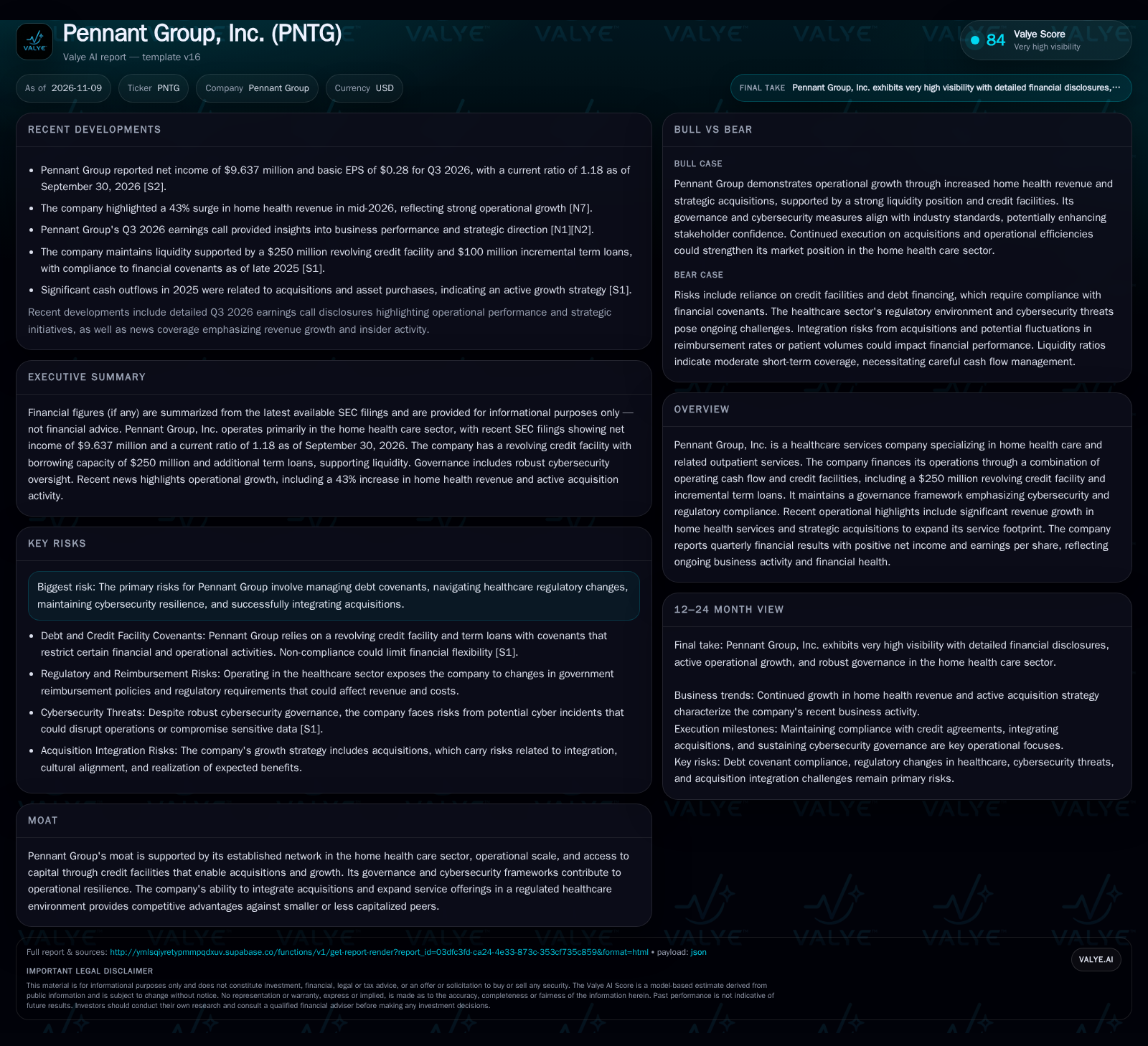
Pennant Group posted $9.6M in Q3 net income and a 43% mid-2026 surge in home health revenue, fueled by operational growth and acquisitions. The company’s capital structure leans on a $250M revolver and $100M in recent term loans. While this supports expansion, debt covenants and integration risks remain material counterforces. Execution on acquisitions and sustained reimbursement rates will be critical for margin and growth durability. [S1] [S2] [N7]
Pennant Group, Inc. stands at a pivotal juncture, balancing robust operational momentum in its home health segment with the complexities of acquisition-driven expansion and a debt-supported capital structure. The company’s 43% surge in home health revenue and positive Q3 earnings demonstrate its ability to capture growth opportunities, but these gains come alongside heightened reliance on credit facilities and the operational challenge of integrating acquired assets. As Pennant Group seeks to scale within the regulated and competitive home healthcare market, its future trajectory will hinge on its capacity to manage debt covenants, execute on acquisitions, and navigate reimbursement and regulatory headwinds.
Recent Financial Performance and Expansion Moves Shape Pennant Group’s Outlook
Pennant Group reported net income of $9.637 million and diluted EPS of $0.26 for the quarter ended September 30, 2026, marking ongoing profitability as it pursues growth [S2]. The most striking operational highlight is a reported 43% surge in home health revenue in mid-2026, pointing to either market share gains, expanded service footprint, or favorable reimbursement trends [N7]. On the balance sheet, Pennant Group reported liquidity-ratio trends of 1.18, indicating moderate short-term liquidity, while its growth strategy is visibly supported by a $250 million revolving credit facility and $100 million in incremental term loans obtained in late 2025 [S1] [S2]. The company’s acquisition activity in 2025 involved significant cash outflows, underlining a commitment to external growth and market consolidation [S1]. Collectively, these facts suggest a business aggressively scaling via both organic and inorganic means, but with financial leverage and integration risk now central to the thesis.
How Pennant Group’s Revenue Model and Capital Structure Could Drive (or Constrain) Value Creation
Pennant Group’s core economics are shaped by the fundamentals of the home health sector: reimbursement-driven revenue, a labor-intensive cost base, and sensitivity to patient volumes and payer mix. The 43% revenue surge suggests a favorable mix of volume growth and possibly service line expansion or improved reimbursement rates. However, home health is exposed to variable margins, as labor costs (nursing, aides, therapists) are largely variable, while administrative and compliance costs have more fixed characteristics.
The company’s acquisition-driven strategy is designed to add scale and diversify revenue streams, potentially improving bargaining power with payers and suppliers. However, integration costs and the risk of underperforming acquisitions could offset intended synergies. Funding this expansion through a $250M revolver and $100M in term loans adds leverage, introducing interest expense as a growing component of the cost structure and making covenant compliance a recurring constraint [S1]. Operating leverage is plausible if overhead can be spread over a broader base, but the risk is that integration friction or reimbursement cuts could erode anticipated margin gains. Capital needs remain significant if the acquisition pace continues, with the company’s ability to generate sufficient operating cash flow to cover debt service and reinvestment a critical test point.
Competing for Scale: Advantages and Counterforces in Home Health Care
Pennant Group operates in a fragmented and highly regulated sector, where local reputation, payer relationships, and clinical quality drive market share. The company’s ability to pursue acquisitions and invest in compliance and cybersecurity (with NIST and SOC standards cited) may provide an edge over smaller, less capitalized providers [S1]. Access to a large revolving credit facility and willingness to deploy capital for growth further distinguish Pennant from regional or independent operators who may lack scale or financing options.
However, the industry is also marked by competition from large diversified health systems, national home health chains, and potentially tech-enabled disruptors aiming to lower costs or improve care coordination. Regulatory scrutiny, shifting reimbursement models (including value-based care), and workforce shortages act as persistent counterforces. The critical question is whether Pennant can integrate acquisitions quickly enough to realize scale benefits before regulatory or market headwinds compress margins. Switching costs for patients are typically low, but relationships with referral sources and payers can provide some stickiness if operational execution remains strong.
What Rapid Integration and Stable Reimbursement Could Unlock for Pennant Group
The most favorable pathway for Pennant Group is one where its acquisition targets are integrated smoothly, with minimal disruption to clinical operations or local market relationships. In this scenario, the company leverages its expanded footprint to negotiate better rates with payers, spreads fixed compliance and administrative costs, and achieves improved margins despite higher debt service costs. Sustained or growing reimbursement rates—whether via Medicare, Medicaid, or commercial contracts—would further amplify the effect.
Evidence confirming this pathway would include continued double-digit revenue growth, margin expansion (EBITDA or net), and consistently positive operating cash flow that covers both debt service and capital expenditures. Additional signs would be successful acquisition announcements with rapid post-close performance improvement, and no adverse covenant-related disclosures. Falsification would come from stalled revenue growth, margin compression post-acquisition, or disclosures of integration setbacks or regulatory penalties.
Pennant Group’s Most Plausible Course: Measured Growth Amid Integration and Debt Management
The likeliest outcome is that Pennant Group continues to grow above industry averages, but at a moderated pace as the operational and financial complexity of recent acquisitions is digested. Margins may improve incrementally if integration is adequately managed and reimbursement rates remain relatively stable.
This scenario would be confirmed by quarterly reporting of steady, if unspectacular, revenue and earnings growth, ongoing covenant compliance, and an absence of major negative surprises in integration or regulatory matters.
If Integration Falters or Reimbursement Tightens, Leverage Could Become a Drag
The adverse chain begins if Pennant Group encounters integration difficulties—such as operational disruptions, higher-than-expected turnover, or failed realization of synergies—leading to margin compression and diminished cash flow. Simultaneously, regulatory or payer-driven reimbursement cuts could reduce top-line growth or even erode revenue, while fixed debt service obligations remain.
Evidence of this scenario would include missed earnings or revenue guidance, covenant breaches or amendments, elevated nonrecurring charges, or increased borrowing costs. Reports of regulatory investigations, significant cyber incidents, or failed acquisition integrations would further confirm a deteriorating outlook. Recovery from this position would likely require a strategic pivot, such as asset sales, equity raises, or operational restructuring.
Milestones That Will Test Pennant Group’s Acquisition-Driven Growth Strategy
Quarterly home health revenue growth rate—especially whether the 43% surge can be sustained or repeated in subsequent periods.
Operating cash flow trends and coverage of debt service requirements; a useful metric would be the ratio of operating cash flow to interest and principal payments, if disclosed.
Integration progress of recent acquisitions, including any disclosed synergies, cost savings, or performance milestones.
Any covenant compliance disclosures or amendments to credit agreements, as these signal potential financial flexibility or constraint.
Changes in reimbursement rates or payer mix, which would materially impact revenue and margin outlook.
Turnover rates among clinical and administrative staff, since workforce stability is critical to both service quality and integration success (if disclosed).
Regulatory or cybersecurity incident disclosures, given the company’s emphasis on governance and compliance.
Management commentary on acquisition pipeline and capital allocation priorities, particularly as leverage approaches covenant thresholds.
Disclaimer: This is research-only, informational analysis and not investment advice. It may include AI-generated interpretation and general industry context. Always verify important details using primary sources.

Comments