
Constellation Energy’s Post-Calpine Integration: Scale, Incentives, and the Stakes of Capital Intensity
Constellation Energy’s acquisition of Calpine significantly expands its generation footprint and financial commitments at a time when federal and state incentives underpin nuclear economics. The company’s ability to extract synergies, manage commodity risks, and maintain capital access will determine whether scale translates into durable value.
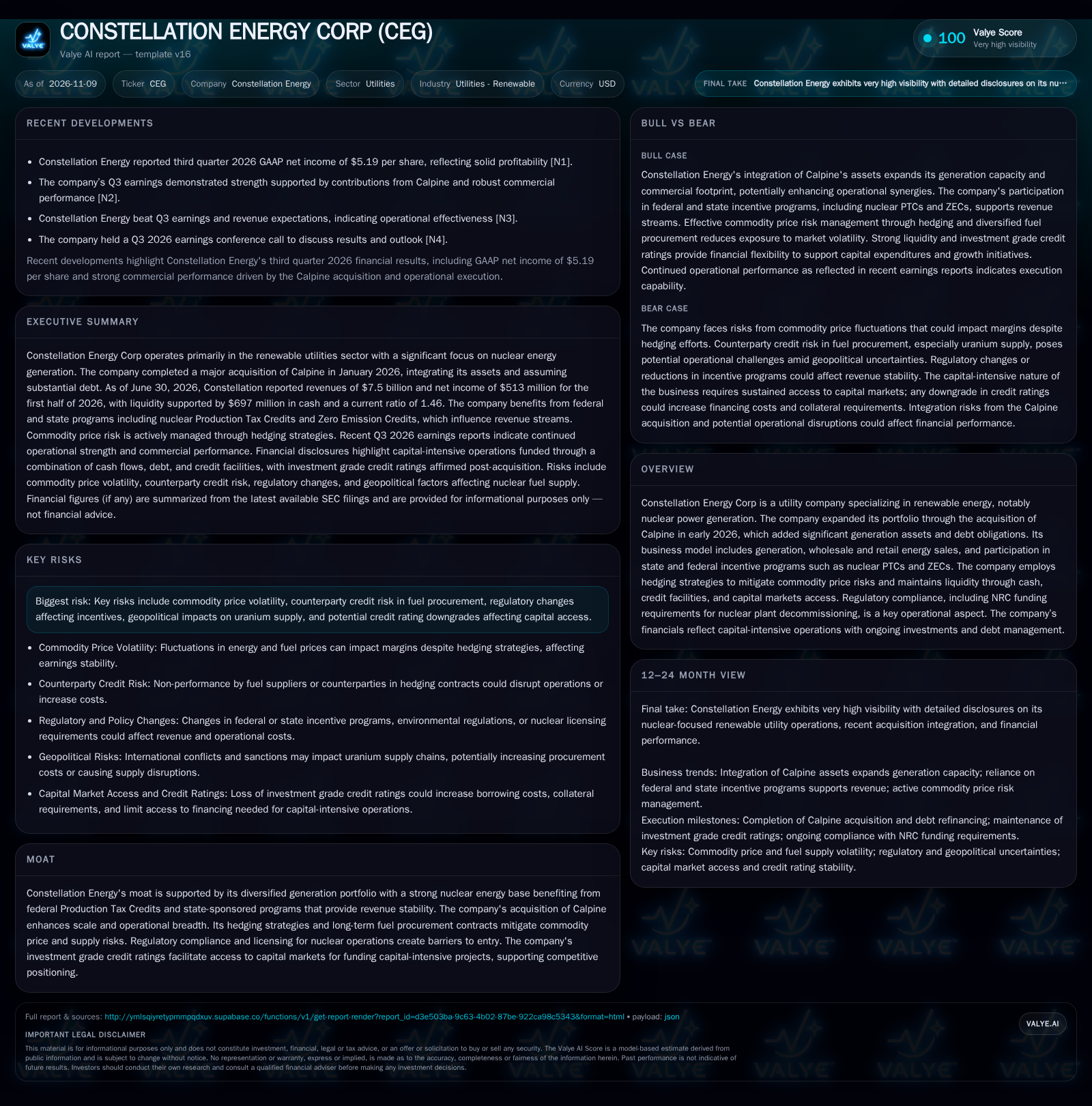
Constellation Energy has completed the Calpine acquisition, adding scale and substantial debt. Q3 2026 results show strong earnings and revenue momentum, supported by federal/state incentives and effective risk management. The company’s long-term trajectory depends on successful integration, regulatory stability, and continued access to capital for its capital-intensive operations. Key watchpoints include credit ratings, regulatory changes, and commodity price volatility. [S2] [N1] [N2] [N3]
Constellation Energy’s transformative acquisition of Calpine in early 2026 has positioned it as a dominant player in clean energy generation, with a pronounced emphasis on nuclear. The integration comes with a substantial increase in both operational capacity and financial leverage, at a time when federal and state incentives play a defining role in nuclear economics. Recent quarterly results post-acquisition demonstrate commercial momentum and operational strength, but the confluence of commodity, regulatory, and capital market risks means that Constellation’s future value creation will hinge on disciplined execution and the durability of external policy supports. [S2] [N1] [N2] [N3]
Calpine Acquisition, Earnings Momentum, and the Role of Incentives
Constellation Energy completed the acquisition of Calpine in January 2026, assuming approximately $12.6 billion of Calpine’s debt and integrating its generation assets into the company’s portfolio. This move expanded both the scale and complexity of Constellation’s operations, materially increasing its exposure to capital markets and debt service requirements [S2].
For the third quarter of 2026, Constellation reported GAAP net income of $5.19 per share, with both revenue and earnings exceeding expectations. Management attributed this outperformance to successful integration of Calpine’s assets and robust commercial execution [N1] [N2] [N3].
Federal Production Tax Credits (PTC) and state-level Zero Emission Credits (ZECs) remain central to Constellation’s revenue model, providing up to $15 per MWh for nuclear generation (subject to phase-outs) and undergirding financial visibility through at least 2032 [S2].
The company reported cash and liquidity metrics for the period; these figures do not by themselves establish operating runway, investment capacity, financial flexibility, or financing capacity. [S2]
How Scale, Incentives, and Hedging Shape Constellation’s Economics
Constellation Energy’s business model is built around large-scale power generation—primarily nuclear, but also including natural gas, hydro, wind, and solar—supplying both wholesale and retail markets. Revenue streams are diversified across geographies and customer types, but the fixed-cost, capital-intensive nature of nuclear generation means that scale is critical for operating leverage.
The acquisition of Calpine amplifies both the top line and fixed cost base, creating opportunities for synergy extraction but also increasing sensitivity to changes in demand, input prices, and regulatory policy. The company’s economics are heavily influenced by incentive programs: the federal nuclear PTC (up to $15/MWh through 2032) and state ZECs provide a buffer against commodity price swings and help stabilize cash flows.
Commodity price exposure is actively managed through hedging (swaps, futures, options), with risk mitigation focused on the prompt three years. However, while hedging can smooth near-term volatility, it does not eliminate long-term exposure to structural changes in market pricing or policy.
Fuel procurement, especially uranium, is managed through long-term contracts with a diversified supplier base, but a meaningful portion is still concentrated among three suppliers, which could pose counterparty or geopolitical risks.
Barriers, Subsidies, and the Challenge of Competing Energy Sources
Constellation’s moat is rooted in its scale, nuclear licensing, and access to federal/state incentives. The capital and regulatory barriers to entry in nuclear generation are formidable: new entrants face multi-year licensing, high upfront costs, and strict operational oversight. The company’s fleet diversity (nuclear plus gas, hydro, renewables) and multi-state presence further reduce regional concentration risks.
However, the competitive landscape is evolving. While few direct peers can match Constellation’s nuclear scale, the rise of utility-scale renewables, battery storage, and distributed energy resources threatens long-term pricing power. In deregulated markets, Constellation competes with independent power producers, vertically integrated utilities, and merchant generators, all of whom are subject to the same commodity and regulatory crosscurrents.
The company’s reliance on federal and state support is a double-edged sword: while it currently benefits from stable incentives, these could be subject to political shifts or budgetary constraints. Further, the rapid pace of cost declines in wind, solar, and storage could eventually erode the relative economic advantage of nuclear, especially if carbon policy or market design changes.
Operationally, Constellation’s ability to hedge commodity risk and secure long-term fuel supply contracts provides some insulation from short-term shocks, but does not eliminate exposure to counterparty risk or market dislocations.
Synergy Realization and Policy Stability Drive Outperformance
If Constellation successfully integrates Calpine’s assets, extracting operational synergies and cost efficiencies, while maintaining high fleet reliability and safety, the company could see enhanced operating leverage and margin expansion. The continuation of federal PTC and state ZEC programs through 2032 would underpin stable, high-quality cash flows, supporting both debt service and strategic reinvestment.
A favorable commodity environment—characterized by higher power prices and relatively stable input costs—would further boost profitability, especially if hedging strategies lock in attractive price spreads. If credit ratings remain solid and capital markets receptive, Constellation could refinance debt at attractive rates, fund growth initiatives, and potentially return capital to shareholders.
Evidence confirming this scenario would include above-peer operating margins, further upward earnings revisions, continued strong cash flow generation, and explicit management guidance on synergy capture and cost discipline. Regulatory signals affirming long-term policy support for nuclear and zero-carbon generation would further validate the upside case.
Operational Execution Underpins Stability, but Sensitivity to Policy and Markets Remains
The most plausible outlook is one in which Constellation delivers steady operational performance, achieving targeted synergies from the Calpine integration and maintaining high fleet availability. Federal and state incentives remain in place through at least the mid-2030s, providing revenue stability, but incremental margin expansion is limited by rising competition from renewables and storage.
Commodity prices remain volatile but manageable within the company’s existing hedging framework. Credit ratings are maintained, allowing continued access to capital for necessary reinvestment and debt service, but the company remains vigilant regarding potential rating pressure from external shocks or policy changes.
Confirmation of this scenario would come from sustained earnings consistency, stable leverage ratios, and continued affirmation of investment grade ratings from credit agencies. Signals of regulatory continuity and ongoing market demand for baseload clean power would reinforce the base case.
Incentive Rollbacks, Credit Deterioration, or Fuel Disruptions Expose Fragility
A negative turn could emerge if federal or state policymakers reduce or phase out nuclear incentives ahead of schedule, removing a core pillar of Constellation’s revenue model. In this scenario, the company’s high fixed costs and debt service obligations could rapidly erode profitability, especially if commodity price hedges roll off in an adverse market environment.
Further risk comes from a credit rating downgrade—potentially triggered by weak cash flows, regulatory setbacks, or a macro shock—which would increase borrowing costs, limit access to fresh capital, and trigger collateral requirements under existing debt covenants.
Geopolitical instability in uranium supply regions or counterparty failures among key fuel suppliers could disrupt operations, drive up input costs, or force expensive spot market purchases.
Confirmation of the downside would be seen in declining margins, negative free cash flow, credit rating downgrades, or emergency capital raises. Regulatory actions curtailing PTC/ZEC eligibility or adverse commodity market developments would also validate this scenario.
Milestones and Metrics That Will Shape Constellation’s Value Trajectory
Synergy realization from Calpine integration: Progress on cost savings, operational improvements, and fleet optimization (if disclosed) would help test the integration thesis.
Ongoing eligibility and legislative signals for federal PTC and state ZEC programs: Monitoring regulatory developments and policy renewals is critical.
Sustained investment grade credit ratings from S&P and Moody’s, and any outlook changes or covenant triggers.
Commodity price movements and the effectiveness of hedging strategies, especially as existing contracts mature.
Uranium and nuclear fuel supply chain stability, including counterparty performance and geopolitical impacts.
Fleet reliability metrics, including unplanned outage rates and NRC compliance (if disclosed).
Trends in capex requirements versus internally generated cash flow, and any changes in external financing needs.
Evidence of competitive encroachment or cost parity from renewables and storage, particularly in core markets.
Disclaimer: This is research-only, informational analysis and not investment advice. It may include AI-generated interpretation and general industry context. Always verify important details using primary sources.

Comments