
Hallador Energy’s Expansion Gamble: Turtle Creek Project, Debt Structure, and the Stakes of Execution
Hallador Energy is making a high-stakes bet on power generation expansion with the $450 million Turtle Creek gas turbine project, financed by a restrictive $550 million term loan.
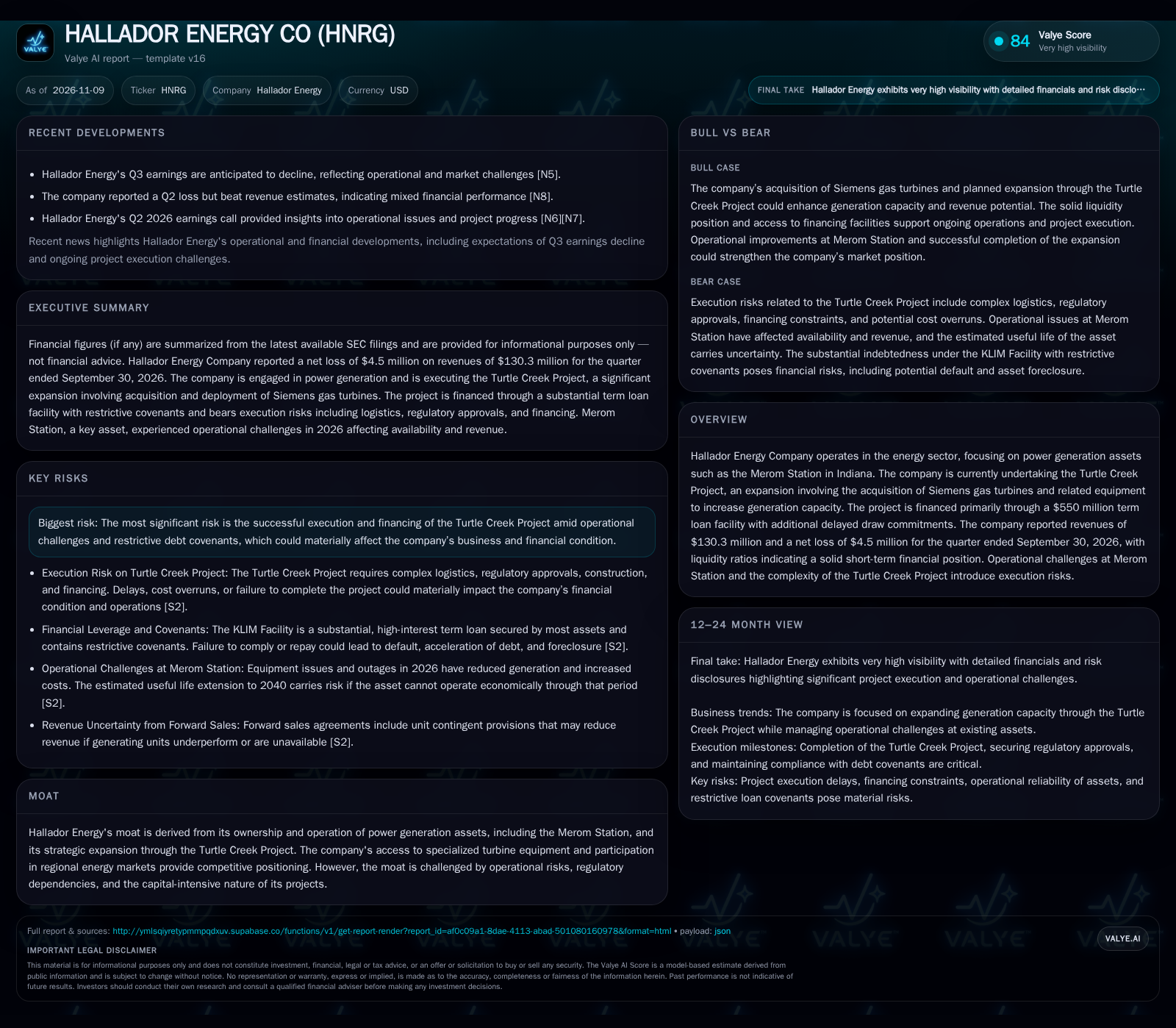
Hallador Energy is pursuing a transformative expansion by acquiring Siemens gas turbines for the Turtle Creek Project, financed by a large, covenant-heavy term loan. Despite holding $103.2 million in cash at quarter-end, the company reported a Q3 net loss of $4.5 million, and faces major execution risks around project completion, operational reliability at Merom Station, and the restrictive terms of its new debt. The outcome of the Turtle Creek Project will likely define Hallador's future revenue base and risk profile. [S2] [N5] [N6] [N7] [N8]
Hallador Energy is at an inflection point, betting its future on the ambitious Turtle Creek Project—a $450 million expansion into gas-fired generation using Siemens turbines, funded by a restrictive $550 million term loan. This move comes as its legacy Merom Station faces reliability issues, and just as the company reported a quarterly net loss. The ability to complete and integrate Turtle Creek will likely determine whether Hallador emerges as a stronger regional power provider or faces prolonged financial and operational strain.
Turtle Creek Project and Debt Structure Dominate the Near-Term Outlook
As of September 30, 2026, Hallador Energy reported $103.2 million in cash and cash equivalents, supporting a current ratio of 3.38 and a cash ratio of 0.64. Despite this liquidity, the company posted a net loss of $4.5 million for the quarter on $130.3 million in revenue, reflecting ongoing operational and financial pressures. [S2]
The centerpiece of Hallador’s strategy is the Turtle Creek Project—a $450 million investment in Siemens gas turbines and related equipment, with nearly all of the purchase price already paid. This expansion is financed primarily through the KLIM Facility, a $550 million term loan that includes a $50 million delayed draw commitment, but carries high interest and restrictive covenants. [S2]
Operational reliability remains a concern: Merom Station, the company’s main power asset, experienced significant equipment issues and outages in 2026, affecting both availability and revenue. This operational fragility is compounded by forward sales contracts that reduce revenue if generation assets underperform. [S2]
Recent news coverage and earnings calls reinforce a narrative of continued losses, project execution focus, and management navigating both expansion and reliability challenges. [N5] [N6] [N7] [N8]
Revenue Streams, Cost Structure, and the Leverage of Expansion
Hallador’s business model is now split between its legacy coal-fired Merom Station and the planned Turtle Creek gas-fired expansion. The company earns revenue through delivered energy and accredited capacity sales, with fuel costs for Merom Station including coal sourced from its own mines under multi-year contracts. This vertical integration potentially moderates input cost volatility but does not eliminate it, as contract prices were set to approximate market levels at inception. [S2]
The addition of Turtle Creek’s 460 MW gas turbines could diversify Hallador’s revenue mix and potentially improve margins if gas-fired generation proves more reliable or cost-effective than coal. However, the economics are highly sensitive to fuel price spreads, carbon regulation, and capacity market pricing. The $550 million KLIM Facility introduces significant fixed costs via interest expense and restrictive covenants, increasing operating leverage and elevating the company’s break-even point. [S2]
Intercompany coal sales are eliminated in consolidated results, so the true economic benefit comes from the ability to optimize fuel sourcing and plant dispatch. Successful integration of the new gas assets may improve the overall asset utilization rate, but failure to achieve operational reliability or regulatory approvals would leave the company with high fixed charges and underutilized capital.
Competitive Standing Hinges on Asset Reliability and Execution
Hallador’s competitive position is rooted in its ownership of regional generation assets and integrated coal supply, but is constrained by the capital-intensive nature of its business and exposure to MISO Zone 6 market dynamics. The Turtle Creek Project could enhance its standing by adding gas-fired capacity, which is generally favored for grid flexibility and emissions compliance compared to coal.
However, the company is not alone in pursuing gas or renewable generation in the Midwest. Larger utilities and independent power producers—many with deeper balance sheets—are also upgrading fleets or adding renewables, potentially compressing capacity prices or crowding out less reliable players. Hallador’s moat is thus operational rather than structural, relying on asset uptime, cost control, and regulatory compliance.
Switching costs for customers are low in wholesale power markets, so sustained underperformance or outages could quickly erode contract value and market share. The company’s forward sales agreements, with provisions that reduce revenue for underperformance, reinforce this fragility.
A Successful Turtle Creek Launch Could Transform Hallador’s Earnings Base
If Hallador completes the Turtle Creek Project on time and on budget, integrates the new turbines without major outages, and secures the necessary regulatory approvals, the company could substantially boost its generation capacity and revenue. Gas-fired assets may allow Hallador to capture more capacity payments and participate more flexibly in energy markets, potentially improving average realized prices and margins.
Upside could also materialize if regional gas prices remain low relative to coal, or if carbon regulation accelerates the shift away from coal-fired generation, giving Hallador’s new assets a competitive edge. Improved reliability at Merom Station would further enhance the earnings base. Confirmation would come from: successful project completion announcements, regulatory approvals, a step-change in reported generation volumes and capacity revenue, and a return to sustained profitability in quarterly results.
Expansion Brings Higher Revenue Potential, But Margin Pressure and Execution Risk Persist
The most plausible outcome is that Hallador completes the Turtle Creek Project, but with some cost overruns or delays, and faces a period of compressed margins as it absorbs higher fixed costs from the KLIM Facility. Merom Station continues to face periodic outages, limiting the ability to fully capitalize on forward sales agreements.
In this scenario, Hallador’s revenue base grows, but interest expense and operational hiccups prevent a rapid shift to robust profitability. Confirmation would be quarterly reports showing incremental capacity additions, gradual improvement in asset uptime, and debt service coverage ratios hovering near covenant thresholds. Falsification would be sustained negative cash flow, missed project milestones, or a spike in regulatory or operational disruptions.
Project Delays, Cost Overruns, or Asset Failures Could Trigger a Liquidity Crisis
If Turtle Creek faces major delays, cost overruns, or fails to achieve regulatory approval, Hallador would be left with a large, underutilized asset base and heavy debt service obligations. Merom Station’s continued outages could worsen the revenue shortfall, while restrictive covenants on the KLIM Facility could lead to technical defaults or forced asset sales.
Downside risk is amplified by the company’s limited remaining borrowing capacity and exposure to forward sales contracts that penalize underperformance. In this scenario, Hallador may be forced to pursue dilutive equity issuance, asset divestitures, or seek restructuring. Confirmation would be negative project updates, covenant breaches, or rapid depletion of the cash balance without corresponding revenue growth.
Milestones and Metrics That Will Shape Hallador’s Expansion Thesis
Progress and cost updates on the Turtle Creek Project—any delays, overruns, or regulatory setbacks would materially impact the thesis.
Quarterly generation volume and availability metrics for both Merom Station and the new gas-fired assets (if disclosed), as a proxy for operational reliability and forward sales contract performance.
Debt service coverage ratio and compliance with KLIM Facility covenants, given the facility’s size and restrictive terms.
Quarterly cash flow from operations versus capital expenditure and debt service requirements, to gauge sustainability.
Updates on forward sales contract pricing, volume, and unit-contingent revenue adjustments, which could impact realized revenue.
Any regulatory or permitting developments affecting Turtle Creek or Merom Station’s operating life.
Management commentary or filings on refinancing risk or incremental financing needs if liquidity tightens.
Segment-level EBITDA trends (if disclosed), especially for Electric Operations, to assess margin trajectory as new assets come online.
Disclaimer: This is research-only, informational analysis and not investment advice. It may include AI-generated interpretation and general industry context. Always verify important details using primary sources.

Comments