
Silver Bow Mining: Acquisition Gamble, Dilution Risks, and the Uncertain Road to Scale
Silver Bow Mining Corp. faces a pivotal moment as it pursues the acquisition of Montana Goldfields—a transaction that could reshape its asset base, risk profile, and shareholder structure. With material dilution and integration hurdles on the horizon, the company’s future hinges on execution, regulatory clearances, and financing linked to the deal’s success.
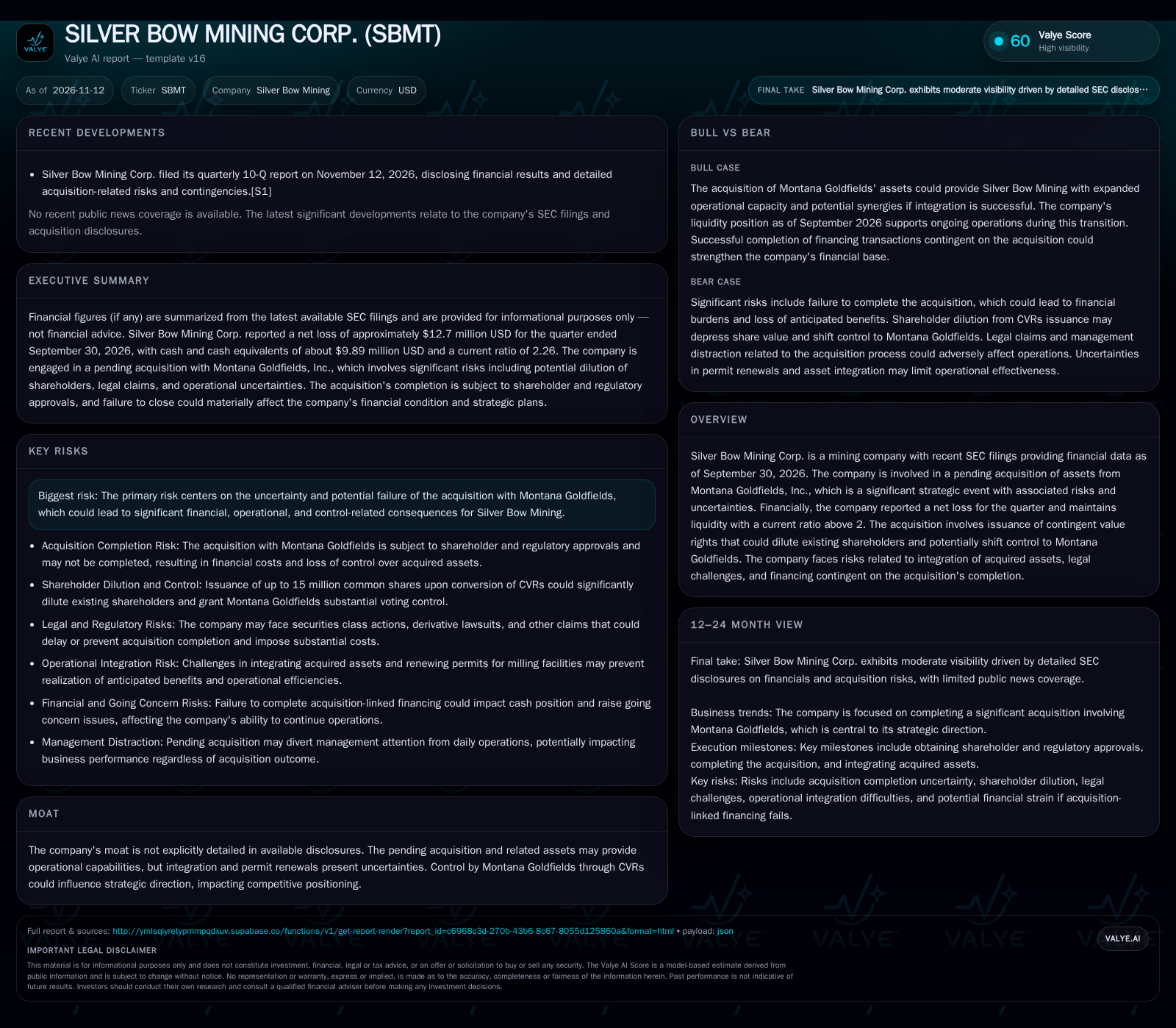
Silver Bow Mining’s pending Montana Goldfields acquisition is a double-edged sword: it offers potential operational scale and financing, but exposes the company to major dilution, legal, and integration risks. Execution and regulatory approval are critical, with the company’s potential financial flexibility and strategic direction at stake.[S1]
Silver Bow Mining Corp. stands at a strategic crossroads. Its planned acquisition of Montana Goldfields is more than a typical asset purchase—it’s a transformative deal with significant implications for ownership, operational complexity, and financial health. The outcome of this acquisition will likely define Silver Bow’s trajectory for years to come, making execution and transparency central to investor calculus.[S1]
Acquisition Stakes: Where Silver Bow Mining Stands Now
As of September 30, 2026, Silver Bow Mining reported $9.89 million in cash and cash equivalents, with current assets totaling $11.96 million and current liabilities of $5.28 million. The company reported cash and liquidity metrics for the period; these figures do not by themselves establish operating runway, investment capacity, financial flexibility, or financing capacity. [S1] The deal structure includes contingent value rights (CVRs) that, upon conversion, could significantly dilute existing shareholders and potentially transfer board and strategic control to Montana Goldfields.[S1] If the acquisition does not close, Silver Bow’s related financing with Ocean Partners UK Limited may also fall through, threatening the company’s cash position and raising going concern questions.[S1]
How the Business Could Monetize New Scale—And Where the Economics May Break Down
Mining companies typically generate revenue through the extraction and sale of metals, with profitability hinging on operational scale, ore grades, cost control, and commodity prices. Silver Bow’s current financials reflect a business under strain, with negative earnings indicating that either production volumes, realized prices, or cost management are insufficient to cover fixed and variable expenses.[S1] The planned acquisition of Montana Goldfields is ostensibly aimed at expanding operational capacity, potentially unlocking scale economies or synergies if integration is successful. However, the economics of this strategy depend on several contingencies:
First, the ability to renew permits for milling facilities will determine whether acquired assets can be fully utilized. Without these permits, the incremental capacity or resource base may remain idle, undermining the deal’s rationale. Second, integration costs and potential operational disruptions could offset any cost savings or revenue gains. Third, financing is linked to the acquisition’s completion; failure to close could leave the company underfunded and without the means to execute its post-merger strategy.
Finally, the issuance of CVRs and potential conversion into up to 15 million common shares introduces the risk of substantial dilution, which could depress per-share value and erode the benefits of any operational improvements for existing shareholders.[S1]
A critical dimension to the monetization of scale is the sensitivity of the combined entity’s cost structure to commodity price volatility. Mining operations often have high fixed costs, so increased scale can improve leverage on these fixed expenses, but only if production volumes ramp as planned. If commodity prices decline or remain depressed, the expanded cost base could exacerbate losses rather than mitigate them. Moreover, the timing of cash flow realization post-acquisition is crucial; delays in ramp-up or unexpected capital expenditures could strain liquidity, particularly given the contingent nature of financing tied to the transaction.
Dilution, Permits, and Strategic Control: Can Silver Bow Build an Edge?
In the mining sector, competitive advantage is typically forged through asset quality, operational efficiency, access to capital, and regulatory positioning. Silver Bow’s pending acquisition could, in theory, strengthen its asset base and operational footprint. Yet the risk of dilution and possible transfer of board control to Montana Goldfields through CVR conversion creates strategic uncertainty for current shareholders.[S1]
Permit renewals for milling facilities are a critical gating factor—without them, even a larger asset base may not translate into higher output or lower unit costs. The company also faces the risk that integration challenges and management distraction could erode competitive position, especially if rivals are able to exploit any disruption or delay. In addition, the legal and regulatory uncertainties surrounding the acquisition could consume resources and divert focus from core operations.
If Silver Bow can integrate the new assets, secure permits, and stabilize its capital structure post-dilution, it could potentially achieve a more defensible cost structure or production profile. However, these are conditional advantages, not yet demonstrated in the current disclosures.
If the Acquisition Delivers: A Route to Scale and potential Financial Flexibility
The optimistic pathway for Silver Bow Mining hinges on the successful completion and integration of the Montana Goldfields acquisition. If shareholder and regulatory approvals are secured and the deal closes, the company could see several favorable outcomes:
— The infusion of new assets and potential operational synergies may lead to higher production volumes, better cost absorption, and improved margins.
— If management can renew necessary permits and integrate operations with minimal disruption, Silver Bow could emerge with a more competitive operational profile and the flexibility to capitalize on favorable commodity price movements.
Navigating Uncertainty: Dilution, Integration, and Modest Progress
The most plausible near-term outcome is a muddled middle: Silver Bow Mining secures the necessary approvals and closes the Montana Goldfields acquisition, but the process is protracted and costly. Shareholder dilution from CVR conversion is realized, and Montana Goldfields gains significant influence over board composition and strategic direction.[S1]
Integration proceeds, but is hampered by delays in permit renewals or operational hiccups, resulting in only gradual improvement in production or cost metrics. Legal and regulatory costs may weigh on profitability, while management bandwidth is stretched between integration and routine operations. Financial performance remains pressured, with any benefits from expanded scale offset by the drag of dilution and integration overhead.
Evidence for this scenario would include delayed or incremental operational gains, continued net losses, and persistent disclosure of integration or legal costs in future filings.
Deal Failure: Funding Risks and Strategic Drift
The adverse scenario materializes if the acquisition fails to close—whether due to regulatory, legal, or shareholder obstacles. In this event, Silver Bow Mining would not only forfeit the anticipated operational scale, but could also lose access to acquisition-linked financing. This would place immediate pressure on its cash reserves, especially given the company’s recent net losses.[S1]
Without the new assets or capital, the company could face going concern issues, potentially requiring asset sales, restructuring, or dilutive emergency financing. Management distraction and legal costs may persist even in the absence of deal closure, further eroding operational performance. Competitors could capitalize on the company’s instability to attract talent or seize market opportunities.
Confirmation would come from disclosures of failed deal negotiations, missed financing milestones, a deteriorating cash position, or announcements of restructuring or asset divestitures.
Signals That Will Define Silver Bow Mining’s Post-Acquisition Reality
Progress toward regulatory and shareholder approval for the Montana Goldfields acquisition, including disclosed voting outcomes and regulatory clearance timelines.
Details on the issuance and potential conversion of contingent value rights (CVRs), and the resulting impact on share count and board control—if disclosed.
Timely completion and funding of the Ocean Partners UK Limited financing, and any changes to cash position or liquidity as a result.
Permit renewal status for milling facilities and any disclosed delays, denials, or conditions attached to renewed permits.
Integration updates: production volumes, cost metrics, and operational disruptions post-acquisition—if disclosed.
Legal or regulatory developments, including new claims, settlements, or material litigation expenses.
Management commentary on strategic priorities, capital allocation, and risk mitigation in the wake of the acquisition.
Disclaimer: This is research-only, informational analysis and not investment advice. It may include AI-generated interpretation and general industry context. Always verify important details using primary sources.

Comments