
Snail, Inc.: Franchise Concentration and Platform Reliance Shape Growth and Risk
Snail, Inc.'s fortunes are deeply intertwined with the ARK franchise and third-party distribution platforms, exposing the company to acute concentration and platform risks. As bookings decline and liquidity metrics tighten, Snail is betting on diversification through new AAA titles, AI gaming, and digital assets—but meaningful transformation remains unproven.
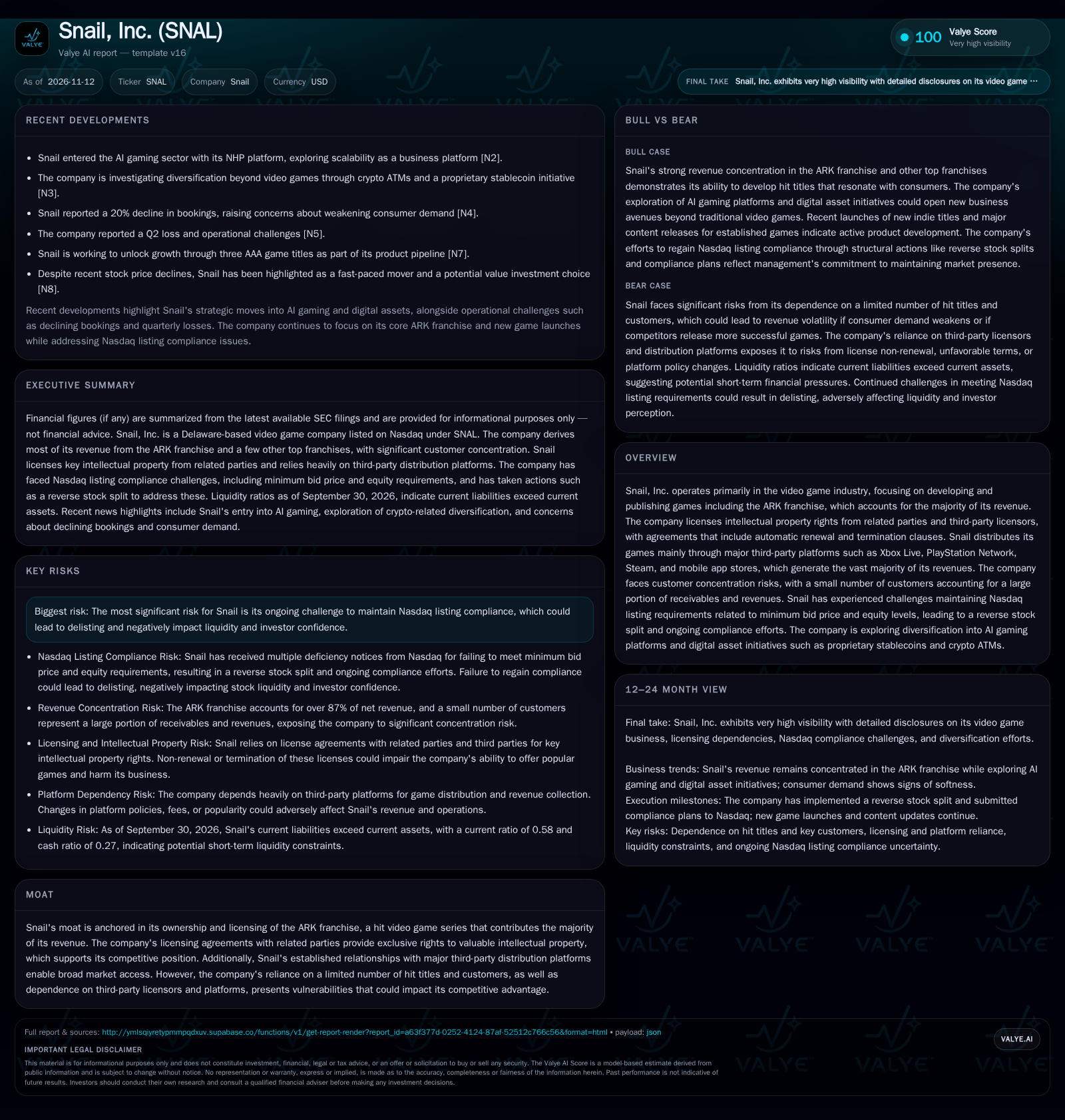
Snail, Inc. (SNAL) is a video game publisher with extreme revenue concentration in the ARK franchise and a handful of top titles, distributed almost exclusively through third-party platforms. Recent declines in bookings and tight liquidity ratios intensify pressure on the company to diversify, as it explores AI gaming and crypto initiatives. Ongoing Nasdaq compliance challenges and customer concentration risk underscore the need for successful execution on new growth avenues. The core question is whether Snail can convert its pipeline and diversification bets into durable, less concentrated revenue streams before financial or platform risks materialize.
Snail, Inc. stands at a strategic crossroads. Its heavy reliance on the ARK franchise and just a handful of customers, combined with near-total dependence on third-party platforms for distribution, leaves the company exposed to volatile consumer demand and external platform policies. While Snail is actively pursuing diversification into AI-driven gaming and digital assets, these initiatives are nascent and unproven at scale. The company's future hinges on whether it can reduce its revenue concentration and platform risk before existing vulnerabilities trigger more severe consequences.
ARK’s Role and Financial Strains Reflect Platform Dependence
For the nine months ended September 30, 2026, Snail derived 87.4% of net revenue from the ARK franchise, with its top five franchises together accounting for 97.2% of revenue [S2]. This concentration makes the business acutely sensitive to franchise performance and consumer demand swings. Simultaneously, 96.5% of revenues are generated through third-party platforms like Steam, PlayStation Network, Xbox Live, and major mobile app stores, amplifying platform risk [S2].
Recent operational data point to stress: Snail reported a 20% decline in bookings, suggesting that consumer demand for its flagship titles may be softening [N4]. Financially, as of September 30, 2026, current liabilities ($45.2M) far exceed current assets ($26.5M), resulting in a current ratio of 0.58 and a cash ratio of 0.27 [S2]. These metrics indicate that the company faces near-term liquidity constraints, sharpening the urgency for new revenue streams or operational improvements.
The company is also under pressure to maintain its Nasdaq listing, having executed a 1-for-5 reverse split in July 2026 and operating under an exception period to regain compliance with equity requirements [S2].
Revenue Model Balances Margin Opportunity with Operational Risks
Snail’s business model is classic hit-driven video gaming: development and publishing costs are front-loaded, but successful franchises can yield high-margin, recurring digital sales with limited incremental cost per unit. ARK, as the principal franchise, underpins this model, but such concentration means that any demand shock or franchise fatigue directly affects overall revenue and profitability.
Revenue recognition is largely tied to digital downloads, in-game purchases, and platform-based sales. However, because almost all revenue is collected through third-party platforms, Snail is subject to platform fees, revenue-sharing arrangements, and potential policy shifts that could compress margins or delay cash collection. The absence of direct-to-consumer channels further limits pricing flexibility and margin capture.
Fixed costs are primarily associated with game development, licensing fees (notably to SDE, a related-party licensor for ARK), and ongoing content updates. Variable costs scale with user activity, but digital distribution means that gross margins can be high—provided that IP licensing terms remain favorable and platform fees do not increase. The company reported cash and liquidity metrics for the period; these figures do not by themselves establish operating runway, investment capacity, financial flexibility, or financing capacity. [S2]
To reduce fragility, Snail is pursuing diversification—AI gaming platforms, crypto ATMs, and stablecoins—but these initiatives are early and may require upfront investment without immediate revenue offset [N2] [N3].
Market Position Benefits and Risks from Customer Concentration
Snail’s primary advantage is exclusive access to the ARK franchise, secured through a long-term license with SDE (expiring 2035, with renewals) [S2]. This gives the company a durable, though not permanent, moat in the survival and sandbox gaming niche. However, its moat is also a double-edged sword: such dependence on a single franchise and a handful of top titles exposes Snail to abrupt shifts if player preferences change, or if a competitor launches a more compelling alternative.
The competitive landscape includes larger, better-capitalized publishers with diversified portfolios, as well as nimble indie developers. Platform dependency further limits Snail’s bargaining power; platform operators can modify terms or algorithmic visibility, impacting Snail’s reach and economics. Customer concentration is also acute: three customers accounted for about 75% of consolidated gross receivables as of September 30, 2026 [S2]. This likely reflects the aggregation role of major platforms, but it means Snail’s cash flow is tightly linked to the policies and performance of a few external partners.
Potential substitutes include new survival games, live-service titles, or shifts in player engagement toward emerging genres (such as AI-driven or blockchain-enabled games). Snail’s push into AI gaming and digital assets may help hedge against these risks, but success will depend on execution and market adoption.
Successful Diversification Could Reshape Revenue and Valuation
The bull case hinges on Snail successfully leveraging its existing ARK user base to launch new AAA titles or expand into adjacent verticals like AI gaming (through the NHP platform) and digital assets (crypto ATMs, stablecoins) [N2] [N3] [N7]. If these initiatives achieve user adoption and generate meaningful revenue, Snail could reduce its acute revenue concentration and platform risk while opening higher-margin or recurring revenue streams.
Confirmation would come from sequential growth in non-ARK revenues, evidence of retention and monetization in new games or platforms, and external validation (such as new licensing deals, partnerships, or favorable media coverage of AI/crypto projects). A successful pivot or expansion could also help Snail meet or exceed Nasdaq compliance thresholds, restoring investor confidence and improving trading liquidity.
Falsification would come from continued revenue concentration, lack of traction for new initiatives, or the need to further restructure or raise dilutive capital to address liquidity.
Franchise Dependence Likely to Continue with Limited Expansion
The most plausible outcome is that ARK and the top five franchises continue to dominate revenue, with Snail delivering incremental improvements—new content updates, indie launches, and annual sales events—to sustain engagement. The diversification efforts into AI gaming and digital assets are likely to remain small contributors in the near term, given the time and capital required to build scale and user adoption.
Revenue may remain volatile, tracking the performance of ARK and consumer demand trends. Platform and customer concentration risks continue, and liquidity remains tight unless operating cash flow improves or new financing is secured. Nasdaq compliance is maintained, but only due to ongoing management effort and structural actions rather than organic growth.
Confirmation would be ongoing reporting of concentrated revenue and persistent liquidity constraints, with diversification initiatives acknowledged but not materially moving the needle. Falsification would require a meaningful shift in revenue mix or a major partnership validating the new business lines.
Diversification Failures and Platform Disruptions Pose Significant Threats
The adverse scenario is that bookings continue to decline, ARK engagement wanes, and new titles or diversification attempts fail to offset lost revenue. If a major distribution platform changes terms, delists Snail’s titles, or delays payments, cash flow could deteriorate rapidly given existing liquidity constraints.
A non-renewal or adverse change in the ARK license agreement with SDE would be particularly damaging, as would further concentration of receivables with a shrinking customer base. Inability to regain or maintain Nasdaq compliance could result in delisting, reducing stock liquidity, access to capital, and potentially triggering debt covenants or supplier concerns.
Evidence for this scenario would include further drops in bookings, negative operating cash flow, failed or delayed launches, or announcements of platform or license disputes. Confirmation could also come from further liquidity events such as emergency financings, asset sales, or restructuring.
Key Developments Will Determine Snail’s Ability to Break Revenue Constraints
Sequential changes in ARK and non-ARK revenue mix, indicating whether diversification is gaining traction or concentration is worsening (if disclosed).
Updates on the status and adoption of the NHP AI gaming platform, including user numbers, engagement, and monetization (would help test the thesis).
Progress or setbacks in crypto ATM and stablecoin initiatives, including any disclosed revenue, partnerships, or regulatory milestones.
Platform policy changes or fee increases by major distributors (Steam, PlayStation Network, Xbox Live, Apple, Google), and Snail’s response or mitigation.
Announced or actual changes in the ARK license agreement, including renewals, renegotiations, or disputes with SDE.
Nasdaq compliance updates, including whether the company achieves compliance organically or must rely on further structural actions.
Quarterly bookings and user engagement trends, especially for new AAA titles and indie launches.
Cash flow from operations and changes in liquidity position, especially in relation to current liabilities and potential working capital stress.
Disclaimer: This is research-only, informational analysis and not investment advice. It may include AI-generated interpretation and general industry context. Always verify important details using primary sources.

Comments