
Fermi Inc.: Project Matador’s Pivot, Lease Risk, and the High-Stakes Path to Hyperscale Data Center Tenancy
Fermi’s future hinges on the successful execution of Project Matador—a private-grid powered data center development in Texas—amid a strategic pivot, a looming lease deadline, and acute regulatory and financing headwinds. The absence of revenue and a non-binding tenant LOI spotlight both the project’s potential and its binary risk profile.
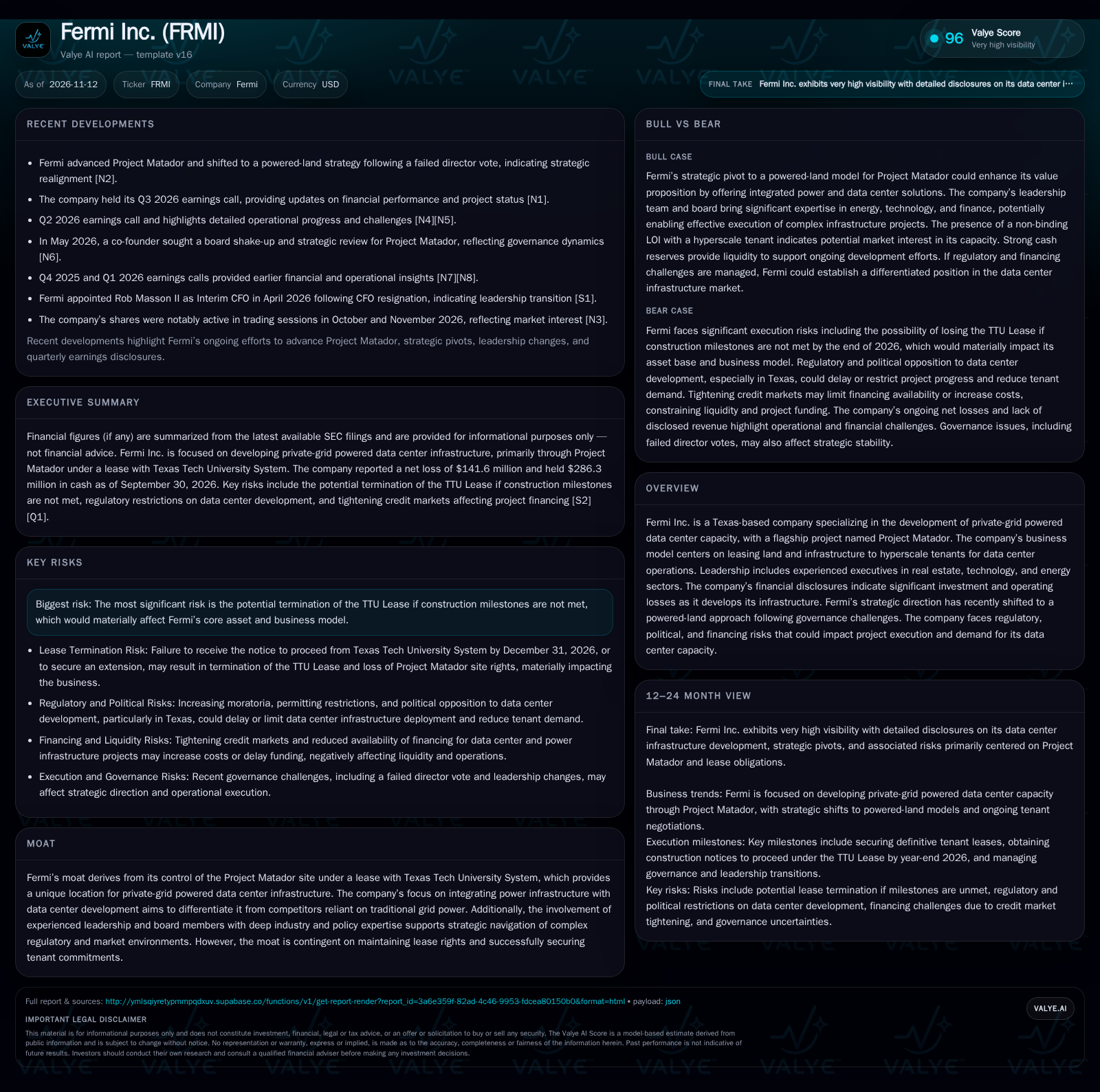
Fermi Inc. is pursuing a differentiated path in the data center infrastructure market by developing Project Matador, a private-grid powered campus on leased land in Texas. With $286.3 million in cash but no disclosed revenue and a net loss of $141.6 million through Q3 2026, Fermi’s business model depends on converting tenant interest (currently only a non-binding LOI) into firm leases by year-end 2026 to avoid lease termination. The strategy shift to a powered-land model, leadership churn, and tightening credit conditions amplify both the upside and the existential risks facing the company.
Fermi Inc. stands at a crossroads: its entire business model and asset base are anchored to the successful launch of Project Matador, a private-grid powered data center development in Texas. With no revenue, ongoing losses, and a lease that could be terminated if construction does not commence by the end of 2026, the company faces a binary outcome—either it secures a hyperscale anchor tenant and begins building, or it risks losing its flagship project altogether. The recent shift to a powered-land strategy, leadership turnover, and a tightening financing environment underscore both the transformative potential and the existential risks Fermi must navigate in the coming year.
Binary Risk: Lease Deadline, No Revenue, and Strategic Pivot Define Fermi’s 2026 Reality
Fermi Inc.’s present situation is defined by three hard facts. First, the company reported $286.3 million in cash and a net loss of $141.6 million for the first nine months of 2026, with no revenue disclosed—highlighting the pre-operational, capital-consuming nature of its business [S2]. Second, Fermi’s primary asset, Project Matador, exists solely under a lease with the Texas Tech University System (TTU Lease); if Fermi does not receive a notice to proceed for vertical construction by December 31, 2026, or secure an extension, it may lose site rights entirely. Third, the only commercial progress reported is a non-binding Letter of Intent (LOI) with a hyperscale tenant—no binding leases or revenue visibility exist.
These facts elevate the importance of the next 12 months: the company must convert tentative tenant interest into a definitive lease and secure regulatory and financing milestones, or risk losing its core asset and business rationale.
How Fermi’s Powered-Land Model Could Create Value—If Tenancy Materializes
Fermi’s business model centers on developing and leasing data center capacity—specifically, powered land with private-grid infrastructure—to hyperscale tenants. The powered-land strategy, recently adopted after governance challenges, suggests a focus on offering ready-to-build sites with integrated power solutions, potentially appealing to cloud providers and AI infrastructure operators seeking energy reliability, scalability, and speed-to-market [N2].
Revenue generation depends entirely on signing long-term ground or facility leases with hyperscale tenants, which may include upfront payments, recurring rent, and possibly revenue-sharing or power cost pass-throughs. The capital intensity is high: substantial upfront investment is required for land preparation, grid interconnection, and possibly shell construction, with returns backloaded and contingent on lease execution. If Fermi can secure an anchor tenant, strong operating leverage may follow, as incremental capacity can be developed and leased at lower marginal cost.
However, the absence of revenue and only a non-binding LOI means the project currently generates no cash flow, and all economics are hypothetical. The company reported cash and liquidity metrics for the period; these figures do not by themselves establish operating runway, investment capacity, financial flexibility, or financing capacity. [S2]
Project Matador’s Moat: Location, Power, and Policy—But Only If Lease and Tenants Are Secured
Fermi’s core competitive proposition is its control—contingent on lease milestones—of a Texas site with private-grid power potential, aiming to offer hyperscale tenants a differentiated alternative to grid-constrained or politically hostile regions. The theoretical moat combines site control, power integration, and a regulatory environment that (historically) has been favorable to energy-intensive infrastructure.
However, the moat is highly conditional. If the TTU Lease lapses, Fermi loses its asset and differentiation. Even with lease retention, the company must compete with incumbent data center REITs, private developers, and utilities increasingly entering the powered-land space. Many competitors already have established tenant rosters, proven development records, and greater access to capital.
Regulatory headwinds—including potential moratoria and political opposition to new data center and power projects in Texas—could erode location advantages. The presence of high-profile board members with energy and policy backgrounds may aid navigation of these hurdles, but does not guarantee success [S1].
Anchor Tenant Conversion and Lease Milestones Unlock Project Matador’s Value
The most optimistic scenario for Fermi depends on converting its non-binding LOI into a definitive, multi-year lease agreement with a major hyperscale tenant before the December 31, 2026, deadline. Such a development would not only secure the TTU Lease (by triggering the notice to proceed and vertical construction) but also provide the credibility and cash flow needed to unlock project-level financing, attract additional tenants, and enable rapid scaling of the site.
Confirmation of this scenario would come from public disclosure of a binding lease, tenant prepayments or deposits, and evidence of construction commencement. Additional signs would include further lease signings, successful regulatory approvals, and capital raises on favorable terms. Falsification would occur if the LOI expires, tenant negotiations stall, or the company fails to secure the notice to proceed by year-end.
Fermi’s Most Likely Path: Delayed Progress, Extensions, and Ongoing Cash Burn
The most plausible near-term outcome is a period of continued cash burn as negotiations with prospective tenants and regulators proceed more slowly than hoped. Fermi may secure an extension from the Texas Tech University System if sufficient progress or credible negotiations with tenants are demonstrated, but not reach definitive lease agreements before the original deadline.
Evidence supporting this scenario would include announcements of lease extensions, incremental project milestones (such as permitting or site preparation), and ongoing leadership communications about tenant interest—without definitive lease conversion. Falsification would be a sudden lease cancellation or, conversely, a surprise anchor tenant signing and notice to proceed.
Lease Termination or Financing Failure Could Render Project Matador a Stranded Asset
The principal adverse scenario is the failure to secure a notice to proceed or tenant commitment, resulting in the TTU Lease being terminated at the end of 2026. This would eliminate Fermi’s only material asset, likely eradicating shareholder value and forcing a strategic overhaul or liquidation.
A secondary but severe risk is the inability to finance ongoing development due to tightening credit markets, regulatory delays, or cost inflation—leading to a cash crunch even if the lease is technically retained. Confirmation of this scenario would be announcements of lease termination, mass layoffs, asset write-downs, or an abrupt halt in project spending. Early warning signs include negative regulatory developments, failed financing attempts, and deteriorating communications with the Texas Tech University System or prospective tenants.
What Could Shift Fermi’s Trajectory: Concrete Milestones and External Catalysts
Disclosure of a binding lease agreement with a hyperscale tenant, including terms and expected revenue contribution, would be the single most important catalyst.
Formal receipt of the notice to proceed or an approved extension from the Texas Tech University System for Project Matador construction.
Announcement of tenant prepayments, deposits, or construction advances—if disclosed—which would validate tenant commitment and project economics.
Material regulatory developments in Texas that affect data center permitting, moratoria, or power infrastructure approvals.
Evidence of successful project-level financing, new equity investment, or non-dilutive funding sufficient to support vertical construction.
Updates on the status of the non-binding LOI, including renewal, expiration, or conversion to a definitive agreement.
Board and leadership changes, especially those affecting strategic direction, project execution, or relationships with key stakeholders.
If disclosed, detailed project cost updates and cash burn trajectory, which would clarify runway and capital requirements.
Disclaimer: This is research-only, informational analysis and not investment advice. It may include AI-generated interpretation and general industry context. Always verify important details using primary sources.

Comments