
Perceptive Capital Solutions: SPAC Execution, Sector Focus, and the Freenome Inflection Point
The company’s future now hinges on deal execution and the value creation potential of its chosen target in a competitive and regulatory-intensive landscape.
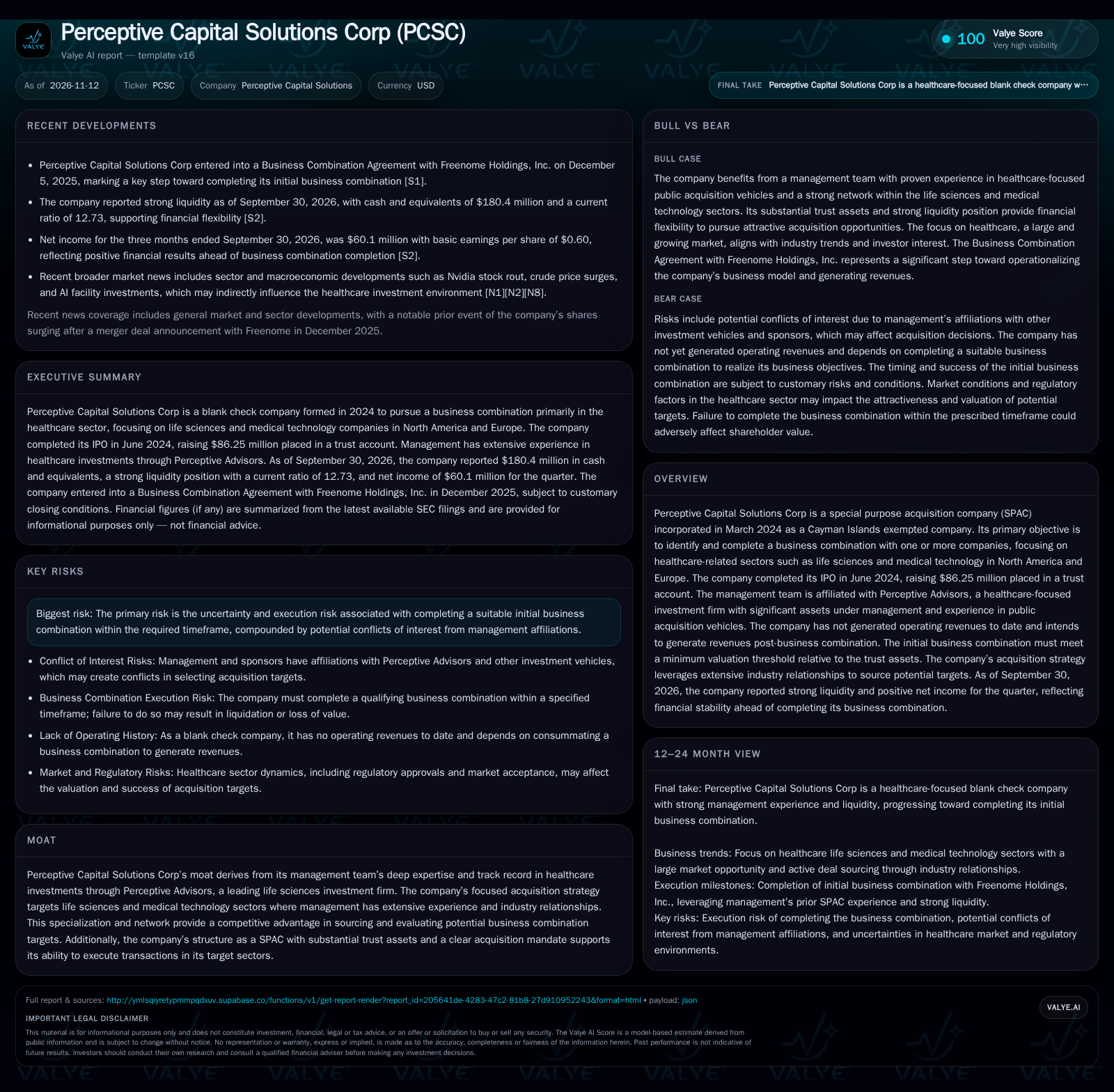
Perceptive Capital Solutions Corp, a healthcare-focused SPAC affiliated with Perceptive Advisors, has entered into a business combination agreement with Freenome Holdings.With $180.4 million in cash, a reported current ratio, and reported net income ahead of the deal, the company’s trajectory now depends on closing the transaction and successfully integrating a life sciences business in a dynamic market environment. Execution risk, regulatory hurdles, and management conflicts of interest remain key factors to monitor as the SPAC approaches its inflection point.
Perceptive Capital Solutions Corp exemplifies the current generation of sector-focused SPACs, blending an experienced healthcare investment team with a substantial trust account to pursue a high-impact business combination. The recent agreement to merge with Freenome Holdings, a move that could soon transform this blank-check vehicle into an operational healthcare entity, marks a critical inflection point. While the company boasts significant liquidity and a strong reputation through its Perceptive Advisors affiliation, its future is now tethered to the successful closure and value realization of its initial deal—against the backdrop of an intensely competitive and regulated life sciences market.
Deal with Freenome and Financial Position Set the Stage for Transformation
Perceptive Capital Solutions Corp entered into a Business Combination Agreement with Freenome Holdings, Inc. on December 5, 2025, representing a pivotal commitment to transition from a SPAC to an operating company in the life sciences sector [S1]. As of September 30, 2026, the company reported $180.4 million in cash and equivalents, alongside current assets of $461.0 million and current liabilities of $36.2 million, yielding a current ratio of 12.73 and a cash ratio of 4.98 [S2]. Notably, the company posted net income of $60.1 million for the quarter, with basic earnings per share of $0.60 [S2]. These figures suggest a reported liquidity position and financial stability ahead of the business combination. However, it is important to recognize that these results largely reflect pre-combination SPAC economics—primarily investment income and low operating expenses—rather than the performance of an underlying operating business. The upcoming merger with Freenome will fundamentally alter the company’s financial profile, operating risks, and value proposition.
SPAC Economics: From Trust Interest to Operating Uncertainty
To date, Perceptive Capital Solutions’ financials are characteristic of a pre-combination SPAC: revenues are absent, and reported net income is typically a function of interest income from trust assets, with minimal ongoing expenses [S2]. This structure results in high apparent profitability and reported liquidity position, but these are not durable once the business combination closes. Upon merging with Freenome, the company’s economics will pivot to those of a growth-stage healthcare or diagnostics business—likely involving substantial R&D, regulatory approval cycles, and commercial ramp-up costs.
Healthcare and life sciences businesses often face a period of negative operating cash flow as they invest in clinical trials, regulatory submissions, and go-to-market infrastructure. Margins and operating leverage in such models are highly sensitive to the pace of clinical milestones, payer adoption, and product mix. If the combined entity can achieve rapid commercial traction, gross margins could eventually scale, but this is typically a multi-year path. The adequacy of the company’s current cash and the terms of any committed financing will determine its ability to fund the post-merger business through inflection points. The sustainability of profitability will depend on Freenome’s revenue model, pricing power in diagnostics, and ability to scale efficiently in a competitive reimbursement environment.
Sector Focus, Network Leverage, and the Realities of Healthcare Competition
Perceptive Capital Solutions’ core advantage lies in its management team’s deep sector experience and its affiliation with Perceptive Advisors, a fund with $9.5 billion in AUM and a strong network in life sciences [S1]. This network may afford the SPAC differentiated access to deal flow and management talent, which can be critical in sourcing and executing attractive transactions. However, the healthcare SPAC arena is crowded, and the competitive landscape for high-quality targets—especially in diagnostics and medtech—is intense. Strategic buyers, traditional private equity, and other sector-focused SPACs all compete for similar assets.
Post-combination, Freenome will enter a market characterized by rapid innovation, regulatory hurdles, and significant capital requirements. The diagnostics space, in particular, is marked by large incumbents, emerging startups, and the constant threat of technological obsolescence. Success will depend on the combined company’s ability to demonstrate clinical efficacy, navigate regulatory approval, secure reimbursement, and build commercial adoption. While Perceptive’s brand and relationships may give the company a seat at the table, durable competitive advantage will ultimately depend on Freenome’s intellectual property, clinical performance, and commercial execution—not just on deal sourcing.
Value Creation If Freenome Delivers Clinical and Commercial Breakthroughs
The most favorable outcome for Perceptive Capital Solutions shareholders would result from Freenome rapidly achieving regulatory approval for its lead diagnostics platform, securing payer reimbursement, and demonstrating robust clinical adoption. In this scenario, the combined entity could transition from cash burn to rapid revenue growth, leveraging high gross margins typical of successful diagnostics businesses.
Evidence that would confirm this scenario includes timely regulatory approvals, positive clinical trial results published in peer-reviewed journals, announced commercial partnerships with major healthcare systems, and sequential revenue growth post-combination. Additionally, early signals of payer coverage, positive physician adoption trends, and a strong pipeline of follow-on products would reinforce the thesis of scalable, recurring revenue generation. If Freenome’s technology is validated as best-in-class and achieves market leadership, the combined company could command premium valuations and attract further strategic interest.
Integration and Execution Risks Define the Likely Near-Term Outcome
The most plausible trajectory is that Perceptive Capital Solutions and Freenome successfully close the business combination, with the combined company facing a typical post-SPAC ramp: integration challenges, ongoing R&D spending, and a multi-year path to commercial scale. Early quarters may show increased operating losses as Freenome invests in regulatory submissions, clinical trials, and initial commercial infrastructure. Revenue growth may be modest or lumpy, depending on the timing of regulatory approvals and payer decisions.
Confirmation of this scenario would come from the successful transaction close, detailed integration plans, and initial updates on clinical and regulatory progress. Financial statements would likely reflect increased cash burn, with liquidity monitoring becoming central. If disclosed, metrics such as cash runway, quarterly operating losses, and progress toward key clinical or regulatory milestones would help clarify whether the company is tracking toward sustainable growth or encountering execution bottlenecks. The pace of hiring, pipeline expansion, and early customer adoption would serve as additional indicators.
Deal Failure or Delays and the Structural Risks Facing SPACs
The principal adverse scenario involves the failure to consummate the Freenome transaction—whether due to regulatory, due diligence, or shareholder approval hurdles—or material deterioration in Freenome’s prospects post-close. If the deal collapses, Perceptive Capital Solutions could be forced to seek an alternative target in a compressed timeframe or return capital to shareholders, resulting in value erosion and opportunity cost. Even if the deal closes, protracted regulatory delays, negative clinical data, or reimbursement setbacks could lead to sustained cash burn and pressure the company to raise additional capital on unfavorable terms.
Evidence supporting this scenario would include deal termination announcements, missed regulatory or shareholder approval deadlines, or adverse updates from Freenome regarding clinical trials or payer coverage. A sharp increase in operating losses, rapid cash depletion, or the need for emergency financing would also point to downside realization. In the extreme, failure to complete a qualifying business combination within the SPAC’s allowed timeframe could trigger liquidation and capital return, crystallizing losses for sponsors and public holders.
Milestones That Will Determine Whether Perceptive Capital Solutions Creates Value
Progress toward closing the Freenome business combination—including regulatory approvals, shareholder votes, and satisfaction of closing conditions—will be pivotal.
Disclosure of the combined company’s pro forma capital structure, anticipated cash burn, and post-merger liquidity will help assess financial runway and funding needs.
Updates on Freenome’s clinical trial progress, regulatory submissions, and timelines for approval would clarify the path to commercialization.
Early revenue figures, customer adoption metrics, and payer reimbursement status (if disclosed) would provide the first signals of commercial traction.
Details on integration plans, management team continuity, and retention of key personnel post-merger would help gauge execution risk.
Any additional PIPE (private investment in public equity) financing or secondary capital raises would indicate confidence in the business plan or reveal funding gaps.
Resolution or escalation of any conflicts of interest involving management’s other investment vehicles would shape governance and alignment.
Disclaimer: This is research-only, informational analysis and not investment advice. It may include AI-generated interpretation and general industry context. Always verify important details using primary sources.

Comments