
QHSLab’s Digital Health Platform: Can Workflow Integration and Recurring Revenue Outpace Scale and Capital Constraints?
QHSLab, Inc. aims to carve out a niche in digital behavioral health and allergy management for small, independent primary care practices through a modular, workflow-integrated platform and recurring per-patient fees. With modest cash and a history of losses, the company’s growth potential hinges on deepening practice adoption and fending off better-resourced competitors while navigating complex healthcare regulations.
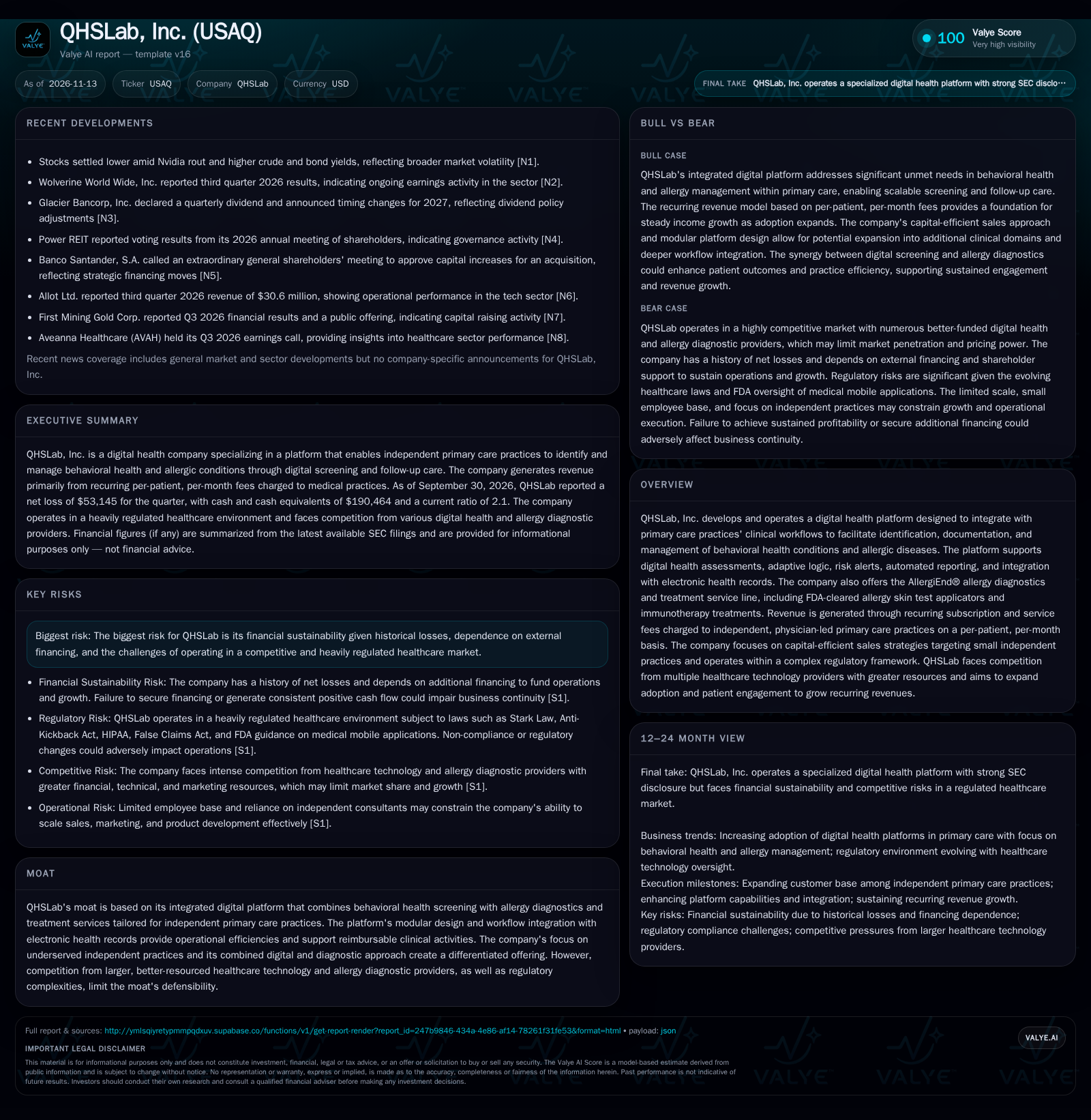
QHSLab, Inc. develops a digital health platform enabling small primary care practices to screen, document, and manage behavioral and allergic conditions, generating recurring revenue via per-patient, per-month fees. As of September 30, 2026, the company reported a quarterly net loss of $53,145 and cash of $190,464. The platform’s integration with clinical workflows and the AllergiEnd® allergy diagnostics line aim to boost adoption and patient engagement, but QHSLab’s financial sustainability remains challenged by historical losses, capital needs, and intense competition from larger healthcare technology players [S1] [S2].
QHSLab, Inc. is positioning itself as a digital health enabler for independent primary care practices, targeting the underdiagnosed arenas of behavioral health and allergy management. Through a modular, workflow-integrated platform, QHSLab offers digital assessments, care management, and an allergy service line, aiming to drive recurring revenue from per-patient, per-month fees. Yet, the company’s small scale, history of net losses, and dependence on outside financing underscore the challenge of achieving profitability and defending its niche against larger, better-funded competitors. The coming quarters will test whether QHSLab’s specialized approach and capital-efficient sales model can deliver sustainable growth in a crowded, regulated market.
Recent Financials and Platform Integration Shape Near-Term Outlook
QHSLab reported a net loss of $53,145 for the quarter ended September 30, 2026, with cash and cash equivalents totaling $190,464, a current ratio of 2.1, and a cash ratio of 0.77 [S2]. The company reported cash and liquidity metrics for the period; these figures do not by themselves establish operating runway, investment capacity, financial flexibility, or financing capacity. The company’s revenue is primarily generated through recurring per-patient, per-month fees from independent primary care practices that use its digital health platform and associated services [S1]. QHSLab’s integrated approach—combining behavioral health screening, care management, and allergy diagnostics—anchors its value proposition and recurring revenue ambitions but also exposes it to the operational and regulatory complexities of the U.S. healthcare system.
How Recurring Fees and Platform Extensions Could Unlock Operating Leverage
The core economic engine for QHSLab is its recurring, subscription-based revenue model: practices pay per patient, per month for digital screening, workflow integration, and care management support [S1]. This structure offers the potential for high revenue visibility and operating leverage if patient enrollment per practice grows and retention remains high. The model’s scalability is theoretically strong—incremental software delivery costs are low, while fixed product development and regulatory compliance costs can be spread across a growing user base.
However, capital needs are nontrivial. Expansion requires investment in sales, support, regulatory affairs, and product development—functions that are currently constrained by a small full-time workforce and reliance on consultants [S1]. The AllergiEnd® service line, which includes FDA-cleared diagnostic tools and immunotherapy treatments, could increase revenue per practice but also introduces inventory, training, and support costs. Because QHSLab does not bill patients or payers directly, its revenue is tied to the financial health and billing capabilities of its provider customers, and is subject to payer reimbursement rules for digital and allergy services. The company’s ability to scale profitably will depend on increasing practice penetration, driving up patient enrollment rates, and minimizing churn, while controlling customer acquisition and support costs.
Defining Differentiation Amid Point Solutions and Platform Giants
QHSLab operates in a crowded digital health landscape, competing with point-solution vendors (focused on behavioral health or chronic care management), broader digital health platforms, EHR-integrated tools, and established allergy diagnostic device makers [S1]. Many of these rivals are larger, better capitalized, and have deeper channel relationships. QHSLab’s differentiation centers on workflow integration for small, physician-led practices and the combination of digital behavioral health and allergy management within a single modular platform. This integrated approach may create switching frictions if practices embed QHSLab’s tools deeply into their clinical and billing workflows.
However, the company’s focus on small, independent practices—while potentially less competitive than hospital systems—limits immediate market scale. Larger platforms and EHR vendors could introduce or improve embedded assessment and care management tools, eroding QHSLab’s value proposition unless it maintains a rapid pace of innovation and customer service. The AllergiEnd® line offers product breadth but faces established diagnostic device competitors with more extensive distribution and support infrastructure. Regulatory complexity and the need for workflow customization further raise barriers to rapid expansion.
Expanding Practice Penetration and Clinical Domains Drives Flywheel Effects
A favorable trajectory for QHSLab would see accelerating adoption among independent primary care practices, with each practice enrolling a growing share of its patient panel in digital screening and allergy management programs. As the platform becomes embedded in practice workflows and EHRs, switching costs increase, reducing churn and supporting durable, recurring revenue. The addition of new clinical domains—leveraging the platform’s modularity—would expand the total addressable market and increase revenue per practice without proportional increases in support costs.
Evidence confirming this scenario would include rising contracted practice counts, consistent quarter-over-quarter growth in active patient enrollments, increased average revenue per practice, and successful launches of new assessment modules or clinical service lines. Strategic partnerships with EHR vendors or payers, or regulatory changes that further incentivize digital care management, would provide additional tailwinds. Falsification would occur if practice adoption stalls, churn rises, or competitors successfully replicate QHSLab’s integrated approach.
Incremental Adoption Balances Growth Ambitions with Resource Constraints
The most plausible path is gradual expansion of QHSLab’s installed base among independent primary care practices, with moderate increases in patient enrollment per practice and steady—if modest—recurring revenue growth. The company continues to invest cautiously in product enhancements, sales, and regulatory compliance, but resource constraints limit the pace of innovation and geographic expansion. The AllergiEnd® line contributes incremental revenue, but uptake is gated by training requirements and practice capacity.
This scenario is confirmed by slow but positive trends in quarterly revenue, stable or improving gross margins (if disclosed), and periodic product updates. A lack of rapid customer churn or dramatic market share loss would support the thesis, while evidence of stagnant practice acquisition, flat revenue per practice, or mounting operating expenses would suggest downside risk.
Financial Strain or Regulatory Shifts Undercut Platform Expansion
Adverse outcomes could emerge if QHSLab is unable to secure sufficient financing to cover ongoing losses or if regulatory changes increase compliance burdens or restrict reimbursable activities. Heightened competition—especially from EHR vendors or large digital health platforms—could accelerate customer attrition or force price concessions, undermining operating leverage. Operational bottlenecks stemming from the small employee base could delay product updates or customer support, further weakening competitive position.
Downside evidence would include declining cash balances with no new funding, rising net losses, layoffs or consultant reductions, practice churn, negative customer feedback, or regulatory warnings. New or changed payer reimbursement rules that reduce the appeal of digital assessments or allergy management in primary care would also threaten the model.
Milestones and Metrics That Will Reveal QHSLab’s Staying Power
Practice acquisition and retention rates: Tracking the number of active, contracted practices and renewal rates over time would clarify adoption momentum and switching frictions.
Patient enrollment per practice: Growth in the average number of patients enrolled in digital screening and allergy management services per participating practice would signal platform value and scalability.
Recurring revenue growth and average revenue per practice: Sequential trends in these metrics (if disclosed) would test the recurring model’s strength and the impact of cross-selling AllergiEnd® services.
Gross margin evolution: Monitoring gross margins, especially as AllergiEnd® scales, would indicate whether operating leverage is being achieved.
Sales and support capacity: Updates on full-time employee count and consultant engagement would show whether QHSLab can keep pace with onboarding and support demands.
Regulatory developments: Any updates on healthcare billing rules, FDA oversight, or enforcement actions could materially affect QHSLab’s business model.
New product or domain launches: The pace and success of new clinical domain modules or partnerships would test the platform’s modular thesis and growth potential.
Disclaimer: This is research-only, informational analysis and not investment advice. It may include AI-generated interpretation and general industry context. Always verify important details using primary sources.

Comments