
Nocopi Technologies: Acquisition-Fueled Expansion Tests the Durability of a Niche Licensing Model
A transformational acquisition and surging revenue highlight Nocopi’s 2026, but customer concentration and license renewal risks leave open the question of whether recent gains can be sustained. As the company extends its specialty ink portfolio and manufacturing footprint, the economics of its licensing-centric strategy face renewed scrutiny.
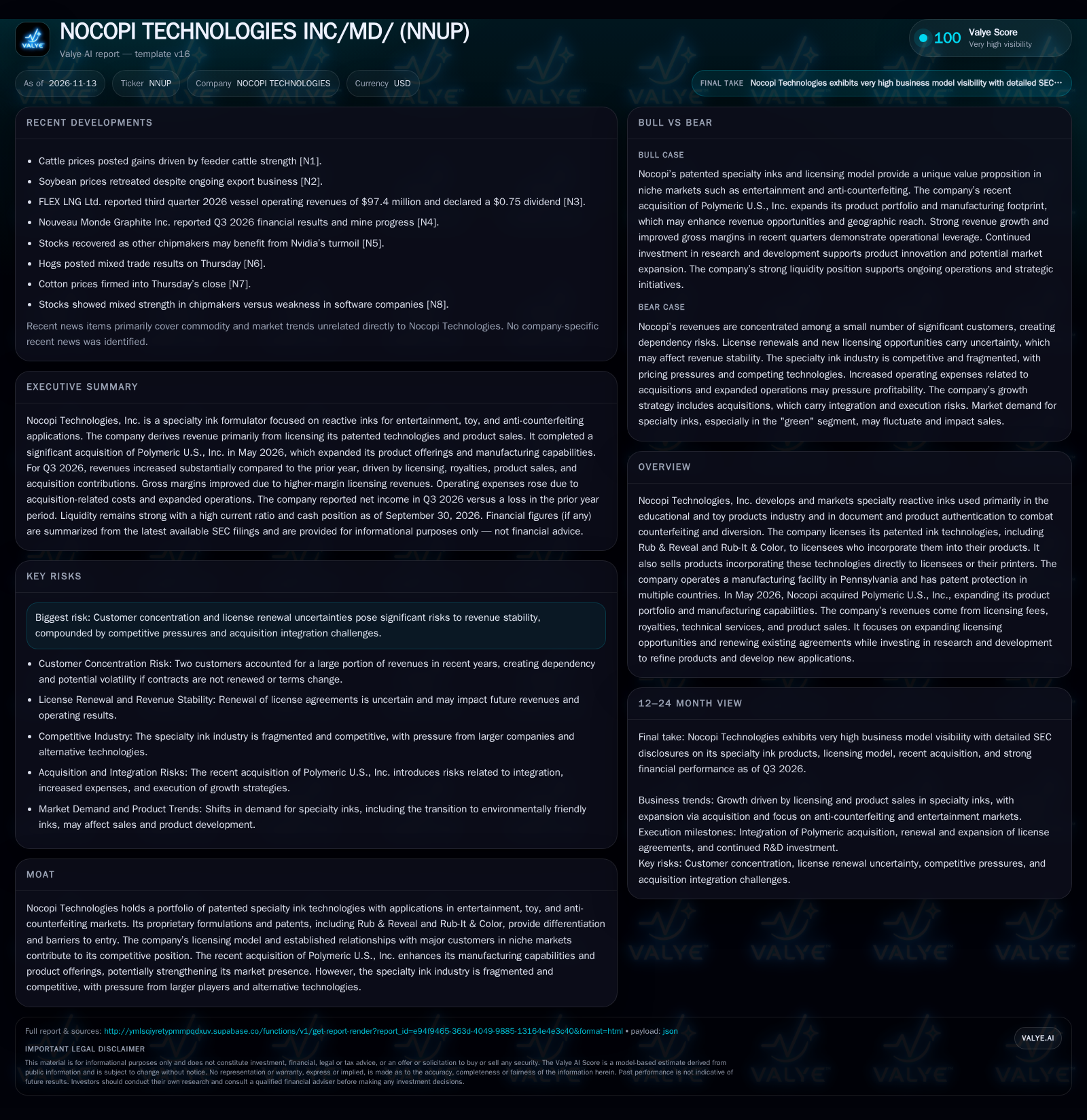
Nocopi Technologies reported a 763% year-over-year revenue surge in Q3 2026, driven by increased licensing, royalties, and the acquisition of Polymeric U. S., Inc. While gross margins expanded sharply, the business remains dependent on a small number of customers and faces uncertainty around license renewals. The acquisition adds manufacturing scale and product breadth, but integration and competitive pressures present material execution risks. The durability of Nocopi’s niche, patent-protected licensing model will be tested as it seeks to diversify its customer base and sustain recent financial momentum. [S2]
Nocopi Technologies’ Q3 2026 performance marks a dramatic inflection, with revenue and profitability surging on the back of a major acquisition and expanded licensing activity. Yet beneath the headline growth, the company’s exposure to a handful of customers, reliance on license renewals, and the challenges of integrating a new manufacturing operation raise critical questions about the sustainability of its gains. As Nocopi deploys its enlarged product portfolio into niche entertainment and anti-counterfeiting markets, investors must weigh the potential for continued expansion against the realities of concentrated risk and evolving industry competition.
Acquisition-Driven Growth and Margin Expansion Define Recent Results
Nocopi Technologies’ Q3 2026 results are dominated by two transformative developments: a 763% year-over-year revenue increase to $3.33 million and the completed acquisition of Polymeric U. S., Inc. in May 2026. The Polymeric acquisition materially expanded Nocopi’s product offerings and manufacturing capabilities, contributing to both top-line growth and a shift in revenue mix. Gross profit margin leapt from 46% to 66%, reflecting higher-margin licensing and royalty revenues. Operating expenses also rose as the company absorbed integration costs and scaled up its operations. The net effect was a swing to $1.4 million in net income for the quarter, reversing prior losses. reported liquidity position, with $7.29 million in cash and a current ratio of 12.49 as of September 30, 2026. Despite these improvements, the business remains highly dependent on a small number of significant customers, and the predictability of future revenues is clouded by uncertainties around license renewals and customer concentration. [S1] [S2]
How the Licensing-Heavy Model Scales—and Where Its Limits Lie
Nocopi’s core business model centers on licensing patented specialty ink technologies—such as Rub & Reveal and Rub-It & Color—to partners in the entertainment, toy, and anti-counterfeiting sectors. Revenue streams include upfront licensing fees, ongoing royalties, technical services, and direct product sales. The licensing component is typically higher margin, as it leverages the company’s intellectual property without commensurate increases in variable costs. This is evident in the Q3 2026 margin expansion, where increased licensing and royalty revenue drove a substantial improvement in gross profit percentage. However, the fixed cost base can rise sharply with acquisitions, as seen in higher operating expenses post-Polymeric. The company’s capital needs are modest for organic growth but can spike with strategic acquisitions or major production investments. Operating leverage is pronounced—incremental licensing revenue drops quickly to the bottom line, but a reversal in license renewals or customer loss would similarly magnify downside impact. Nocopi’s ability to sustain or grow its licensing base is thus the primary determinant of its long-term earnings power.
Patented Niche Defenses Meet Fragmented, Pressurized Market
Nocopi’s competitive position relies on its portfolio of proprietary, patented ink technologies and the regulatory or customer requirements for anti-counterfeiting and safety in entertainment and product authentication applications. The company’s differentiation comes from features such as invisible printing, non-toxic formulations, and unique interactive properties. However, the specialty ink industry is highly fragmented, with numerous small innovators and large chemical or materials companies capable of developing alternative solutions. Competitive threats include both direct patent challenges and the risk that major customers could switch to in-house or rival technologies if licensing terms are unfavorable or if Nocopi’s innovations lapse. The Polymeric acquisition broadens the company’s product capabilities, but it also exposes Nocopi to manufacturing execution risks and potentially more direct competition in custom ink formulations. Customer relationships are deep but not necessarily contractually long-term, and the renewal cycle creates periodic vulnerability to competitive encroachment.
If Licensing Expands and Integration Delivers, Margin Leverage Could Compound
The most favorable scenario for Nocopi involves successful integration of Polymeric, leading to a broader product suite that attracts new licensees in both existing and adjacent markets. If the company can renew its major licenses and win new agreements—particularly with large entertainment or security printing partners—incremental revenue would likely carry high incremental margins due to the licensing model’s low variable costs. Additional upside could come from cross-selling Polymeric’s capabilities to existing customers and leveraging expanded manufacturing to support custom product development. Evidence supporting this scenario would include new customer wins, renewal of expiring licenses at equal or better terms, and sustained or expanding gross margins. A further indicator would be a reduction in customer concentration, signaled by a more diversified revenue base.
Sustaining Momentum Hinges on License Renewals and Managing Integration Costs
The most plausible outcome is that Nocopi maintains its enlarged revenue base in the near term, provided it can renew key customer licenses and avoid significant churn. Gross margins may stay elevated if the mix remains tilted toward licensing and royalty income, but operating expenses could remain high as integration and expanded manufacturing costs persist post-acquisition. The revenue mix may gradually diversify if Polymeric’s offerings attract new customers, but the pace is likely to be measured given the slow-moving nature of licensing negotiations and qualification cycles in regulated or safety-sensitive markets. Confirmation of this scenario would come from stable or growing revenues, maintenance of gross margin levels, and updates on license renewals or expansion into new geographies or product categories. A falsification signal would be the loss of a major customer or failure to renew a key license, leading to a sharp revenue decline.
Customer Churn or License Loss Could Trigger a Profitability Reversal
The principal risk to Nocopi’s outlook is the loss or non-renewal of one or more major licenses, given the company’s dependence on a few large customers. If a key licensee defects to a competitor or brings ink production in-house, revenues could drop precipitously, with fixed costs from the Polymeric acquisition compounding the impact on profitability. The fragmented nature of the specialty ink market means replacement customers may not be readily available at comparable scale or terms. Further downside could emerge if integration of Polymeric proves more costly or operationally disruptive than anticipated, eroding margins and consuming cash reserves. Evidence for this scenario would include disclosures of customer or license loss, falling gross margins, rising operating losses, or indications that cash reserves are being depleted to cover ongoing expenses in the absence of replacement revenue.
Thesis-Defining Milestones for Nocopi’s Licensing and Integration Playbook
Renewal status and term lengths of major licensing agreements—especially with the two largest customers—will directly test revenue durability.
Revenue contribution and margin profile from Polymeric-acquired operations: a useful metric would be product-level or segment-level reporting, if disclosed.
Gross margin trends as an indicator of mix shift between high-margin licensing and lower-margin product sales.
Customer concentration metrics: tracking the proportion of revenue from the top two or three customers would help assess risk.
New customer wins or expanded licensing agreements, particularly in untapped geographies or verticals.
Integration cost disclosures and progress updates on operational synergies or production ramp at the expanded manufacturing facility.
Sustained R&D investment and resulting patent filings or new product introductions in response to evolving industry standards or customer needs.
Evidence of competitive displacement or pricing pressure, such as lower royalty rates or customer migration to alternative suppliers.
Disclaimer: This is research-only, informational analysis and not investment advice. It may include AI-generated interpretation and general industry context. Always verify important details using primary sources.

Comments