
Nexalin Technology: From Neurostimulation Innovation Toward Commercial Success
Nexalin Technology’s proprietary brain-stimulation devices and digital platform target a vast unmet need in mental health, but the company faces acute regulatory, financial, and commercialization hurdles. Key milestones in clinical trials, FDA engagement, and capital structure will determine whether its next-generation technology can transition from promise to sustainable market presence.
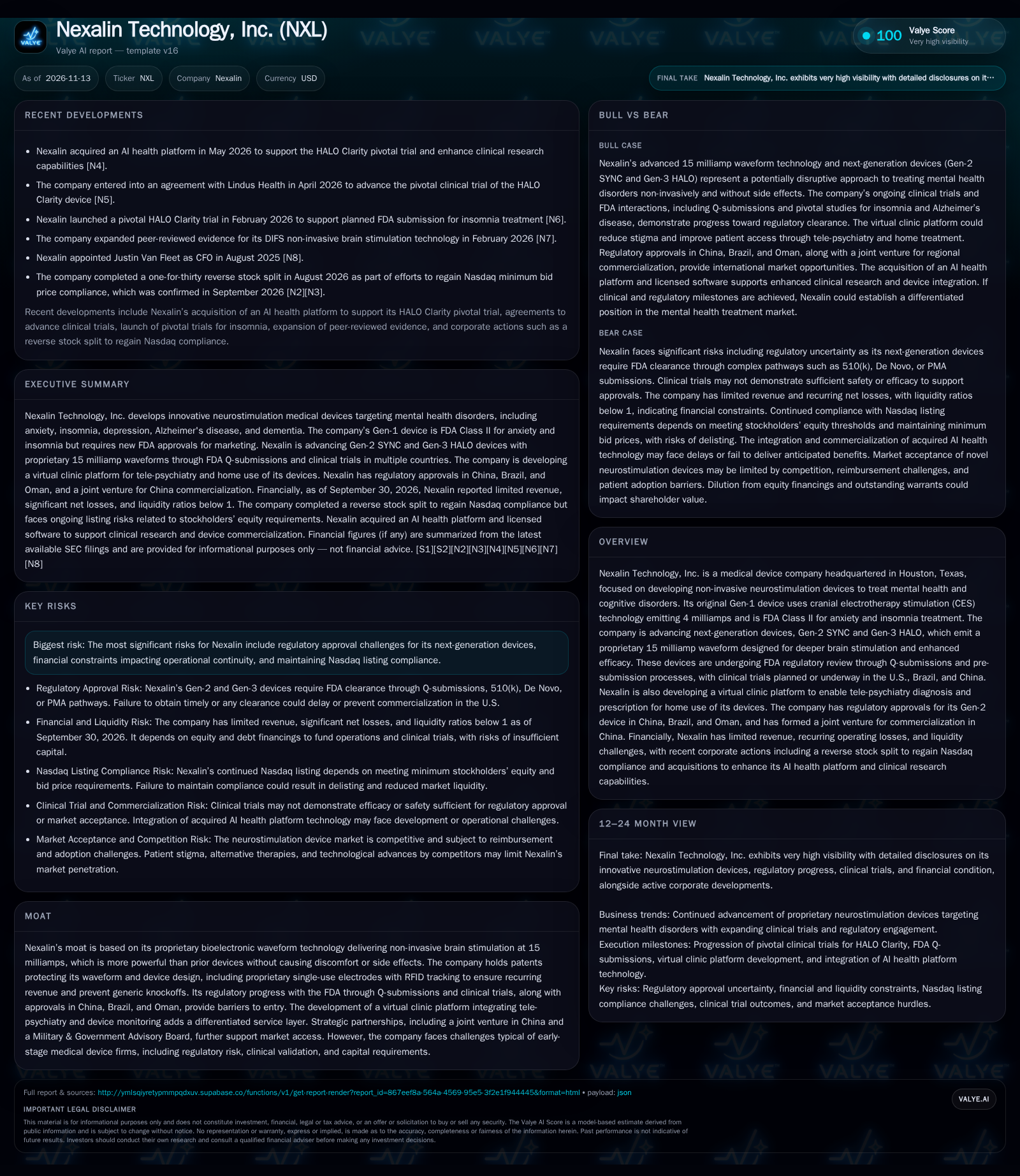
Nexalin Technology’s next-generation neurostimulation devices, featuring a proprietary 15 milliamp waveform, are pursuing regulatory clearance and clinical validation for mental health indications. Success hinges on pivotal trial outcomes, U.S. regulatory progress, and Nexalin’s ability to secure financing while avoiding Nasdaq delisting.
Nexalin Technology, Inc. sits at the intersection of innovation and risk in the fast-evolving neurostimulation market. With next-generation devices designed to treat anxiety, insomnia, and cognitive disorders through proprietary, non-invasive brain stimulation, the company offers a differentiated technological approach. However, the journey from clinical promise to commercial traction is fraught with obstacles: pivotal clinical trials, FDA regulatory hurdles, and a capital structure stretched by persistent operating losses and subpar liquidity. Whether Nexalin can convert its technological and regulatory headway into a viable business will depend on near-term milestones in trial results, U.S. market clearance, and the company’s ability to secure financing while retaining its public listing.
Regulatory Advances and Financial Challenges Shape Nexalin’s Current Landscape
The company reported cash and liquidity metrics for the period; these figures do not by themselves establish operating runway, investment capacity, financial flexibility, or financing capacity. [S1] [N6] [S2] [N2] [N3] [N4] [N5]
These facts matter because Nexalin’s entire business model is contingent on achieving regulatory clearance and demonstrating clinical efficacy for its next-generation devices, all while navigating acute liquidity pressures and the threat of losing public listing status. The intersection of these milestones will determine whether Nexalin can pivot from a pre-commercial innovator to a viable, scaling medical device company.
Economic Potential Hinges on Overcoming Regulatory and Adoption Hurdles
Nexalin’s business model is structured around the sale (and potentially the lease or prescription) of proprietary neurostimulation devices for mental health—primarily anxiety, insomnia, and cognitive disorders. The company’s revenue could come from three sources: (1) direct device sales to clinics or healthcare providers, (2) recurring revenue from single-use electrodes (protected by RFID and patents), and (3) a digital platform enabling tele-psychiatry and at-home monitoring, possibly on a subscription basis if commercialized as planned.
If the virtual clinic and remote prescription model gains traction, Nexalin could benefit from high gross margins typical of software-enabled medical devices, with operating leverage as fixed R&D and regulatory costs are spread over increasing volumes. However, the economics are currently hypothetical: the company’s reported revenue is negligible, and all next-generation devices are still awaiting FDA clearance for U.S. marketing [S2].
Capital intensity is currently high, with ongoing clinical trials, regulatory engagement, and platform development requiring continual external financing. The company’s sub-1 liquidity ratios, recent ATM and AMPA financing arrangements, and the need for a reverse split to sustain Nasdaq listing highlight the precarious funding position and potential for further shareholder dilution [S2]. Without clinical and regulatory breakthroughs, Nexalin’s fixed costs and cash burn could overwhelm any incremental revenue gains.
Evaluating Nexalin’s Position Amidst Neurostimulation Competitors
Nexalin’s main competitive lever is its proprietary 15 milliamp waveform technology, which aims to deliver more effective, non-invasive brain stimulation without reported adverse side effects—a differentiator versus traditional CES devices and some invasive neuromodulation approaches [S1]. Patents on waveform, device design, and RFID-enabled electrodes provide some intellectual property protection, and regulatory progress (notably approvals in China, Brazil, and Oman) may enable first-mover or early-mover advantages in select international markets [S1].
However, the neurostimulation market is intensely competitive, with both established device makers (in areas like TMS, tDCS, and CES) and emerging digital mental health platforms vying for provider and patient adoption. Key counterforces include: (1) the need for robust, peer-reviewed clinical evidence to convince prescribers and payers; (2) reimbursement uncertainty, as payers may be slow to cover novel therapies without strong data; (3) patient and physician inertia or skepticism toward new modalities; and (4) the risk of substitute therapies, including pharmacological treatments, behavioral health apps, and other neuromodulation solutions.
Nexalin’s virtual clinic strategy could, in theory, build switching costs and ecosystem lock-in if it successfully integrates device, data, and remote care. But until clinical and commercial traction is established, these potential advantages remain unproven.
Clinical Validation and U.S. Approval Could Propel Nexalin’s Digital Neurotherapeutics Growth
In a favorable scenario, Nexalin’s pivotal clinical trials for the HALO Clarity device and other indications generate compelling evidence of safety and efficacy, supporting successful FDA clearance through Q-submission pathways. This would allow commercial launch in the U.S. for high-prevalence conditions such as insomnia and anxiety, enabling access to large addressable markets and potential reimbursement.
If the virtual clinic platform is launched and adopted, Nexalin could benefit from rapid provider onboarding, remote patient access, and recurring revenue from device usage and consumables. Internationally, leveraging existing approvals in China, Brazil, and Oman—and the Hong Kong joint venture—could accelerate revenue diversification and volume growth [S1]. The integration of the AI health platform may further differentiate Nexalin’s offering by supporting outcomes tracking and personalized protocols [N4].
Evidence that would confirm this scenario includes: publication of positive pivotal trial results, FDA clearance and CMS reimbursement coverage, rapid ramp in device shipments and recurring consumables revenue, and successful onboarding of providers/patients to the digital clinic.
Incremental Clinical and Regulatory Milestones Extend Capital Needs and Delay Market Entry
The most plausible near-term path is that Nexalin achieves incremental progress in clinical trials and regulatory engagement but faces delays or mixed results. Some international sales may begin to trickle in thanks to approvals in China and Brazil, but U.S. commercialization remains on hold pending additional data or FDA feedback. The virtual clinic platform may launch in pilot form but struggles to drive meaningful adoption without clear reimbursement or clinical consensus.
Financially, Nexalin remains reliant on serial equity and debt financings, with continued dilution and balance sheet strain. Nasdaq compliance is maintained only through further capital infusions or technical actions (such as additional reverse splits). Revenue remains limited and losses persist, but the clinical and regulatory pipeline keeps the company in play for future inflection points.
Evidence for this scenario would include slow growth in top-line revenue, frequent capital raises, delays in trial readouts or FDA decisions, and modest pilot partnerships rather than large-scale commercial launches.
Setbacks in Regulation or Clinical Trials Coupled with Funding Gaps Could Endanger Nexalin’s Future
In a negative outcome, pivotal clinical trials for Gen-3 HALO or other devices fail to demonstrate sufficient efficacy or safety, resulting in FDA denials or protracted review cycles. Without U.S. market access, and if international demand fails to scale, Nexalin’s limited revenue base cannot offset mounting operating losses. Integration or deployment of the AI health platform stalls, and the virtual clinic gains little traction.
Chronic cash burn, combined with sub-1 liquidity ratios and lack of large-scale financing, could force Nexalin to pursue highly dilutive financings, asset sales, or even bankruptcy protection. Loss of Nasdaq listing—if stockholders’ equity requirements are not met by early 2027—would further erode investor confidence and access to capital markets [S2].
This scenario would be confirmed by failed or inconclusive clinical trial results, negative FDA decisions, insolvency warnings in filings, increasingly aggressive dilution, and eventual delisting from Nasdaq.
Key Milestones Will Decide Nexalin’s Role in Mental Health Treatment
Readout of pivotal clinical trial results for the Gen-3 HALO device in insomnia and other mental health indications—positive or negative outcomes will be decisive [N6].
FDA clearance or clear regulatory feedback for Gen-2 SYNC and Gen-3 HALO devices, including pathway and timeline updates if disclosed.
Revenue growth by geography and by product line, especially any indication of meaningful sales from international markets or initial U.S. adoption if/when authorized.
Updates on the launch, adoption, and user retention of the virtual clinic platform—metrics such as active providers, patient enrollments, and recurring usage would help test the digital strategy.
Progress in integrating and commercializing the acquired AI health platform; useful metrics would include clinical protocol enhancements, AI-driven outcomes, or new partnerships leveraging the platform [N4].
Cash runway and capital raise disclosures—frequency, terms, and dilution impact of new financings will directly affect shareholder value and operational continuity.
Nasdaq compliance status, especially with respect to minimum stockholders’ equity and bid price, as well as any communications regarding potential delisting or restructuring actions [S2].
Disclaimer: This is research-only, informational analysis and not investment advice. It may include AI-generated interpretation and general industry context. Always verify important details using primary sources.

Comments