
Texas Ventures Acquisition IV Corp: SPAC Economics, Disclosure Gaps, and the Road to a Business Combination
Its status as a newly listed SPAC means the company’s value proposition, risk profile, and future prospects hinge entirely on its ability to identify and execute a successful business combination within regulatory timeframes.
The company’s future depends on its ability to source and complete an acquisition, while investors face unusually high uncertainty due to minimal transparency and evolving risk factors. [S1]
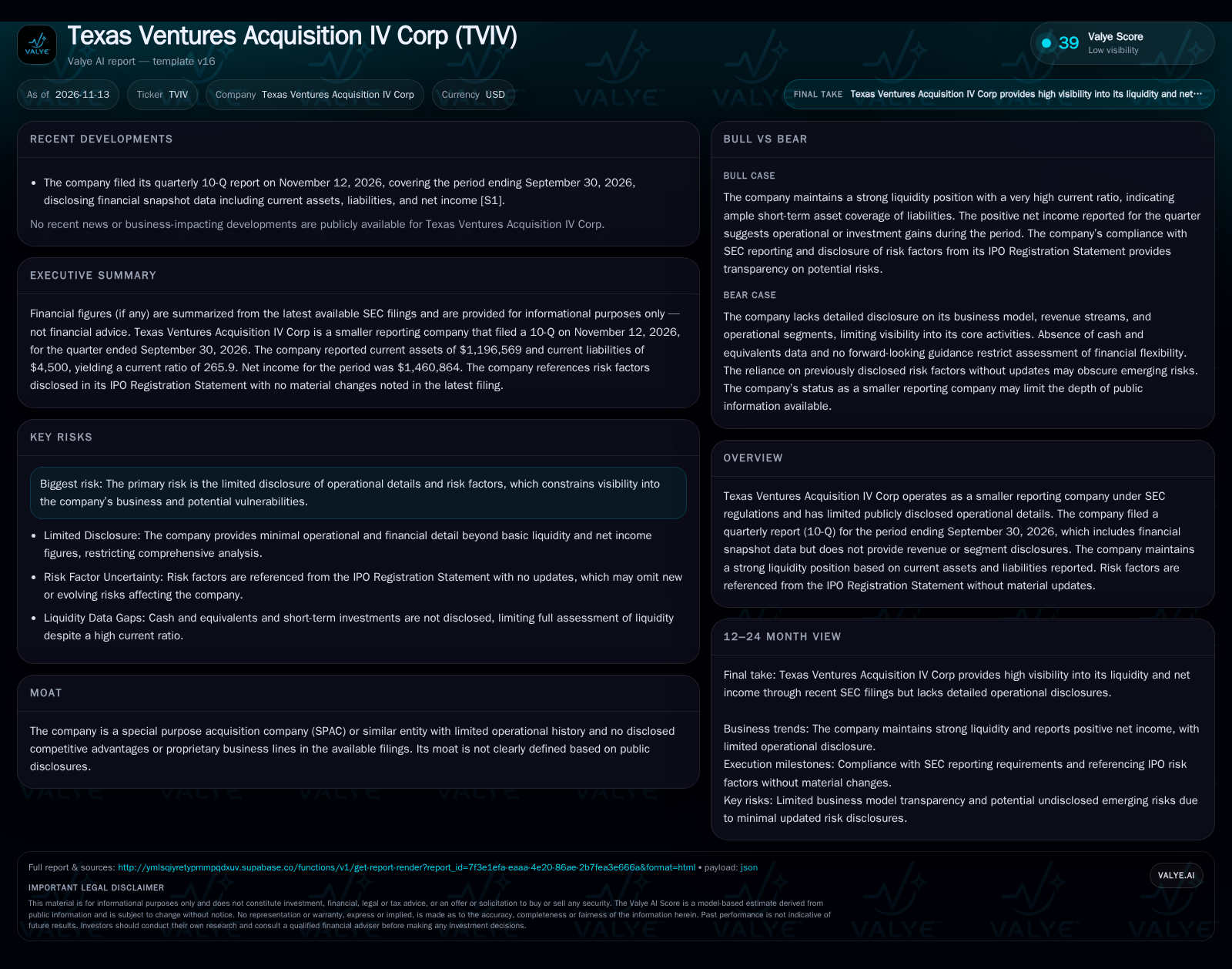
Texas Ventures Acquisition IV Corp (TVIV) stands as a textbook example of a newly listed special purpose acquisition company (SPAC): flush with initial capital, transparent about its liquidity, yet nearly opaque regarding any underlying operating business, revenue streams, or acquisition targets. As of September 30, 2026, TVIV’s disclosures are limited to a strong current asset position and a positive net income, but provide no details on how these figures were generated or what the company intends to do next. This lack of operational transparency—typical for SPACs at this stage—means that the entire value proposition and risk profile are contingent on the company’s ability to identify and execute a compelling business combination within a fixed regulatory timeline. [S1]
Liquidity Snapshot and Absence of Operational Disclosure Define TVIV’s Present Reality
As of September 30, 2026, Texas Ventures Acquisition IV Corp reported current assets of $1,196,569 and current liabilities of $4,500, resulting in a current ratio of approximately 265.9—an unusually high figure that reflects the classic SPAC structure of holding IPO proceeds in trust. The company also reported net income of $1,460,864 for the quarter, though no revenue, segment, or operating expense details were disclosed. This means investors know the company is well-capitalized and has generated some form of accounting profit, but the underlying source of income—whether from interest on trust assets, mark-to-market adjustments, or other non-operating items—is not specified. Risk factor disclosures reference the IPO Registration Statement, with no material changes or new risks highlighted as of the latest filing. [S1]
SPAC Financial Mechanisms: How Value Could Be Created or Lost
The economics of Texas Ventures Acquisition IV Corp are inextricably linked to the typical SPAC lifecycle. At this stage, revenue generation is rare; instead, net income is often driven by interest earned on funds held in trust or by changes in fair value of outstanding warrants and related financial instruments. The company’s reported current ratio is structurally engineered to safeguard public investors’ capital ahead of a business combination, but does not signal any underlying operating profitability.
A SPAC’s fixed versus variable cost structure is minimal prior to a business combination, with most expenses consisting of professional fees, regulatory compliance, and potential warrant-related costs. Capital needs are generally limited to covering these costs until an acquisition is identified. Upon consummating a business combination, the economics shift dramatically: the merged entity inherits the operating leverage, revenue mix, and capital requirements of the target. Until then, the company’s only plausible economic lever is the careful stewardship of trust assets and the negotiation of favorable deal terms.
An additional dimension to consider is the impact of warrant dilution on the post-combination capital structure. Warrants issued at the SPAC IPO can create significant dilution if exercised, which may alter the incentives of both sponsors and public shareholders. The timing and likelihood of warrant exercises depend on the eventual pricing of the combined entity’s shares and the terms of the warrants themselves. This dynamic introduces a layer of complexity to valuation and investor returns, as the potential dilution must be balanced against the benefits of completing a transaction that unlocks operating cash flows and growth prospects. Understanding how the company manages or hedges these dilution risks would provide deeper insight into the economic trade-offs inherent in the SPAC model.
SPAC Market Saturation and the Competitive Search for Targets
Texas Ventures Acquisition IV Corp’s competitive position is fundamentally dictated by the broader SPAC market, which is characterized by a high number of blank-check companies all seeking differentiated acquisition targets within a limited timeframe. Competitive advantage at this stage is not derived from product, service, or technology, but from the management team’s deal-sourcing networks, credibility, and ability to identify targets appealing to public investors.
Counterforces include an oversupply of SPACs, target-company wariness about public market volatility, and increasing regulatory scrutiny. Substitute structures—such as direct listings, traditional IPOs, or private equity buyouts—can siphon away attractive targets. While some SPACs differentiate via sector focus, sponsor reputation, or deal structure, TVIV’s lack of public disclosure about target sectors or sponsor expertise means its relative position is opaque.
The competitive landscape for acquisition targets is also influenced by the evolving regulatory environment and market sentiment towards SPACs. Heightened scrutiny from regulators may increase due diligence costs and lengthen negotiation timelines, potentially disadvantaging SPACs with less experienced management teams or smaller sponsor backing. Additionally, market volatility can affect target companies’ willingness to engage in SPAC mergers, as public market valuations fluctuate and investor appetite shifts. These external factors create a feedback loop where successful deal sourcing increasingly depends on a sponsor’s ability to navigate regulatory complexities and maintain strong relationships with potential targets, underscoring the importance of qualitative factors beyond mere capital availability.
Unlocking Value Through a High-Quality, Accretive Business Combination
The most favorable outcome for Texas Ventures Acquisition IV Corp would be the successful identification and execution of a business combination with a private company that offers strong growth prospects, credible management, and public-market appeal. If the chosen target operates in an attractive sector—such as technology, healthcare, or sustainability—and the transaction is structured to minimize dilution while aligning incentives, TVIV could deliver meaningful value to shareholders.
Evidence that would confirm this scenario includes the announcement of a definitive merger agreement with a well-regarded private company, robust pro forma financials, and positive market reaction upon deal disclosure. Early signals might also include increased disclosure about target sectors, sponsor expertise, or letters of intent. Conversely, failure to announce a compelling deal, or shareholder rejection of a proposed transaction, would quickly falsify this upside scenario.
In scenarios where TVIV successfully consummates a business combination, the post-merger integration phase will be critical to realizing shareholder value. The merged entity must effectively transition from a SPAC shell to an operating company, which involves establishing robust governance, executing strategic initiatives, and managing public market investor expectations. The degree to which the combined company can leverage synergies, optimize capital allocation, and demonstrate consistent financial performance will ultimately determine the sustainability of the value created. Investors should therefore monitor not only the deal announcement but also subsequent operational milestones and financial disclosures to assess whether the anticipated benefits of the transaction are being realized over time.
Probable Course: Prolonged Search and Heightened Investor Uncertainty
The most plausible near-term scenario is that Texas Ventures Acquisition IV Corp continues to operate in a holding pattern, incurring minimal expenses while searching for a suitable business combination. During this period, investors are likely to face persistent information asymmetry and market volatility, as the company provides little operational transparency and the SPAC market remains crowded.
Confirmation of this scenario would include continued filings devoid of substantive updates, incremental increases in professional fees, or generic statements about the search process. Evidence that would falsify the base case would be either a material change in risk factors, a significant capital outlay, or the announcement of a binding deal with a private operating company.
Failure to Secure a Transaction: Redemption Risk and Sponsor Dilution
The principal risk for TVIV is failing to secure a viable merger target within the Nasdaq-mandated 36-month window following its IPO. If this happens, the company would be forced to liquidate, returning trust proceeds to public shareholders and leaving sponsors and early investors with significant losses on their founder shares and warrants.
Indicators of this downside scenario would include repeated extensions of the combination deadline, erosion of trust value due to administrative expenses, or public announcements about unsuccessful negotiations. A spike in redemptions or negative proxy voting on proposed deals would also signal rising risk of liquidation or value destruction. Regulatory or market shifts that make SPAC deals less attractive would further exacerbate this scenario.
Milestones That Will Define TVIV’s SPAC Journey and Value Proposition
Announcement of a letter of intent or definitive agreement with a private operating company would materially alter the investment thesis.
Disclosure of target sector focus, sponsor expertise, or deal criteria—if provided—would help clarify the company’s strategic direction.
Any changes or updates to risk factors in future SEC filings would signal evolving risks or operational intent.
Movement in trust account value (interest income, administrative expenses) would provide insight into capital stewardship and runway.
Shareholder voting patterns and redemption rates at the time of a proposed business combination would test investor confidence.
Regulatory shifts or changes in SPAC market sentiment could materially affect the company’s ability to consummate a deal.
If disclosed, details on warrant exercise, private placement activity, or sponsor support would help assess dilution risk and alignment.
Disclaimer: This is research-only, informational analysis and not investment advice. It may include AI-generated interpretation and general industry context. Always verify important details using primary sources.

Comments