
Energous Corp: Wireless Charging’s Promise Collides with Commercialization and Adoption Hurdles
The company’s future hinges on converting product launches and retail contracts into repeatable, profitable business amid a competitive and evolving market.
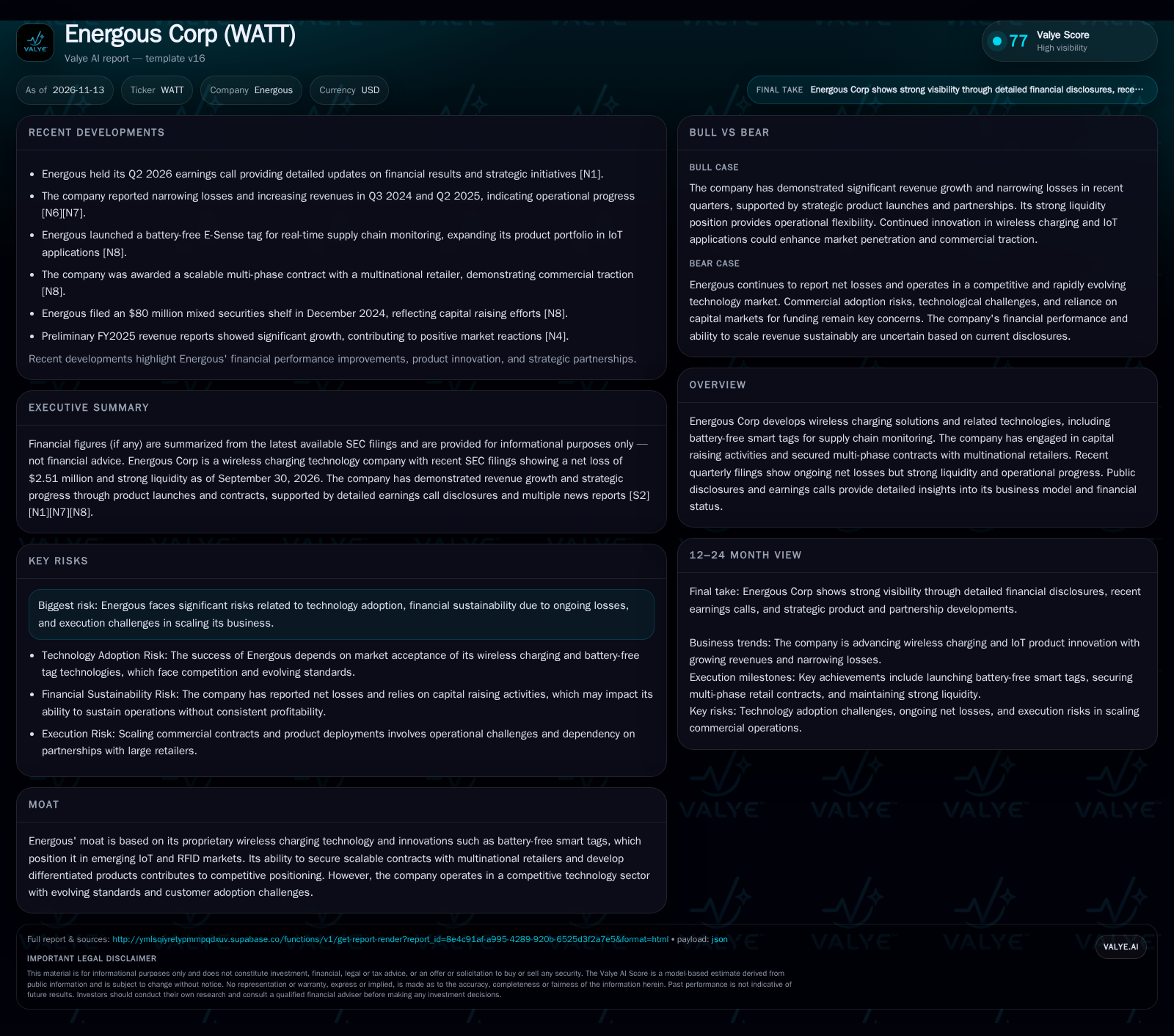
Energous Corp develops wireless charging solutions and battery-free IoT tags, reporting reported liquidity position ($28.83M cash, current ratio 8.05) and ongoing net losses (-$2.51M for Q3 2026) [S2]. While product innovation and multi-phase contracts with major retailers signal progress, the business remains dependent on broader technology adoption and scaling revenue to achieve profitability.
Energous Corp stands at a pivotal moment as it seeks to turn its proprietary wireless charging and battery-free IoT innovations into a sustainable business. While recent quarters have seen narrowing losses and reported liquidity position, the company’s commercial success depends on overcoming technology adoption barriers and competitive pressures in a rapidly evolving market. The key question is whether Energous can translate early traction with large retailers and product launches into a scalable, profitable model before capital markets appetite or industry standards shift.
Recent Financials and Strategic Moves Shape Energous’s Outlook
Energous reported a net loss of $2.51 million for Q3 2026, with basic and diluted EPS at -$0.45, continuing its record of negative earnings [S2]. As of September 30, 2026, the company held $28.83 million in cash and cash equivalents, resulting in a current ratio of 8.05 and a cash ratio of 5.56 [S2]. This liquidity positions Energous to weather near-term volatility and invest in growth, but operating losses underscore the urgency of scaling revenue. Recent product launches, such as battery-free smart tags, and multi-phase contracts with multinational retailers signal operational progress and the potential for broader commercialization [N8]. Revenue growth and narrowing losses in recent quarters indicate some traction, but the company remains in an investment phase with profitability still out of reach [N6] [N7].
Wireless Charging Economics: Volume Leverage vs. Commercial Friction
Energous’s core business model is built around licensing and/or selling wireless charging technology and related IoT hardware, including battery-free smart tags. The economics of this model depend on achieving scale: high upfront R&D and fixed costs must be amortized across growing unit volumes or recurring software/service revenue. If Energous can secure large, multi-phase contracts with major retailers, it could unlock significant operating leverage, as incremental hardware has lower variable cost compared to fixed R&D and SG&A. However, if commercial adoption remains slow or contracts are limited in scope, fixed costs will continue to dominate, delaying breakeven.
The capital intensity of ongoing product development and the need for continued marketing and sales investments mean that Energous will likely require further funding if losses persist. Pricing power is not yet established, as the wireless charging sector faces pressure from alternative solutions (e.g., wired charging, competing wireless standards) and customer skepticism regarding cost-benefit tradeoffs. The ability to evolve toward a recurring revenue model—such as device monitoring or data subscriptions for IoT deployments—could improve margin structure but requires widespread adoption and integration.
A critical factor in Energous's path to profitability lies in the balance between upfront investment and the pace of market penetration. If the company can leverage strategic partnerships to reduce customer acquisition costs and accelerate adoption, the fixed cost burden could be more efficiently spread over a larger revenue base. Conversely, if market education and integration complexity prolong sales cycles, the cash runway may be pressured, necessitating more conservative capital deployment or alternative funding sources. Additionally, the potential for modular product offerings or tiered service levels might enable Energous to capture a broader customer spectrum, enhancing revenue diversification and reducing dependency on a few large contracts.
The transition from hardware sales to a recurring revenue model presents both opportunities and challenges. While subscription-based services tied to device monitoring or data analytics could improve gross margins and provide predictable cash flows, success hinges on the ability to demonstrate clear incremental value to customers. This requires robust software development, data security assurances, and seamless integration with existing IT infrastructures. If Energous can establish such capabilities, it may create higher switching costs and customer stickiness. However, failure to deliver a compelling software ecosystem could limit the company's competitive differentiation and leave it vulnerable to commoditization.
Competing for Share in a Fragmented and Evolving Wireless Charging Market
Energous operates in a highly competitive landscape, vying against both incumbent charging technologies (wired and inductive wireless) and emerging alternatives from larger electronics and IoT platform players. Proprietary technology, including battery-free smart tags, offers a potential differentiator, particularly for supply chain and asset tracking use cases. However, the company faces challenges in establishing its technology as a potentially leading standard, as large customers are often reluctant to commit to non-standard solutions without broad ecosystem support.
Switching costs for customers may be low unless Energous’s products are deeply integrated into business processes or offer clear TCO (total cost of ownership) advantages. While the company’s ability to secure multi-phase contracts with multinational retailers provides validation, it remains unclear whether these relationships are recurring or easily expanded. The risk of technology substitution is high, as advances in energy harvesting, ultra-low-power electronics, or alternative wireless protocols could erode Energous’s window of differentiation.
Energous’s competitive positioning also depends on its ability to influence or adapt to emerging industry standards. In markets where interoperability and ecosystem compatibility are paramount, proprietary solutions risk marginalization unless they align with widely adopted protocols. The company’s innovation in battery-free IoT tags could provide a niche advantage, but scaling beyond this requires engagement with standard-setting organizations and collaboration with complementary technology providers. Without such alignment, Energous may face barriers to entry in larger enterprise deployments, where procurement decisions often favor vendors with established ecosystems and long-term support commitments.
Moreover, the pace of technological evolution in wireless power and IoT sectors necessitates continuous innovation to maintain relevance. Competitors with deeper R&D budgets or broader product portfolios may outpace Energous in feature development or cost reduction, intensifying pricing pressure. To counteract this, Energous might focus on specialized applications where its technology offers unique benefits, such as environments unsuitable for wired charging or where battery maintenance is impractical. Success in these verticals could build a defensible market position, but scaling beyond them requires overcoming the inertia of incumbent technologies and convincing customers to adopt new operational models.
Pathway to Scale: Retail Contract Expansion and IoT Integration Drive Profitability
If Energous successfully expands its existing multi-phase contracts into broad rollouts with major retailers, it could rapidly scale revenue and move toward profitability. The adoption of battery-free smart tags for real-time supply chain monitoring would validate the technology’s value proposition and create a reference case for other enterprises [N8]. This scenario would likely be confirmed by a sequence of new high-volume contract announcements, significant acceleration in quarterly revenue, and evidence of customer retention or repeat orders.
Further upside could come from developing a proprietary ecosystem or securing standard-setting partnerships, which would lock in recurring revenue streams and could raise switching costs. Confirmation of such a scenario would include disclosures of multi-year agreements, integration with major IoT platforms, or public endorsements from large corporate customers. A shift toward positive operating cash flow and margin expansion would falsify concerns about the business model’s scalability.
Incremental Progress with Persistent Profitability Challenges
The most plausible trajectory is that Energous continues to incrementally grow revenue through additional product launches and gradual expansion of existing customer relationships. Losses may narrow, but fixed costs and the need for ongoing investment in R&D and sales will likely keep the business unprofitable for several more quarters.
Confirmation of this scenario would come from modest sequential revenue growth, continued net losses (albeit at a reduced pace), and periodic announcements of new pilot programs or limited-scale contracts. Falsification would involve either a sharp inflection in revenue or a notable contraction in customer engagement, suggesting either a breakthrough or a stall in adoption.
Adoption Headwinds and Competitive Pressure Threaten Momentum
In a negative scenario, Energous fails to convert pilot programs and initial contracts into sustainable, large-scale deployments. Technology adoption may lag due to customer hesitancy, integration challenges, or the emergence of lower-cost alternatives. Increased competition from established electronics or IoT vendors could lead to pricing pressure and margin compression.
Confirmation of this downside would be signaled by stagnant or declining revenue, widening operating losses, or the need for dilutive capital raises. A lack of contract renewals or public references from key customers would indicate that initial traction is not translating into durable commercial relationships. If disclosed, a rising churn rate or delayed product launches would further validate this bearish outcome.
Milestones and Metrics That Will Determine Energous’s Commercial Trajectory
Quarterly revenue growth rates—sustained acceleration would indicate broader adoption; stagnation would challenge the bull case.
Disclosure of new or expanded multi-phase contracts with large retailers, as evidence of commercial traction and scalability.
Gross margin trends—improvement would suggest operating leverage and successful cost management; deterioration could indicate pricing pressure or inefficiency.
Cash burn and operating expense trajectory—if disclosed, tracking whether losses are narrowing in proportion to revenue growth.
Product adoption metrics: number of deployed battery-free smart tags or IoT devices, if disclosed, as a proxy for end-market penetration.
Customer renewal or repeat order rates—would help test whether contracts are recurring or merely pilot-scale.
Announcements of partnerships or integrations with major IoT platforms or standard-setting bodies, which could validate ecosystem acceptance.
Frequency and terms of capital-raising activities, as persistent dilution or emergency funding needs would signal ongoing financial strain.
Disclaimer: This is research-only, informational analysis and not investment advice. It may include AI-generated interpretation and general industry context. Always verify important details using primary sources.

Comments