
ADI Global Distribution: Testing Independence Amid Market Weakness and Strategic Realignment
After its spin-off from Resideo, ADI Global Distribution confronts a challenging residential market and a major goodwill impairment, but its scale, omnichannel reach, and exclusive brands offer strategic levers for future margin and share gains if execution aligns with market recovery.
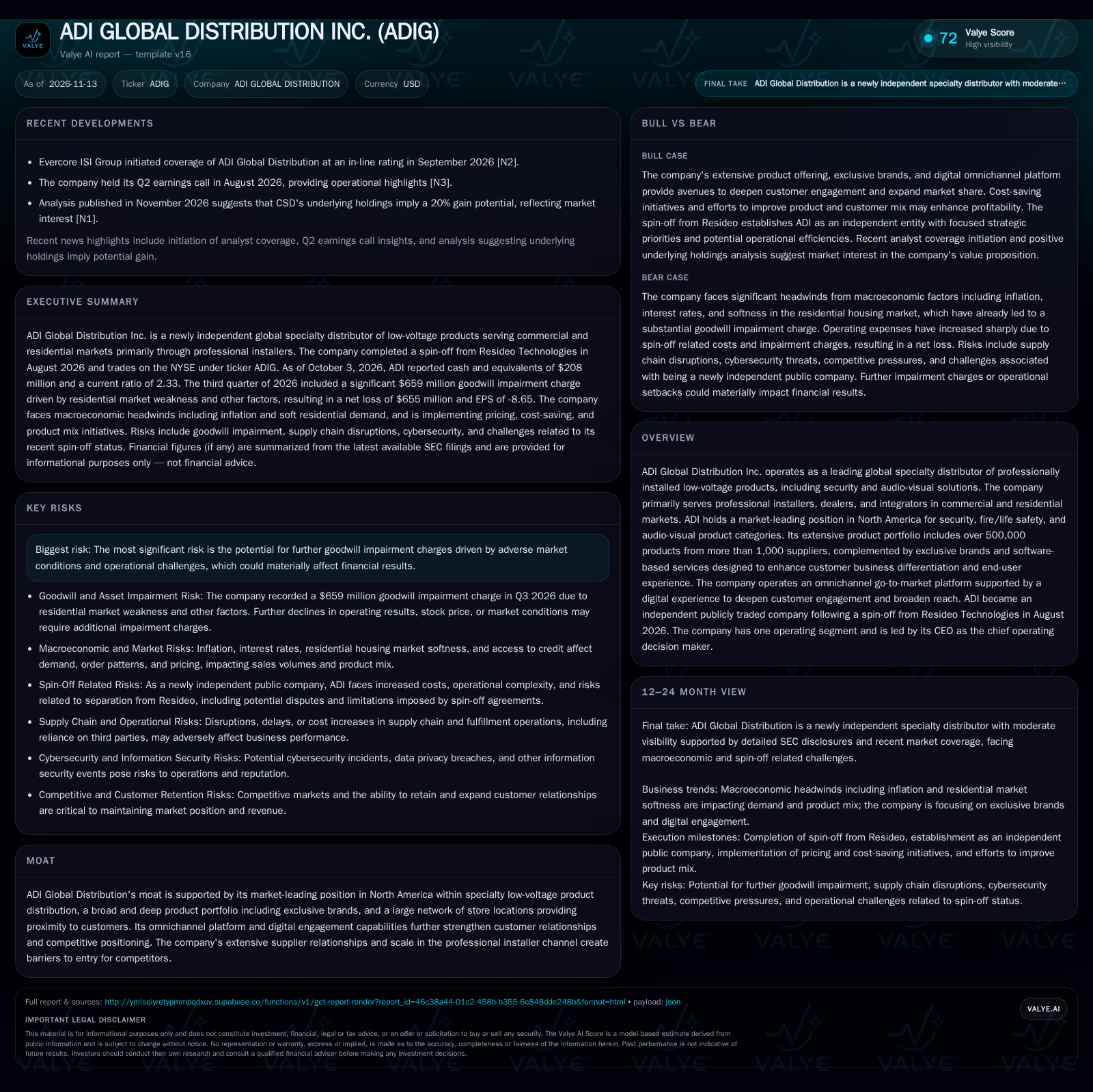
ADI Global Distribution became an independent public company in August 2026, immediately facing residential market softness that triggered a $659M goodwill impairment and a Q3 net loss. While its scale, supplier network, and exclusive brands could support future growth, execution risk is high as the company implements pricing, cost-saving, and mix initiatives amid macro and spin-off-related headwinds. The success of these efforts, along with stabilization in end markets, will determine whether ADI can translate its distribution leadership into sustainable profitability.
ADI Global Distribution’s first months as an independent public company have been a stress test of both its business model and its operational resilience. Spun off from Resideo Technologies in August 2026, ADI immediately faced a sharp downturn in residential market demand, resulting in a $659 million goodwill impairment and a significant net loss for the third quarter. Yet, with a commanding distribution footprint, a vast low-voltage product portfolio, and strategic moves to deepen exclusive brand penetration, ADI is pressing forward with pricing and efficiency initiatives to adapt to the new environment. The company’s ability to navigate macroeconomic headwinds and complete its post-spin transformation will shape whether its scale and channel access can convert to durable margin and cash flow.
Spin-Off, Impairment, and Market Headwinds: The Immediate Post-Separation Reality
ADI Global Distribution completed its spin-off from Resideo Technologies in August 2026, becoming a standalone public company on the NYSE under ticker ADIG. The separation involved a $900 million cash payment to Resideo, share recapitalization, and left Resideo with no ownership, while Clayton, Dubilier & Rice affiliates now hold nearly 20% voting power [S1].
In the third quarter of 2026, ADI reported net revenue of $1.306 billion and a gross profit margin of 20.9%, but posted a net loss of $655 million after recording a $659 million goodwill impairment. The impairment was attributed to residential market weakness, unfavorable shifts in product and customer mix, and declines in stock price and market capitalization [S1].
At quarter-end, ADI held $208 million in cash and equivalents, with a current ratio of 2.33. The company is implementing cost-saving and pricing initiatives, and increasing focus on exclusive brands to address margin and demand challenges [S1].
How ADI’s Distribution Economics Could Evolve Post-Spin
ADI operates as a specialty distributor, generating revenue primarily through the sale of over 500,000 low-voltage products sourced from more than 1,000 suppliers. Its customer base consists mainly of professional installers, dealers, and integrators in the commercial and residential sectors, with distribution economics driven by product mix, volume, and the breadth of its offering.
Gross margins in distribution are typically thin—ADI’s 20.9% Q3 margin falls in line with industry norms—so profitability is highly sensitive to both pricing discipline and the ability to drive mix toward higher-margin categories, such as exclusive brands or value-added services. Fixed costs include distribution center operations, digital platform investments, and the cost structure required to support its omnichannel model. Variable costs scale with sales volume but are subject to supply chain and fulfillment efficiency.
Capital and funding needs are pronounced post-spin: the $900 million payment to Resideo and the transition to standalone operations likely increase pressure to generate cash flow and optimize working capital. The company reported cash and liquidity metrics for the period; these figures do not by themselves establish operating runway, investment capacity, financial flexibility, or financing capacity.
Operating leverage could materialize if revenue growth resumes and cost-saving initiatives take hold, but the risk is that persistent market softness, especially in residential, keeps volumes and margins under pressure, limiting upside from fixed-cost absorption.
Distribution Scale and Exclusive Brands: Are Barriers Durable in a Fragmented Market?
ADI claims a market-leading position in North America for specialty low-voltage distribution, supported by an extensive supplier network, exclusive brands, and an omnichannel approach. These factors create some barriers to entry: supplier relationships and inventory breadth are difficult for smaller players to replicate, and the ability to serve professional installers with both local branch presence and digital ordering increases customer stickiness.
However, the distribution landscape is competitive and fragmented, with regional distributors, national electrical wholesalers, and direct sales from manufacturers all vying for share. Price competition can be intense, especially on commodity products. Exclusive brands and value-added services may provide higher margins and some differentiation, but their success depends on installer acceptance and perceived value.
Technology adoption—such as integrated digital procurement, inventory management, and customer engagement tools—can further entrench relationships, but also raises the bar for ongoing investment. If ADI can leverage its scale to negotiate better supplier terms, optimize logistics, and deepen exclusive brand penetration, it may sustain its moat. The risk remains that larger electrical distributors, manufacturers, or new digital entrants could pressure margins or erode volume if ADI’s service or pricing falters.
Margin Expansion if Exclusive Brands and Digital Initiatives Gain Traction
If ADI’s focus on exclusive brands and product mix optimization succeeds, the company could see gross margin improvement even if top-line growth remains muted. Exclusive brands typically offer higher margins and more control over pricing and supply. Digital engagement and omnichannel reach could drive stronger customer retention and share of wallet among professional installers, translating to more resilient volume and service revenue.
The upside scenario would be confirmed by a sequential or year-over-year improvement in gross margin (excluding one-time items), stabilization or growth in net revenue, and evidence of increasing contribution from exclusive brands or value-added services if disclosed. A recovery in residential market demand, combined with effective execution of cost-saving initiatives, would accelerate operating leverage and restore profitability.
Falsification would come from continued margin compression, customer attrition, or evidence that exclusive brands fail to gain share, suggesting that ADI’s differentiation is insufficient or that competitive pricing pressure is overwhelming mix improvements.
Adapting to a Tough Market While Building Standalone Capabilities
The most likely outcome is that ADI spends the next several quarters stabilizing its operations and margin structure while navigating weak residential demand and the complexities of post-spin independence. Revenue may remain flat or slightly down as the company implements pricing and mix initiatives, with gross margin fluctuating but not collapsing.
Progress would be reflected in improved SG&A efficiency, evidence of digital platform adoption among customers, and gradual increases in the penetration of exclusive brands. The company would likely continue to face operating expense headwinds related to standalone public company costs and necessary investments in IT, compliance, and supply chain resilience.
Confirmation of this scenario would include modest improvement in operating income (excluding impairment), stable or improved liquidity, and no further major goodwill or asset impairments. Falsification would be signaled by renewed steep losses, further impairment charges, or operational disruptions that undermine customer relationships or supplier confidence.
Prolonged Residential Weakness and Execution Missteps Compound Losses
The primary risk is that residential market softness persists or worsens, driving ongoing revenue declines and unfavorable product/customer mix. If cost-saving and pricing initiatives fail to offset these pressures, and exclusive brands do not gain traction, gross margins could erode further.
Operationally, the demands of running a standalone public company—without the support of a larger parent—could expose weaknesses in systems, supply chain, or cybersecurity, leading to unanticipated expenses or business disruptions. Additional goodwill or asset impairment charges would further depress reported earnings and could undermine stakeholder confidence.
This downside would be confirmed by continued net losses, further impairment charges, deteriorating liquidity, or signs of customer defection to competitors. An inability to stabilize or improve margins, especially as public company costs ramp, would suggest that the current business model is not resilient enough to weather extended macro headwinds.
Milestones That Will Define ADI’s Post-Spin Trajectory
Quarterly gross margin trends, especially evidence of improvement driven by exclusive brands or mix optimization, would help test whether ADI’s strategic initiatives are gaining traction.
Reported growth or share of revenue from exclusive brands and value-added services (if disclosed) would clarify whether differentiation is translating to margin expansion.
Net revenue trends in both residential and commercial segments (if disclosed) would indicate whether end-market demand is stabilizing or deteriorating further.
SG&A as a percentage of revenue and trends in operating expenses (excluding non-cash charges) would reveal progress on cost-saving and efficiency initiatives.
Any further goodwill or asset impairment charges, and the rationale for such charges, would provide insight into management’s outlook and market trajectory.
Customer retention rates, order frequency, or installer engagement with digital platforms (if disclosed) would demonstrate the effectiveness of ADI’s omnichannel and digital strategies.
Updates on supply chain resilience, cybersecurity incidents, or operational disruptions would help gauge the stability of standalone operations.
Disclaimer: This is research-only, informational analysis and not investment advice. It may include AI-generated interpretation and general industry context. Always verify important details using primary sources.

Comments