
Agassi Sports Entertainment: Early-Stage Ambitions in Racket Sports, but Execution and Funding Loom Large
Agassi Sports Entertainment Corp. is betting on AI-powered digital platforms and the growing popularity of racket sports to carve out a niche in sports media and event management.
Agassi Sports Entertainment is transitioning from a shell to an operating company focused on AI-driven digital platforms and live events in tennis, pickleball, and padel. Timely platform launches and market traction are critical for validating the business model and securing sustainable growth. [S1] [S2]
Agassi Sports Entertainment Corp. is staking its future on the convergence of artificial intelligence, digital community building, and the rapidly expanding market for racket sports like pickleball and padel. With a high-profile brand and ambitious plans for both digital and live event properties—including the 'World Series of Pickleball'—the company is transitioning from a shell to an operator in a highly competitive, capital-intensive sector. The next year will be critical as the company attempts to prove product-market fit and secure the capital needed for sustainable growth. [S1] [S2]
Strategic Launches and Financial Pressure Define the Current Phase
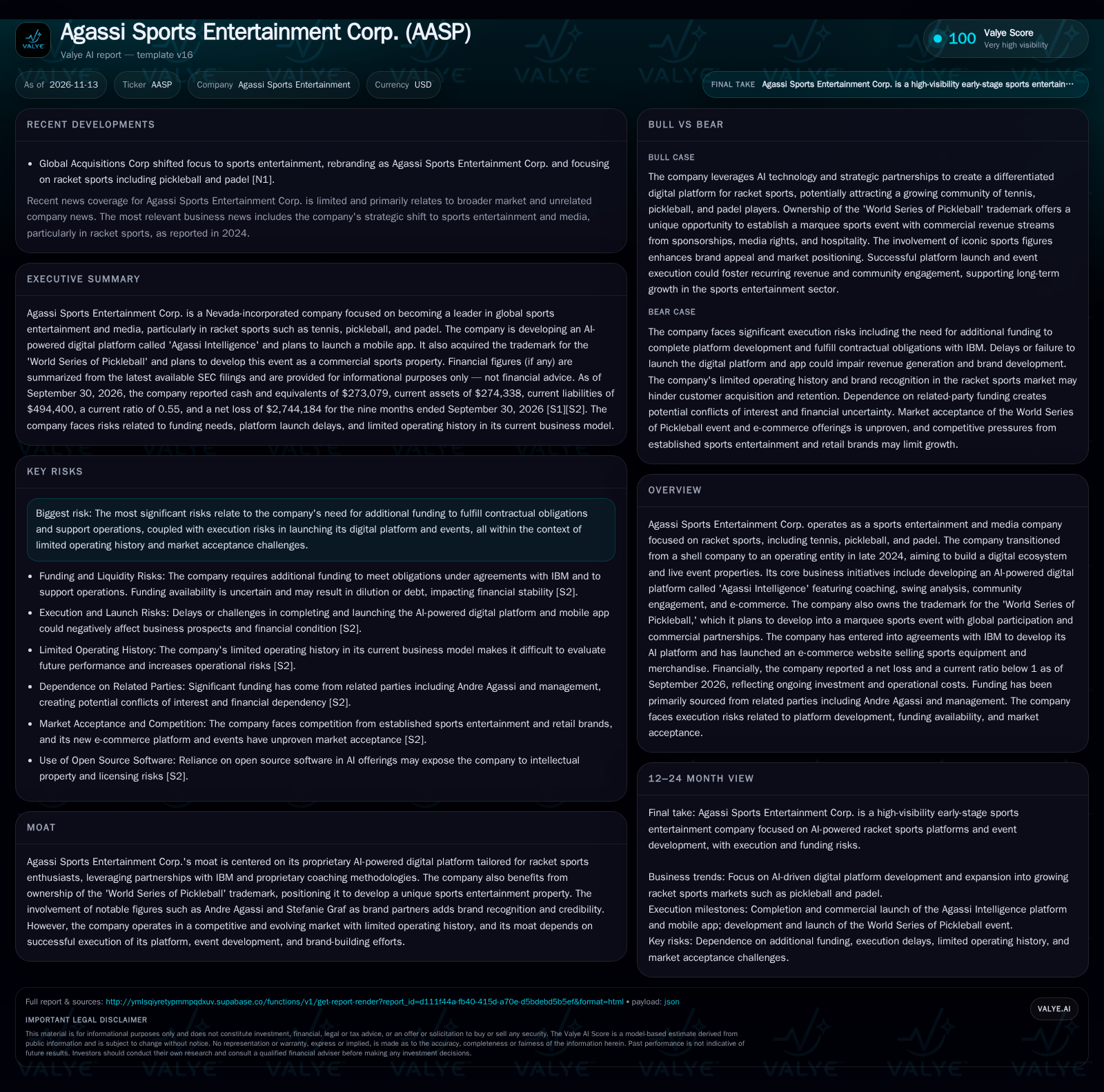
Agassi Sports Entertainment has made several pivotal moves in 2026: its AI-powered 'Agassi Intelligence' digital platform is in beta with a planned full launch by Q2 2026, and a mobile app is set to follow later in the year [S1]. The company has also launched an e-commerce site offering tennis and pickleball gear, nutrition, and merchandise, and holds the trademark for the 'World Series of Pickleball,' with ambitions to make it a global event property [S1] [S2]. However, these growth initiatives are juxtaposed against a challenging financial backdrop: as of September 30, 2026, Agassi reported just $273,079 in cash, a current ratio of 0.55, and a net loss of $2.74 million for the year-to-date period [S2]. The company’s ability to fund operations and fulfill obligations, including a $2.5 million agreement with IBM for platform development, is uncertain and heavily reliant on related-party financing [S2]. These facts set the stage for a make-or-break period where execution and capital access will determine whether Agassi can bridge its ambition with commercial reality.
How the Model Could Scale: Platform, Events, and Commerce
Agassi’s business model aspires to blend multiple revenue streams: digital subscriptions or memberships for its AI-powered coaching platform, event-driven income from ticketing, hospitality, and sponsorships tied to the World Series of Pickleball, and product sales from its e-commerce site. If the Agassi Intelligence platform achieves user traction, recurring digital revenue could generate high gross margins typical of SaaS or content platforms. However, the economics of sports event management are capital-intensive and cyclical, with upfront costs for marketing, venue, and talent often preceding realized revenue. Sponsorship and media rights could provide significant upside if the World Series of Pickleball gains traction, but these are typically competitive and require proof of audience scale to command premium pricing. E-commerce margins in sports retail are generally thin unless the company can differentiate through exclusive products, celebrity endorsements, or integrated digital experiences.
Operating leverage could emerge if digital platform adoption scales rapidly, as incremental users may add revenue without proportional cost increases. However, the company’s current cost base—especially development costs with IBM and ongoing marketing and staffing—remains high relative to revenue. Agassi’s capital needs are substantial, especially given the working capital deficit and the need to fund both technology and event launches. Without external or internally generated funding, the company risks being unable to execute on its vision or may have to dilute existing shareholders to raise necessary capital.
Navigating a Crowded Field: Differentiation and Competitive Threats
Agassi’s competitive positioning relies on a combination of proprietary technology, celebrity association, and event IP. The digital platform aims to offer AI-powered coaching and community features that could appeal to a growing base of tennis, pickleball, and padel enthusiasts. However, the company faces competition from established digital fitness and coaching platforms, traditional sports media, and e-commerce retailers with deeper resources and existing user bases.
The World Series of Pickleball trademark could confer first-mover advantage in a rapidly expanding sport, but established event organizers, sports leagues, and media companies may quickly react if Agassi demonstrates traction. Brand equity from the Agassi name and involvement of sports icons could drive initial attention, but sustainable differentiation will depend on the quality of the digital experience, event execution, and the company’s ability to build a sticky community. The risk of technology substitution is also present—if AI-driven coaching becomes commoditized or if incumbent platforms integrate similar features, Agassi may struggle to maintain pricing power or user retention.
What Success Looks Like: Community Flywheel and Commercial Validation
The upside scenario requires two things to go right: successful, timely launch and adoption of the Agassi Intelligence platform, and strong early traction for the World Series of Pickleball as a commercial event. If the digital offering resonates with racket sports enthusiasts, rapid community growth could drive network effects—users attract more users, coaches, and partners, reinforcing platform stickiness and enabling upselling of premium features or content. The integration of e-commerce and AI-driven recommendations could boost average order value and create a seamless ecosystem.
On the event side, a well-executed World Series of Pickleball with celebrity involvement could generate media buzz, attract sponsorships, and establish a recurring revenue stream from ticketing and hospitality. Agassi would need to demonstrate that it can secure sponsorships and media rights deals at attractive terms, which would in turn validate the brand and attract further investment. Confirmation of this scenario would come from disclosed digital platform user growth, successful event execution with measurable attendance or viewership, and evidence of commercial partnerships or growing e-commerce sales. A falsification would be persistent delays, flat user adoption, or weak event traction.
Testing Product-Market Fit: Incremental Traction and Ongoing Funding Needs
The most plausible path is one of incremental progress: Agassi launches its digital platform and app, but adoption and monetization ramp slowly as the company gains trust and iterates on features. The World Series of Pickleball may debut with moderate attendance and limited sponsorship, requiring several cycles to build a marquee brand. E-commerce provides modest supplemental revenue, but margins remain pressured by competition and marketing spend.
Throughout this phase, Agassi likely continues to rely on related-party or external funding to bridge operating losses and invest in product and event development. Confirmation would come from platform launch on schedule, initial but not breakout user growth, and evidence of repeat event planning or small-scale commercial partnerships. Falsification would be major execution missteps, inability to secure additional financing, or a lack of user and sponsor engagement despite marketing efforts.
Failure to Launch: Capital Constraints and Market Indifference
The primary downside risk is a combination of execution failure and funding shortfall. If Agassi cannot secure the capital to fulfill its IBM obligations or fund event launches, development may stall or be abandoned. Delays in digital platform or app rollouts could erode early interest, allowing competitors to capture the market or rendering the company’s value proposition obsolete.
Market indifference to the World Series of Pickleball—e.g., low ticket sales, weak sponsor uptake, or minimal media coverage—would undermine the event’s commercial rationale. Continued net losses and a working capital deficit could force the company into highly dilutive financing, asset sales, or even restructuring. Evidence confirming this scenario would include missed platform/app launch deadlines, disclosure of financing distress, or lack of meaningful traction in user metrics, sales, or event attendance.
Milestones That Will Clarify Agassi’s Trajectory in the Next Year
Actual launch date and user adoption metrics for the Agassi Intelligence digital platform and mobile app, if disclosed, will provide the first test of product-market fit.
Execution of the inaugural World Series of Pickleball, including attendance, media coverage, and sponsorship deals, will be a key proof point for the event-driven business model.
Updates on e-commerce revenue, average order size, and repeat customer rates would help gauge the viability of direct-to-consumer sales.
Evidence of commercial partnerships—such as signed sponsorships, media rights deals, or high-profile endorsements—will indicate market acceptance and monetization potential.
Quarterly cash flow and burn rate disclosures will clarify the urgency and magnitude of additional funding needs.
Announcements of external, non-related-party financing or successful capital raises on favorable terms would reduce risk of dilution and dependency.
Disclosure of any material technology, IP, or open source licensing issues would impact the long-term sustainability of the AI platform.
Progress updates regarding obligations and deliverables under the IBM agreements would signal execution discipline and partnership stability.
Disclaimer: This is research-only, informational analysis and not investment advice. It may include AI-generated interpretation and general industry context. Always verify important details using primary sources.

Comments