
Corteva’s Q3 Setback: Regulatory Drag, Brazil Weakness, and the Battle for Agricultural Resilience
Corteva’s third-quarter 2026 loss and reduced outlook underscore the company’s vulnerability to regional volatility, regulatory headwinds, and environmental obligations. With its core crop protection and seed businesses under pressure, the path forward hinges on regulatory navigation, innovation, and execution in key growth markets.
Corteva reported a Q3 2026 net loss and lowered its full-year outlook, citing sales weakness—especially in Brazil—and ongoing regulatory and environmental challenges. The thesis now rests on Corteva’s ability to manage approvals, adapt its portfolio, and restore regional growth.
Corteva, Inc.—a global leader in crop protection and seed solutions—has entered a challenging phase, as revealed by its Q3 2026 net loss and downward revision of its full-year outlook. The company’s performance was notably hampered by weak sales in Brazil, a crucial agricultural market, and broader regulatory and environmental headwinds. As the agricultural sector faces heightened scrutiny and shifting policies, Corteva’s future will be shaped by its ability to secure product approvals, manage compliance costs, and navigate increasingly complex competitive dynamics.
Recent Losses and Outlook Reduction Signal Shifting Market Realities
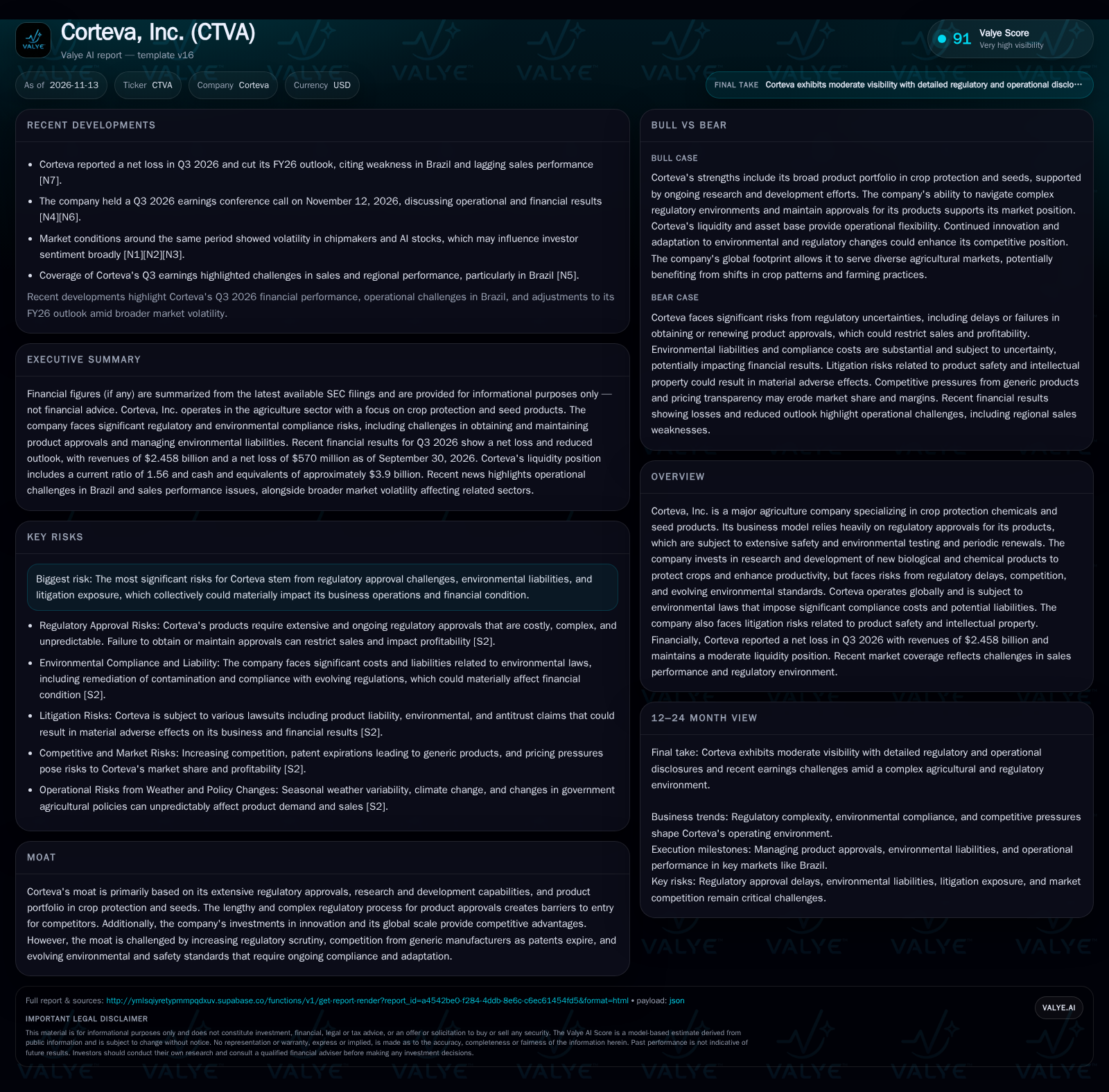
Corteva reported a net loss of $570 million for Q3 2026 on revenues of $2.458 billion, marking a significant swing into negative territory and prompting a revision of its full-year outlook [S2] [N7]. This underperformance was attributed primarily to sales weakness in Brazil, a region where both demand and operational execution are critical for global agricultural players [N5] [N7]. The company reported cash and liquidity metrics for the period; these figures do not by themselves establish operating runway, investment capacity, financial flexibility, or financing capacity. [S2] The company’s recent earnings call and news coverage have highlighted ongoing challenges, including regulatory complexity and environmental liabilities, which continue to weigh on investor confidence and operational visibility [N4] [N6].
How Corteva’s Revenue Model Faces Pressure from Compliance and Volatility
Corteva’s business model is anchored in selling crop protection chemicals and seeds to growers globally, with revenue driven by a mix of proprietary and, over time, off-patent products. Pricing leverage is contingent on regulatory exclusivity, brand trust, and the ability to deliver yield improvements or reduce risk for farmers. The economics of the business are capital- and R&D-intensive: regulatory approvals for new products require lengthy, costly trials and ongoing compliance as environmental standards evolve.
Fixed costs are significant due to R&D, manufacturing, and compliance infrastructure, while variable costs scale with production and distribution. Operating leverage can be substantial when volumes rise, but downside risk is magnified during periods of demand weakness or when regulatory hurdles delay product launches. The company’s exposure to regional agricultural cycles, government subsidy regimes, and climate variability introduces further volatility into both pricing and volume. Capital needs are persistent—not only for innovation, but also for environmental remediation and legal liabilities, which are difficult to predict or hedge. As a result, Corteva’s margin profile is acutely sensitive to product mix (proprietary vs. generic), regulatory timelines, and regional market health.
The interplay between regulatory compliance and product innovation also affects Corteva’s capital allocation strategy. Given the lengthy and uncertain approval timelines, the company must balance investment in breakthrough technologies with maintaining cash flow from established products. This dynamic creates a capital efficiency challenge, as resources tied up in regulatory pipelines may delay returns, while aggressive R&D spending without commensurate approvals can strain potential financial flexibility. Additionally, the geographic dispersion of regulatory regimes means that product launches may be staggered globally, complicating revenue forecasting and operational planning. This fragmentation requires Corteva to maintain adaptive supply chains and market-specific strategies to optimize timing and scale of product introductions.
Moreover, Corteva’s exposure to environmental liabilities introduces contingent risks that can distort financial outcomes beyond typical operating cycles. Environmental remediation costs and litigation settlements can be episodic yet substantial, impacting cash flow unpredictably. The company’s ability to anticipate and provision for such liabilities depends heavily on evolving regulatory interpretations and enforcement intensity, which vary by jurisdiction. This uncertainty necessitates robust risk management frameworks and scenario planning to preserve capital buffers. If these contingencies materialize more frequently or at greater scale, they could necessitate reprioritization of investment projects or increased reliance on external financing, thereby affecting long-term strategic initiatives.
Barriers, Substitutes, and the Erosion of Regulatory Moats
Corteva’s competitive position historically benefits from high regulatory barriers: bringing a new crop protection product to market can take a decade and hundreds of millions of dollars, creating a formidable moat for established players. However, these same barriers are a double-edged sword—regulatory unpredictability can delay launches, restrict usage, or force costly reformulations. The company faces competition from both other global agrochemical giants and regional players, with generic manufacturers gaining ground as patents expire.
Substitutes are emerging as biologicals, digital agriculture platforms, and integrated pest management solutions become more viable, especially as regulators and growers seek lower-risk, sustainable alternatives. Pricing pressure intensifies when governments adjust subsidy policies or when commodity prices drop, eroding farmers’ purchasing power. Antitrust scrutiny and litigation risk further complicate Corteva’s ability to use loyalty programs or bundling as a competitive tool [S2]. To sustain differentiation, continued investment in innovation, data-driven agronomy, and regulatory relationships is required, but these are increasingly costly and uncertain bets.
Innovation, Regulatory Wins, and Regional Recovery Could Restore Momentum
A favorable scenario for Corteva hinges on its ability to bring new, differentiated products to market—especially biological crop protection agents or high-performance seeds that secure rapid regulatory approval and premium pricing. If the company successfully navigates evolving regulations and demonstrates strong environmental safety, it could reinforce its relationships with both regulators and growers, supporting volume recovery and margin expansion.
A rebound in Brazil—driven by improved weather, government policy support, or economic stabilization—would meaningfully boost regional sales and sentiment. Evidence confirming this scenario would include above-consensus revenue growth in key markets, successful new product launches with clear regulatory endorsements, and a sustained decline in legal or remediation provisions. Falsification would come from continued regulatory delays, tepid adoption of new offerings, or persistent regional underperformance.
Navigating Regulatory Complexity and Regional Churn: The Most Likely Trajectory
The most plausible path for Corteva involves managing through continued regulatory scrutiny, with incremental approvals and a slow recovery in lagging regions like Brazil. The company is likely to experience ongoing volatility in quarterly results as weather, policy, and competitive dynamics shift, but its diversified portfolio and global footprint provide some resilience.
Confirmation of this scenario would be stable-to-slightly improving revenues, modest margin recovery, and manageable levels of litigation and remediation expense. A shift away from this trajectory would be signaled by renewed losses, further guidance cuts, or major regulatory setbacks.
Regulatory and Environmental Shocks Could Trigger Sustained Erosion
An adverse scenario could unfold if Corteva faces substantial new regulatory restrictions, protracted approval delays, or heightened environmental liabilities that materially increase costs or restrict product access. A further deterioration in Brazil or other key markets—whether due to macroeconomic stress, unfavorable policy changes, or severe weather—could compound topline pressure and erode the company’s ability to fund R&D or meet remediation obligations.
Evidence supporting this downside would include a sharp increase in legal or remediation accruals, negative cash flow trends, further downward revisions to outlook, or significant product withdrawals/recalls. If the company’s regulatory moat becomes more of a liability than an asset—slowing innovation while competitors pivot to less regulated or more sustainable solutions—long-term market share and profitability could be at risk.
Signals That Will Define Corteva’s Ability to Regain Agricultural Leadership
The pace and success rate of new product regulatory approvals, especially for biological or next-generation crop protection technologies, if disclosed.
Revenue and margin trends in Brazil and other major markets, as regional recovery is essential to offsetting global headwinds.
Shifts in legal, remediation, and environmental compliance expense accruals, which would indicate regulatory or litigation escalation.
The mix between proprietary and off-patent/generic product sales, as this shapes pricing power and margin trajectory.
Disclosure of changes in government agricultural policies or subsidy regimes in core markets, as these directly impact grower demand.
Updates on litigation outcomes or antitrust settlements, which could influence commercial strategy and risk profile.
R&D investment levels and pipeline disclosures, as sustained innovation is key to defending and expanding market share.
Evidence of improved or deteriorating working capital and cash flow, revealing underlying operational health.
Disclaimer: This is research-only, informational analysis and not investment advice. It may include AI-generated interpretation and general industry context. Always verify important details using primary sources.

Comments