
Starbucks in 2026: Navigating Growth and Liquidity Pressures Amid Strong Brand Momentum
Starbucks delivered robust comparable store sales growth of 7.9% and raised its full-year guidance in 2026, signaling effective operational execution.
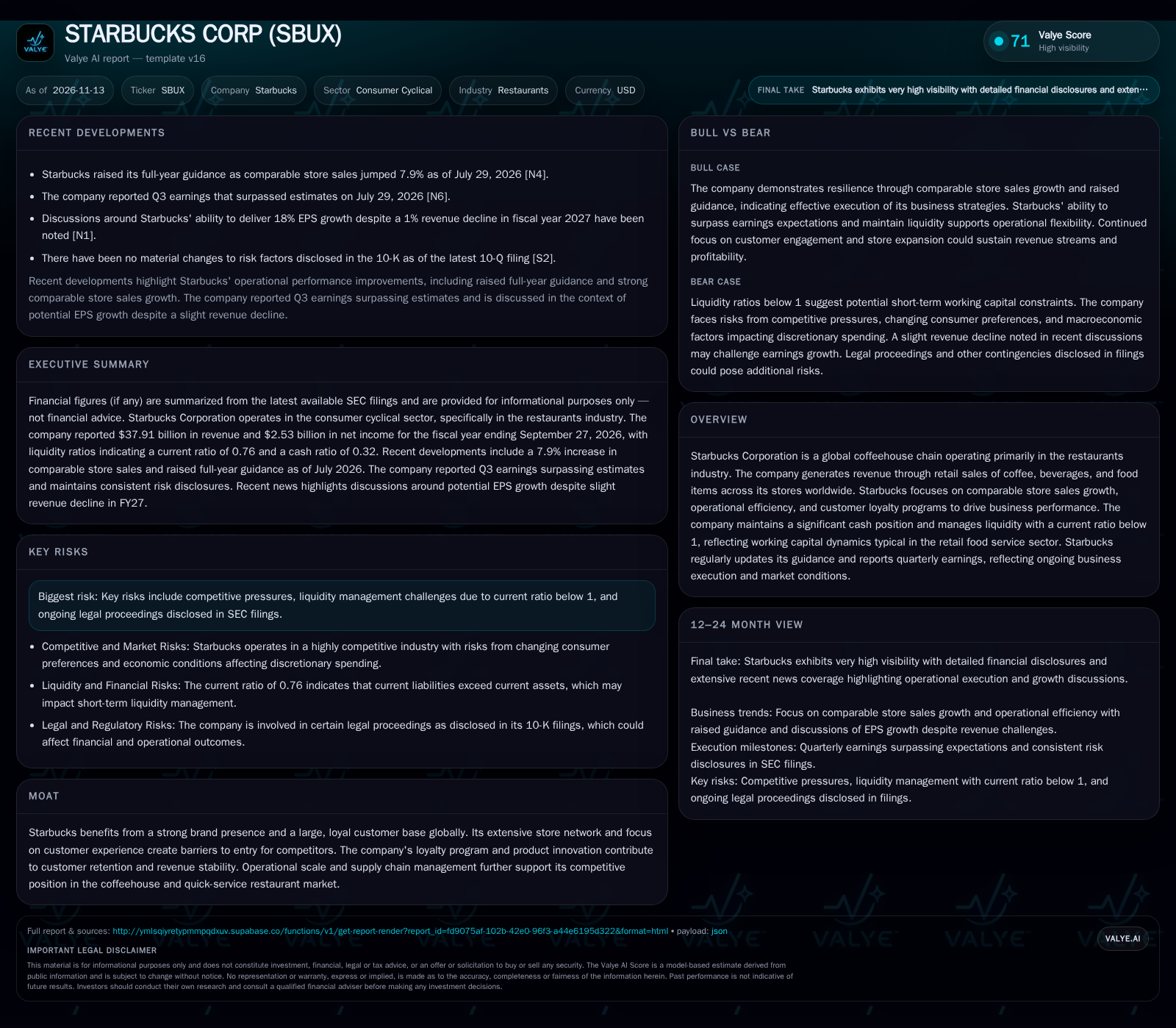
Starbucks reported $37.91 billion in annual revenue and $2.53 billion in net income for fiscal 2026, driven by a 7.9% jump in comparable store sales and Q3 earnings that exceeded expectations. Starbucks’ brand strength and loyalty program continue to underpin its competitive position, but the path forward hinges on sustaining operational efficiency and navigating industry headwinds. [S1] [N4] [N6]
Starbucks enters late 2026 on the strength of a 7.9% jump in comparable store sales and raised full-year guidance, capping a year of robust operational performance and earnings that surpassed expectations. With annual revenue at $37.91 billion and net income of $2.53 billion, the company’s scale and brand resilience are clear. However, a current ratio below 1 underscores that working capital management remains a critical watchpoint, especially as Starbucks continues to invest in growth amid a competitive and evolving restaurant landscape. The company’s ability to translate its brand equity and customer loyalty into sustainable long-term economics will be tested as both macro and industry-specific pressures intensify. [S1] [N4] [N6]
2026 Performance: Strong Sales Growth Meets Liquidity Constraints
Starbucks reported $37.91 billion in revenue and $2.53 billion in net income for the fiscal year ending September 27, 2026, highlighting the company’s operational scale and profitability. The standout metric was a 7.9% increase in comparable store sales, which led management to raise full-year guidance by July 2026, reflecting confidence in ongoing demand and execution. Q3 2026 earnings also beat analyst expectations, further supporting the narrative of execution strength. These facts frame a company excelling in topline growth but operating within tight liquidity parameters. [S1] [N4] [N6]
How Starbucks Drives Profit: Volume Leverage and Operational Efficiency
Starbucks’ core economic engine is its ability to drive high volumes through a dense global retail footprint, with revenue generated primarily from beverage and food sales in company-operated and licensed stores. The business model’s economics are characterized by relatively high fixed costs (rent, labor, supply chain infrastructure) and the potential for significant operating leverage as same-store sales and throughput rise. The 7.9% comparable store sales growth in 2026 likely contributed disproportionately to profit expansion, as incremental revenue can flow through at higher margins once fixed costs are covered.
Pricing power is supported by brand strength and differentiated product offerings, yet is bounded by consumer sensitivity to price increases—especially in a discretionary category like specialty coffee. Starbucks also benefits from a robust loyalty program, which can drive frequency and average ticket size, but the company must continually invest in digital platforms, new product development, and store refreshes to sustain engagement. Capital requirements remain substantial, both for new store openings and for maintaining existing locations, requiring careful balance between growth ambitions and liquidity management. If working capital pressures intensify, the company could be forced to moderate expansion or adjust capital allocation priorities.
Brand, Scale, and Loyalty: Starbucks’ Moat and the Threat of Evolving Rivals
Starbucks’ primary competitive advantages stem from its globally recognized brand, extensive store network, and deeply integrated loyalty program. These attributes could increase switching friction for regular customers and provide a defensive moat against smaller chains and local independents. The company’s digital and mobile ordering ecosystem further enhances customer retention and operational efficiency, although true network effects are limited compared to pure digital platforms.
The competitive landscape, however, remains intense. Starbucks faces pressure from quick-service chains, specialty coffee shops, convenience stores, and at-home coffee brands, each vying for share in both premium and value segments. Consumer preferences are also shifting toward healthier options, specialty beverages, and unique experiences, requiring Starbucks to innovate continually. While its scale provides procurement and marketing advantages, rapid changes in consumer sentiment or aggressive pricing by competitors could erode share or force margin concessions. Starbucks’ ability to adapt menu offerings, maintain service consistency, and harness customer data for personalization will be central to defending its position.
Operational Execution Unlocks Margin Expansion and Global Growth
A favorable outcome for Starbucks would see continued strong comparable store sales growth translating into outsized margin expansion, as operating leverage intensifies with higher throughput per location. If digital engagement and loyalty program participation continue to rise, average spend per customer could increase, supporting both top-line and bottom-line growth. International markets, particularly in Asia, may provide additional runway if localized offerings and store formats resonate with diverse consumer segments.
Confirmation of this scenario would come from sustained double-digit growth in digital sales, higher loyalty program penetration, and evidence of margin improvement outpacing revenue growth.
Sustained Brand Strength, but Growth Moderates as Industry Headwinds Persist
The most plausible trajectory for Starbucks over the next 12-24 months is one of continued, but moderating, growth in comparable store sales and steady profitability. The company’s brand and loyalty ecosystem are likely to keep core customer cohorts engaged, but incremental growth may slow as macroeconomic uncertainty and competitive intensity weigh on discretionary spending. Starbucks may prioritize operational efficiency—optimizing labor, supply chain, and digital ordering—over rapid physical expansion, especially if working capital constraints persist.
Evidence supporting this scenario would include ongoing, but single-digit, comparable store sales increases, stable or slightly improving margins, and management commentary emphasizing cost control and measured capital deployment. If liquidity ratios remain below 1 but do not deteriorate further, and cash flows from operations remain sufficient to fund maintenance and moderate growth, this would affirm a steady-state outlook. Conversely, a sharp drop in same-store sales or negative cash flow trends would challenge this base case.
Liquidity Pressure and Shifts in Consumer Behavior Threaten Expansion
The adverse scenario centers on a combination of tightening liquidity and negative shifts in consumer sentiment. In this scenario, the company may be forced to slow or suspend new store openings, reduce capital expenditures, or even close underperforming locations to preserve cash.
Additional downside risk comes from accelerated competition—such as aggressive discounting by rivals, surging popularity of alternative beverage formats, or a consumer pivot toward at-home consumption—which could drive negative comparable store sales and erode brand premium. Confirmation would come from a material decline in same-store sales, a further drop in liquidity ratios, negative operating cash flow, or management disclosures of asset sales, restructuring, or emergency financing. Legal or regulatory setbacks could further amplify downside, especially if associated with material settlements or operational restrictions.
Factors That Will Shape Starbucks’ Strategic and Financial Trajectory
Sustained growth in comparable store sales, particularly in core North American and high-potential international markets, will be a primary signal of continued brand relevance and execution.
Trends in the current ratio and cash ratio—should these improve or deteriorate—would help assess the company’s evolving liquidity position and capital allocation flexibility.
Digital engagement metrics, such as mobile order share and loyalty program penetration (if disclosed), will indicate the health of Starbucks’ customer ecosystem and its impact on average ticket size.
Gross and operating margin trends, especially in relation to input cost inflation and wage pressures, will reveal whether operational efficiency gains are keeping pace with cost headwinds.
The pace and profitability of new store openings, particularly in emerging markets, would clarify whether Starbucks can replicate its mature-market economics abroad.
Material developments in ongoing legal proceedings, as disclosed in SEC filings, could affect near-term financial outcomes or strategic flexibility.
Evidence of accelerated competitive encroachment—such as significant market share losses in key regions or rapid growth by new entrants—would test the durability of Starbucks’ moat.
Disclaimer: This is research-only, informational analysis and not investment advice. It may include AI-generated interpretation and general industry context. Always verify important details using primary sources.

Comments