
Avidia Bancorp’s Strategic Growth: Testing Diversification and Scale in a Crowded Massachusetts Banking Market
Avidia Bancorp’s transformation from a mutual to a stock holding company, coupled with its diversified loan portfolio and payments processing business, positions it for growth in a competitive regional landscape. Execution, credit quality, and the evolving competitive set will determine whether recent momentum translates into sustainable value.
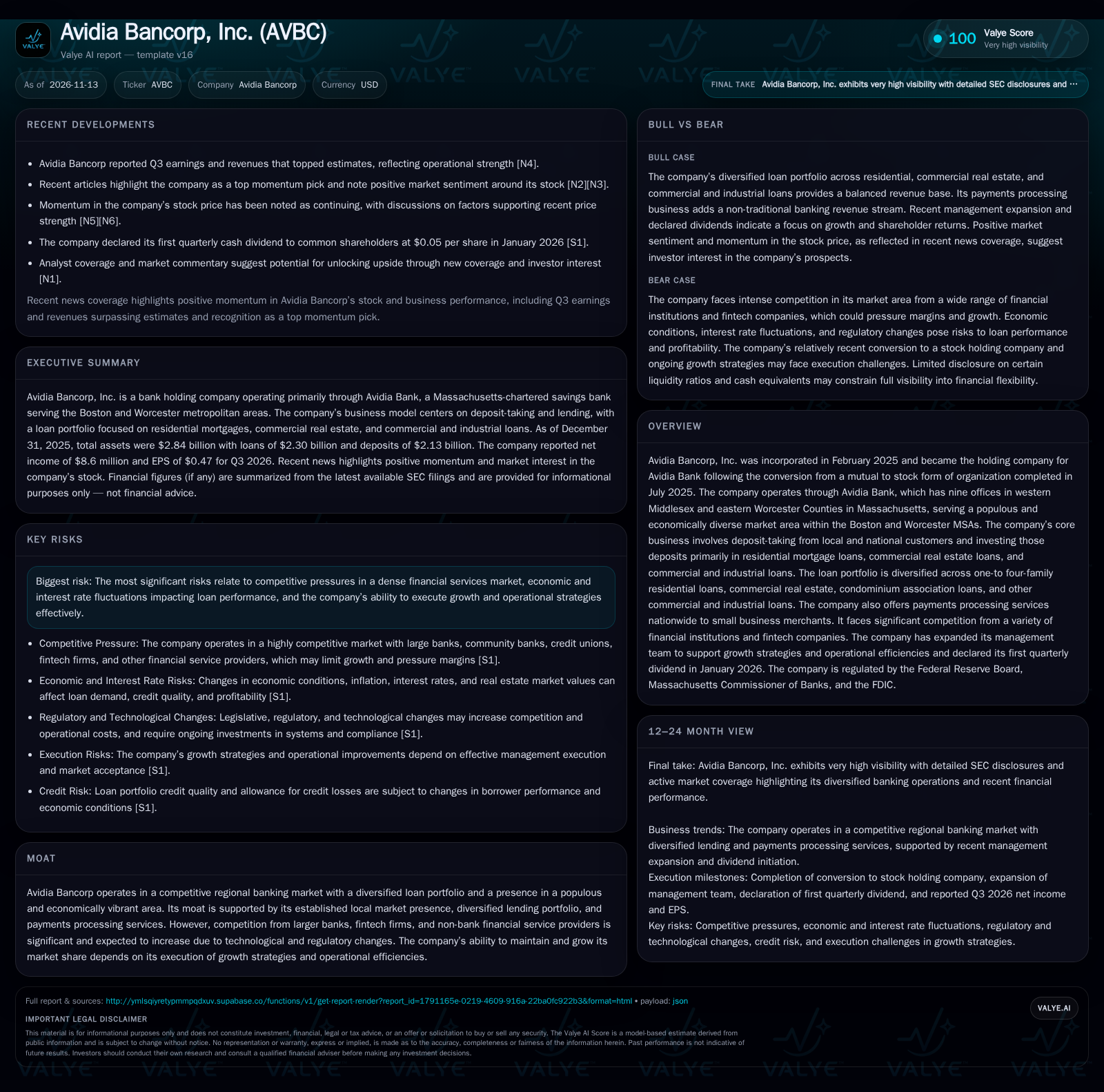
Avidia Bancorp, now a stock holding company for Avidia Bank, operates in the populous and economically vibrant Boston-Worcester corridor. With $2.84 billion in assets and a loan book balanced between real estate and commercial lending, it has posted strong recent earnings and declared its first dividend. The bank’s success will depend on its ability to scale, defend margins against aggressive competitors, and execute on growth strategies amid shifting regulation and technology [S1] [S2] [N4].
Avidia Bancorp’s recent emergence as a stock holding company marks a pivotal chapter for the Massachusetts-based bank, which serves a dense and diverse region stretching from Boston to Worcester. With a loan portfolio split between real estate and commercial lending, and a payments processing business that reaches beyond its local footprint, Avidia is pursuing growth on multiple fronts. The cited source reports dividend-related activity; that disclosure alone does not establish dividend-policy continuity, management confidence, or a material constraint on capital flexibility.
Recent Milestones: Stock Conversion, Earnings Beat, and Dividend Initiation
Avidia Bancorp’s most significant recent development is its July 2025 conversion from a mutual to a stock holding company, a move that typically unlocks new capital-raising options and aligns governance with shareholder interests [S1]. As of December 31, 2025, the company reported $2.84 billion in total assets, $2.30 billion in loans, and $2.13 billion in deposits, reflecting a sizable regional banking footprint [S1]. In Q3 2026, Avidia posted net income of $8.6 million and basic/diluted EPS of $0.47, with news coverage noting that both earnings and revenues topped estimates [S2] [N4]. The company reported cash and liquidity metrics for the period; these figures do not by themselves establish operating runway, investment capacity, financial flexibility, or financing capacity. [S1] These milestones matter because they create both new growth expectations and new pressures to deliver consistent financial performance.
How Avidia Makes Money: Lending, Deposits, and Payment Services
Avidia’s core economics are rooted in traditional banking: gathering deposits and lending them out, primarily to residential mortgage borrowers, commercial real estate owners, and local businesses. As of year-end 2025, its loan book was split 56.4% real estate (mostly residential mortgages and commercial real estate) and 43.4% commercial and industrial loans, with consumer lending almost negligible [S1]. The spread between interest earned on loans and interest paid on deposits (net interest margin) is the primary profit engine, though the precise margin is not disclosed in current filings.
Non-interest income is augmented by payments processing services, offered nationwide to small business merchants—a distinguishing feature for a bank of Avidia’s size [S1]. While the mechanics (e.g., fee structure, revenue split, volume growth) are not detailed, such services can provide higher-margin, less capital-intensive income compared to lending, especially if volumes scale and customer acquisition costs remain contained. The company’s asset base and loan mix suggest moderate operating leverage, but rising deposit costs and credit provisioning—especially in a competitive, rate-sensitive region—could constrain returns.
The stock conversion provides more flexibility for capital management, including potential for future equity raises, buybacks, or expanded dividend payouts, but also introduces market pressure for near-term performance.
Navigating a Crowded Field: Local Scale vs. National Players and Fintechs
Avidia’s market area—the western Boston and Worcester corridor—offers both opportunity and challenge. The region is economically vibrant, with a combined population of 2.6 million as of March 2026, but competition is fierce: large national and regional banks, community banks, credit unions, mortgage lenders, and an increasing array of fintech and non-bank entrants all compete for the same customer base [S1].
Avidia’s advantages include local brand recognition, a diversified loan book, and a payments processing business that extends its reach beyond physical branches. However, larger banks may have lower funding costs, broader technology investments, and greater marketing muscle. Fintech competitors, meanwhile, can undercut on price and offer frictionless digital experiences, particularly in payments and small business services.
The question is whether Avidia can maintain its customer relationships, defend its share of local deposits and loans, and scale its payment services fast enough to offset margin pressure from these well-capitalized rivals. Execution on technology, customer service, and niche product offerings will be critical.
Leveraging Diversification and Scale to Outpace Regional Banking Peers
In a favorable scenario, Avidia capitalizes on its diversified lending and payments processing platform to generate above-peer growth and profitability. If management’s expansion strategies succeed—bolstered by the recent addition of experienced executives—Avidia could grow its loan book faster than local competitors while maintaining credit quality.
The payments processing business could scale, driving fee income and providing valuable cross-sell opportunities to small business clients.
Evidence confirming this scenario would include accelerating non-interest income, sustained outperformance versus peer banks on loan growth and credit metrics, rising operating leverage (improving efficiency ratio), and positive trends in customer acquisition or retention in both traditional and payments lines.
Balancing Growth with Margin Pressure in a Competitive Banking Environment
The most plausible outcome is that Avidia delivers steady, but not dramatic, growth as it manages the trade-offs inherent in regional banking. Loan growth may track the broader Massachusetts economy, with periodic upticks in payments processing income, but margin compression from rising deposit costs and competitive loan pricing may limit earnings upside.
Management’s focus on operational efficiency and customer experience could help sustain moderate profitability, but the bank will need to adapt to digital transformation trends and regulatory shifts that continue to reshape the industry. Occasional earnings volatility is likely as credit cycles turn and as the payments business faces both fintech disruptors and larger bank rivals.
This scenario would be confirmed by stable or modestly increasing EPS, maintenance of asset quality metrics in line with peers, and incremental, rather than breakout, growth in fee-based revenues.
Margin Squeeze and Credit Weakness Undermine Growth Ambitions
The adverse scenario involves a convergence of competitive and macroeconomic headwinds. Intense pricing pressure from large banks and fintechs could force Avidia to accept lower loan yields or pay up for deposits, eroding net interest margins. Meanwhile, execution risk in scaling non-interest income—especially payments processing—could leave the bank exposed to cost overruns or underwhelming fee growth.
A local economic slowdown, real estate correction, or sectoral credit event could drive higher loan losses, especially given the large proportion of commercial and real estate lending. If Avidia’s new management team struggles to execute on growth and efficiency initiatives, the bank could see its profitability and market share erode.
This scenario would be confirmed by rising non-performing loans, declining or volatile EPS, negative operating leverage (rising efficiency ratio), and a stall or decline in payments-related income.
What Will Prove Avidia Bancorp’s Strategic Durability?
Quarterly trends in net interest margin—if disclosed—would clarify the bank’s ability to defend lending spreads as deposit costs rise.
Growth rates in non-interest (fee) income, especially payments processing revenue, will indicate whether the business mix is shifting and scaling as planned.
Asset quality metrics such as non-performing loan ratios and charge-offs, particularly across commercial and real estate segments, will be critical in assessing credit risk.
Efficiency ratio trends would reveal whether management’s operational improvements are boosting profitability.
Branch-level deposit and loan growth, especially in the context of local market share changes, would help test the thesis that Avidia can outcompete larger rivals.
Customer acquisition and retention rates in both traditional banking and payments lines—if disclosed—would provide insight into competitive positioning.
Updates on technology investments and digital banking adoption will show whether Avidia is keeping pace with fintech-driven customer expectations.
Disclaimer: This is research-only, informational analysis and not investment advice. It may include AI-generated interpretation and general industry context. Always verify important details using primary sources.

Comments