
Ascend Wellness Holdings: Scaling Vertically in a Fragmented Cannabis Market, but Profitability Remains Elusive
Ascend Wellness Holdings is aggressively expanding its vertically integrated cannabis platform across seven limited-license states, pursuing growth through cultivation scale, retail openings, and brand development. Despite robust revenue momentum, net losses persist as regulatory uncertainty and operational complexity challenge the path to sustainable profitability.
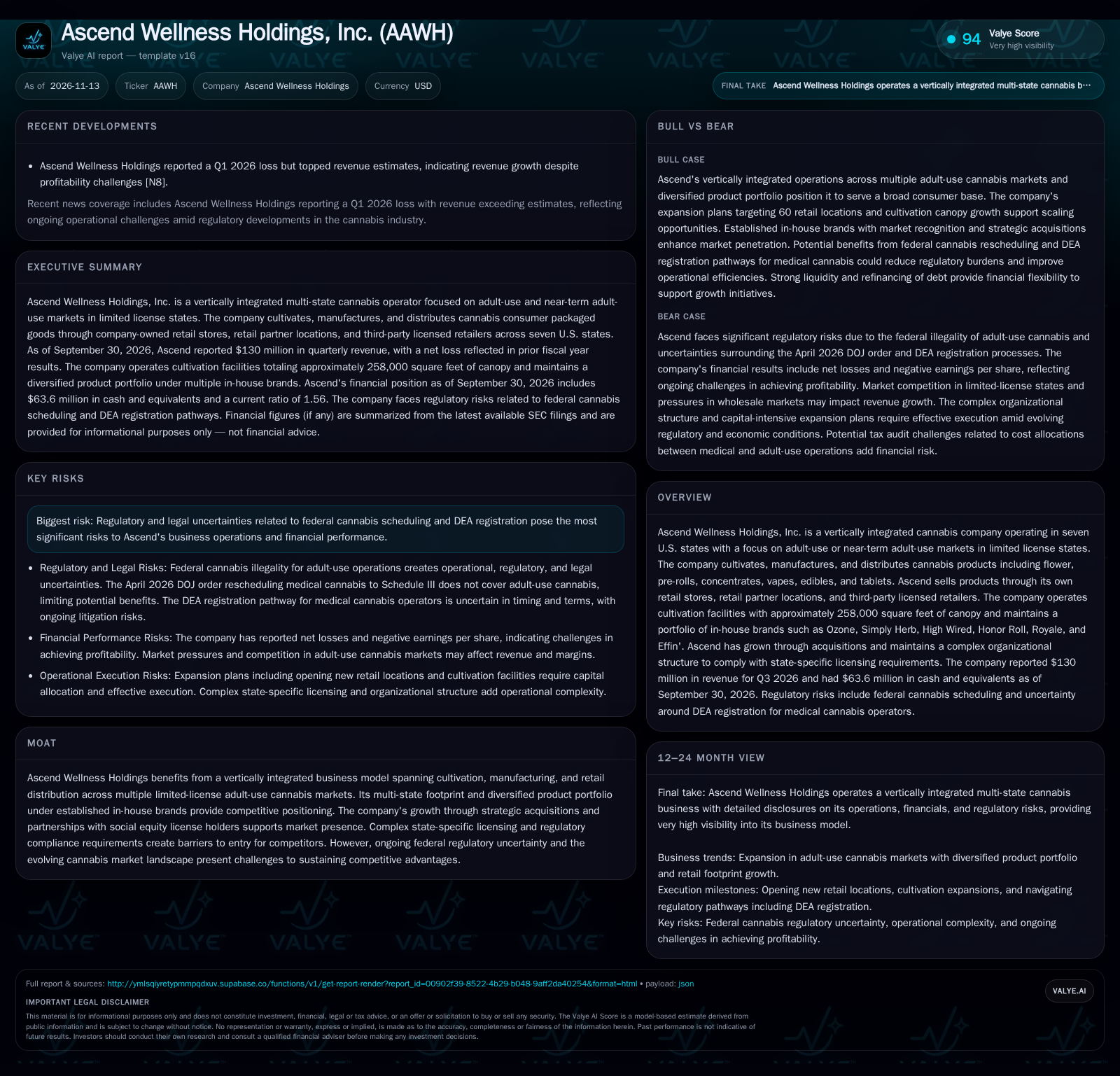
Ascend Wellness Holdings operates 47 dispensaries and cultivation in seven U.S. states, with ambitions to reach 60 retail locations. Q3 2026 revenue was $130 million, but profitability remains out of reach as the company posted negative EPS and continues to invest in growth. Federal regulatory ambiguity, especially around adult-use cannabis, and capital-intensive expansion pose both risk and opportunity for future margins and market share. [S1] [S2]
Ascend Wellness Holdings is pursuing scale in the competitive and highly regulated U.S. cannabis industry by combining cultivation, manufacturing, and retail under one roof, with a focus on adult-use and near-term adult-use states. While the company is achieving notable revenue growth and expanding its physical footprint, persistent net losses, complex regulatory hurdles, and the capital demands of expansion raise critical questions about the timing and sustainability of future profitability. The interplay between regulatory developments, operational execution, and evolving consumer demand will define whether Ascend's vertically integrated strategy can yield durable economic advantages—or if structural industry obstacles will keep margins under pressure.
Recent Expansion and Financial Performance: Ascend’s Position Entering Late 2026
Ascend Wellness Holdings ended Q3 2026 with $130 million in revenue, confirming ongoing growth across its multi-state operations. The company now operates 47 dispensaries—42 of which are in adult-use-permitted states—and maintains ambitions to reach 60 total retail locations including partner stores. Its cultivation footprint spans approximately 258,000 square feet across six states, supporting a wide product portfolio under multiple in-house brands. Despite revenue gains, both basic and diluted EPS for the quarter were -$0.14, and net losses have persisted since at least 2022. On the balance sheet, as of September 30, 2026, the company reported $63.6 million in cash and equivalents, $181.2 million in current assets, and a current ratio of 1.56. Regulatory uncertainty remains pronounced: the April 2026 DOJ order rescheduling certain medical cannabis to Schedule III does not directly benefit Ascend’s adult-use business, and DEA registration benefits for medical operators are still undefined. [S1] [S2] [N8]
Revenue Scaling Versus Margin Compression: The Economic Mechanics of Vertically Integrated Cannabis
Ascend’s vertically integrated model—owning cultivation, manufacturing, and retail—offers potential for margin capture across the value chain. In theory, this structure allows for wholesale margin retention, product differentiation, and supply reliability, particularly in limited-license states where competition is restricted. However, capital intensity is high: cultivation, processing, and retail buildouts require significant up-front investment, and state-by-state compliance raises overhead costs. The company’s broad product mix (flower, pre-rolls, vapes, edibles, tablets) targets multiple consumer segments, but price compression and tax inefficiencies (such as the lack of federal deductibility for adult-use operations) can erode profitability. Operating leverage is plausible if retail and cultivation utilization increase, but negative EPS and ongoing net losses suggest that fixed costs and competitive pricing continue to outpace revenue gains. Debt refinancing and credit facility usage underscore the need for external capital to fund ongoing expansion. [S1] [S2]
If Ascend can improve same-store sales, drive higher-margin branded product penetration, and leverage scale to reduce per-unit costs, operating margins could inflect. However, absent federal reform enabling full tax deductibility or interstate commerce, the economics remain structurally challenged for many multi-state operators.
Barriers and Vulnerabilities: Ascend’s Moat in Limited-License Cannabis Markets
Ascend’s primary competitive advantage lies in its access to limited-license markets, which restrict new entrants and can support higher retail pricing and wholesale margins compared to open-license states. Vertical integration enables supply chain control and brand consistency, while a multi-state footprint and established in-house brands (Ozone, Simply Herb, High Wired, Honor Roll, Royale, Effin’) enable targeting of distinct consumer segments. Strategic acquisitions and partnerships with social equity license holders have accelerated market presence.
Counterforces include regulatory instability—federal illegality of adult-use cannabis continues to block access to institutional capital and interstate commerce, while shifting state regulations can alter market dynamics. Competition from other vertically integrated multi-state operators, as well as local incumbents and illicit market players, keeps pressure on both pricing and market share. If federal reform or DEA registration opens the door to broader competition (or enables new entrants with lower costs), Ascend’s current moat could erode. Conversely, if limited-license regimes persist and brand equity deepens, the company may sustain its competitive position.
Unlocking Margin Expansion Through Regulatory Relief and Retail Execution
A favorable scenario would see federal regulatory changes—such as meaningful tax reform (removal of 280E restrictions on deductibility for adult-use cannabis) or a clear, broadly applicable DEA registration pathway—reduce Ascend’s effective tax rate and compliance burden, directly boosting margins. Simultaneously, successful execution of retail expansion to 60+ locations, combined with increased penetration of high-margin in-house brands, could drive both top-line and margin growth. If the company achieves higher utilization rates in cultivation and processing, fixed costs could be leveraged more efficiently.
Evidence confirming this scenario would include a sustained trend toward positive operating income and EPS, improved gross and operating margins, and successful navigation of new regulatory frameworks. Additional signals would be robust same-store sales growth and increasing branded product mix within retail sales. Conversely, if regulatory relief is delayed or competitive intensity rises, this scenario would be less plausible.
Gradual Growth Amid Structural Industry Constraints
The most plausible near-term outcome is that Ascend continues to grow revenue through incremental retail openings and modest gains in cultivation efficiency, but profitability remains constrained by high fixed costs, price competition, and ongoing regulatory ambiguity. The company may improve operating metrics at the margin by optimizing store performance and product mix, but persistent net losses and negative EPS are likely unless there is a material industry shift (such as federal legalization or significant tax reform).
Confirmation would come from continued revenue growth at a pace similar to recent quarters, maintenance of the current ratio and cash position, and slow progress toward breakeven at the operating level. Falsification would be a reversal in revenue growth, significant margin deterioration, or inability to fund planned expansion.
Operational Drag and Regulatory Stagnation Expose Financial Strain
In an adverse scenario, persistent regulatory uncertainty—such as a lack of federal progress, unfavorable tax audits, or delayed DEA registration—would sustain high compliance costs and block meaningful margin improvement. If capital markets remain tight or the company’s debt burden increases, Ascend could face pressure to curtail expansion or restructure operations. Operational missteps, such as underperforming new locations, inventory write-downs, or branding failures, would compound losses.
Signs confirming this scenario would include further net losses, deteriorating balance sheet metrics (declining cash, worsening current ratio), store closures, or delays in planned retail/cultivation expansion. If the company is forced to raise capital on unfavorable terms or divest assets, downside risk would be further validated.
Milestones and Metrics That Will Shape Ascend’s Multi-State Cannabis Ambitions
Net income and EPS trajectory: Sustained improvement—or continued losses—would clarify whether scale and integration are translating into profitability.
Same-store sales growth (if disclosed): This would help assess organic retail momentum versus mere footprint expansion.
Gross and operating margins: Trends in these metrics will reveal the impact of product mix, pricing, and operating leverage.
Branded product penetration: The proportion of sales from in-house brands would indicate progress toward higher-margin, differentiated offerings.
Retail footprint growth: Actual versus targeted store openings, and performance of new locations, will test the scalability of Ascend’s model.
Regulatory developments: Any changes in federal tax policy, DEA registration rules, or state-level licensing that affect cost structure or market access.
Tax audit or compliance developments: Outcomes of any tax-related disputes or regulatory reviews could materially affect financial performance.
Disclaimer: This is research-only, informational analysis and not investment advice. It may include AI-generated interpretation and general industry context. Always verify important details using primary sources.

Comments